On this page
- 01Key takeaways
- 02What is an AI website chatbot?
- 03When does a chatbot help a small business?
- 04What are the risks?
- 05What do UK data rules require?
- 06How do you implement a chatbot safely?
- 07When is a chatbot the wrong choice?
- 08What does this look like in practice?
- 09Chatbot checklist
- 10Next step
- 11Sources and further reading
- 12Frequently asked questions
Key takeaways
An AI chatbot on a small business website helps when visitors ask repetitive, factual questions outside working hours and the bot answers from your own approved content, with an easy route to a person. It hurts when it gives wrong answers, blocks access to humans, slows the page, or handles personal data carelessly. Start narrow and measure.
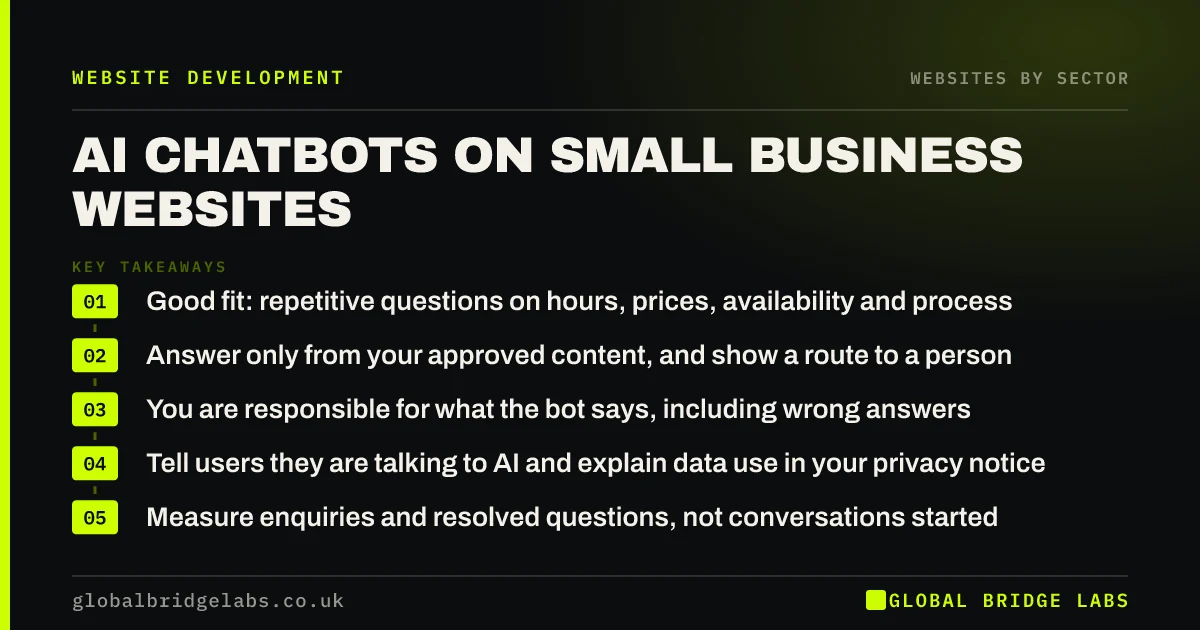
- Good fit: repetitive questions on hours, prices, availability and process.
- Answer only from your approved content, and show a route to a person.
- You are responsible for what the bot says, including wrong answers.
- Tell users they are talking to AI and explain data use in your privacy notice.
- Measure enquiries and resolved questions, not conversations started.
Considering an AI chatbot? Message us on WhatsApp and we will tell you whether your enquiries suit one.
Chat on WhatsApp →What is an AI website chatbot?
An AI website chatbot is a chat interface on a website that uses a large language model to understand visitors' questions and generate answers, often drawing on the business's own content, and sometimes capturing enquiries or booking appointments.
It differs from older rule-based chatbots, which followed fixed scripts, and from live chat, where a person answers. Many tools combine all three, with AI handling first responses and handing over to staff when needed.
When does a chatbot help a small business?
Chatbots help when a large share of enquiries are the same few questions, when visitors arrive outside opening hours, and when the answers already exist in writing. Clinics, hospitality, e-commerce and trades often fit this pattern.
The benefit is speed: a visitor gets an answer at 10pm instead of the next morning, and staff spend less time answering the same question. The best implementations capture contact details for anything the bot cannot resolve.
What are the risks?
The main risk is wrong answers. Language models can produce confident but incorrect statements, and the business is responsible for what its website says. In a widely reported 2024 case, a Canadian tribunal held Air Canada liable for incorrect refund information given by its website chatbot.
Other risks include frustrating visitors who want a person, heavy scripts that slow the page, and personal data sent to a third-party AI provider without adequate agreements or transparency.
- Incorrect prices, policies or availability.
- Advice in regulated areas the bot should not give.
- No easy route to a person.
- Extra scripts harming Core Web Vitals.
- Personal data processed without proper agreements.
What do UK data rules require?
If the chatbot collects or processes personal data, UK GDPR applies. Tell users they are talking to an AI, explain in your privacy notice how chat data is used and by whom, sign a data processing agreement with the provider, and check whether data leaves the UK and under what safeguards.
Take extra care with special category data, such as health information, and avoid using chats to make significant automated decisions about people without human involvement.
Want a chatbot provider's terms checked for UK data handling? Message us on WhatsApp.
Chat on WhatsApp →How do you implement a chatbot safely?
Start narrow. Limit the bot to answering from your own approved content, such as FAQs, service pages and policies. Test it with the 50 questions customers actually ask, and correct wrong answers before launch.
Make escalation obvious: a visible option to message or call a person, and capture of contact details for anything unresolved. Review transcripts weekly for the first month, and update content where the bot struggles.
When is a chatbot the wrong choice?
A chatbot is the wrong choice when enquiries are complex, high-value or sensitive, when your content is not yet clear enough to answer from, or when your customers strongly prefer a person. In those cases, a well-staffed WhatsApp or phone line and better FAQ pages will do more.
The trade-off is availability against accuracy. A chatbot is always on, but only as good as the content behind it. Fix the content first.
What does this look like in practice?
A pattern we see: a general-purpose chatbot added to a small business site, answering from the open web rather than the business's own content, and quoting prices and services the business does not offer.
Restricting the bot to the site's own FAQs and service pages, adding a clear hand-off to WhatsApp, and reviewing transcripts turns it from a liability into a useful out-of-hours assistant. Often the transcripts reveal FAQ gaps worth fixing on the site itself.
Chatbot checklist
Check these before and after launch.
- Confirm enquiries are repetitive and factual.
- Restrict answers to approved content.
- Test with real customer questions.
- Make hand-off to a person obvious.
- Disclose that users are talking to AI.
- Update your privacy notice.
- Sign a data processing agreement.
- Check page speed impact.
- Measure resolved questions and enquiries.
Next step
If you are considering an AI chatbot, we will review your enquiries and content with you in 30 minutes and tell you whether a bot, better FAQs or WhatsApp would help most.
Message us on WhatsApp for chatbot advice, or book a 30-minute consultation.
Chat on WhatsApp →Sources and further reading
- Lawful basis for processing personal data · Information Commissioner's Office
- Special category data · Information Commissioner's Office
- Understanding Core Web Vitals and Google search results · Google Search Central
Frequently asked questions
Should I add an AI chatbot to my small business website?
Consider one if many enquiries are the same factual questions, visitors often arrive outside opening hours, and your answers already exist in writing. Restrict it to your own content, make a human route obvious and measure results. For complex or sensitive enquiries, people usually do better.
Am I responsible for what my website chatbot says?
Generally yes. The business is responsible for information on its website, including chatbot answers. In a widely reported 2024 case, a Canadian tribunal held Air Canada liable for incorrect refund information given by its chatbot. Restrict answers to approved content and test thoroughly.
Is a website chatbot GDPR compliant?
It can be. Tell users they are talking to AI, explain chat data use in your privacy notice, sign a data processing agreement with the provider, check international transfers and safeguards, and take extra care with special category data such as health information.
What is the difference between a chatbot and live chat?
A chatbot answers automatically, either from scripts or using AI, and is available at any time. Live chat connects visitors to a person, which is better for complex questions but limited to staffed hours. Many businesses combine them, with a bot handling first responses and handing over to staff.
Written by

Global Bridge Labs (GBL) is a UK–Sri Lanka partner for social media, websites and BPO. Everything here comes from client delivery, not theory.