On this page
- 01Key takeaways
- 02Why does inconsistent wording confuse visitors?
- 03What does WCAG say?
- 04Where does wording drift?
- 05How do you create a word list?
- 06When is variety acceptable?
- 07What does this look like in practice?
- 08Consistent wording checklist
- 09Next step
- 10Sources and further reading
- 11Frequently asked questions
Key takeaways
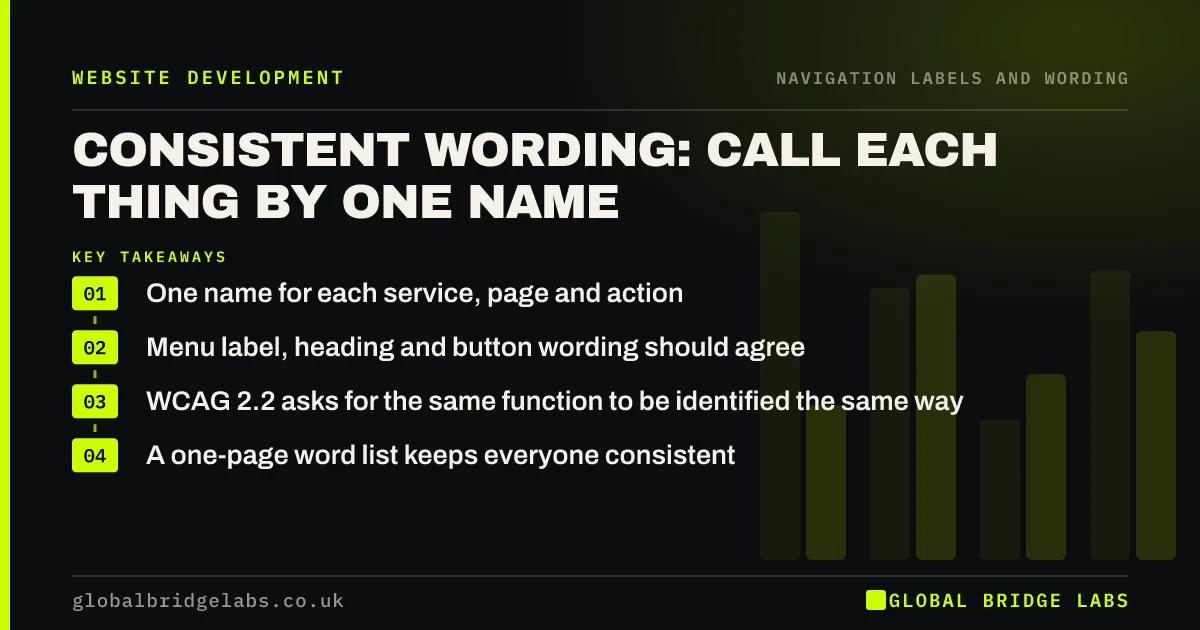
Consistent wording means each service, page and action has one name, used the same way everywhere: in the menu, headings, buttons, links and emails. When a service is 'Bookkeeping' in the menu and 'Accounts support' on the page, visitors wonder whether they are the same thing. Keep a short word list and use it for every page.
- One name for each service, page and action.
- Menu label, heading and button wording should agree.
- WCAG 2.2 asks for the same function to be identified the same way.
- A one-page word list keeps everyone consistent.
Want a word list drawn up for your site? Message us on WhatsApp.
Chat on WhatsApp →Why does inconsistent wording confuse visitors?
Visitors assume different words mean different things. If the menu says 'Pricing', a button says 'See fees' and the page is headed 'Investment', some will wonder whether there are three pages. Nielsen Norman Group's guidance on consistency and standards says users should not have to wonder whether different words mean the same thing.
What does WCAG say?
WCAG 2.2 success criterion 3.2.4, Consistent Identification, says components with the same function across a set of pages should be identified consistently. A search box labelled 'Search' on one page and 'Find' on another, or a contact link with different names, fails it. The rule helps screen reader users and everyone else.
Where does wording drift?
Wording drifts as different people write different pages over time. The common places are the menu versus page headings, buttons across forms, service names in blog posts, and the words used in emails and invoices compared with the website.
- Menu labels versus page headings.
- Button text across different forms.
- Service names in blog posts and case studies.
- Words in emails, quotes and invoices.
- Footer links versus header links.
How do you create a word list?
List every service, key page and action. Pick one name for each, based on what customers call it. Note any words to avoid. Share the list with everyone who writes for the site, and check new pages against it before publishing. A single page is usually enough.
Want your site audited for wording drift? Message us on WhatsApp and we will discuss your requirements.
Chat on WhatsApp →When is variety acceptable?
In body copy, some variety reads naturally and helps search, such as 'loft conversion' and 'loft extension' where customers use both. Keep labels, headings, buttons and links consistent, because those are what visitors use to navigate.
What does this look like in practice?
A pattern we see: a firm's menu says 'Payroll', the service page says 'Payroll bureau', the footer says 'Wages' and the contact form offers 'Salary services'. Choosing 'Payroll' throughout, with 'payroll bureau' explained in the copy, removes the doubt.
Consistent wording checklist
- List every service, page and action.
- Pick one customer-facing name for each.
- Match menu, headings, buttons and links.
- Check emails and invoices use the same words.
- Review new pages against the list.
Next step
Pick your main service and search the site for every name it goes by.
Message us on WhatsApp for a wording review, or book a 30-minute consultation.
Chat on WhatsApp →Sources and further reading
Frequently asked questions
Why is consistency important in web design?
Consistency lets visitors learn once and rely on it. When labels, buttons and layouts stay the same, people stop thinking about how the site works and focus on what they came for. Inconsistency makes them double-check every step.
What is consistent identification in WCAG?
It is WCAG 2.2 success criterion 3.2.4 at level AA. Components with the same function across a set of pages, such as search, contact or download links, should be identified consistently, with the same labels and names.
Does using synonyms help SEO?
In body copy, natural variation can help a page match related searches. In navigation, use one name per page so visitors and search engines are not confused about which page covers what. Match that name to what customers search for.
Written by

Global Bridge Labs (GBL) is a UK–Sri Lanka partner for social media, websites and BPO. Everything here comes from client delivery, not theory.