On this page
Key takeaways
Your call reasons are a ready-made list of questions customers cannot answer for themselves. Turning the top ones into clear website answers, written in callers' own words and linked from the places they look, helps customers help themselves and reduces calls. It works only if the answers are complete, easy to find and kept up to date.
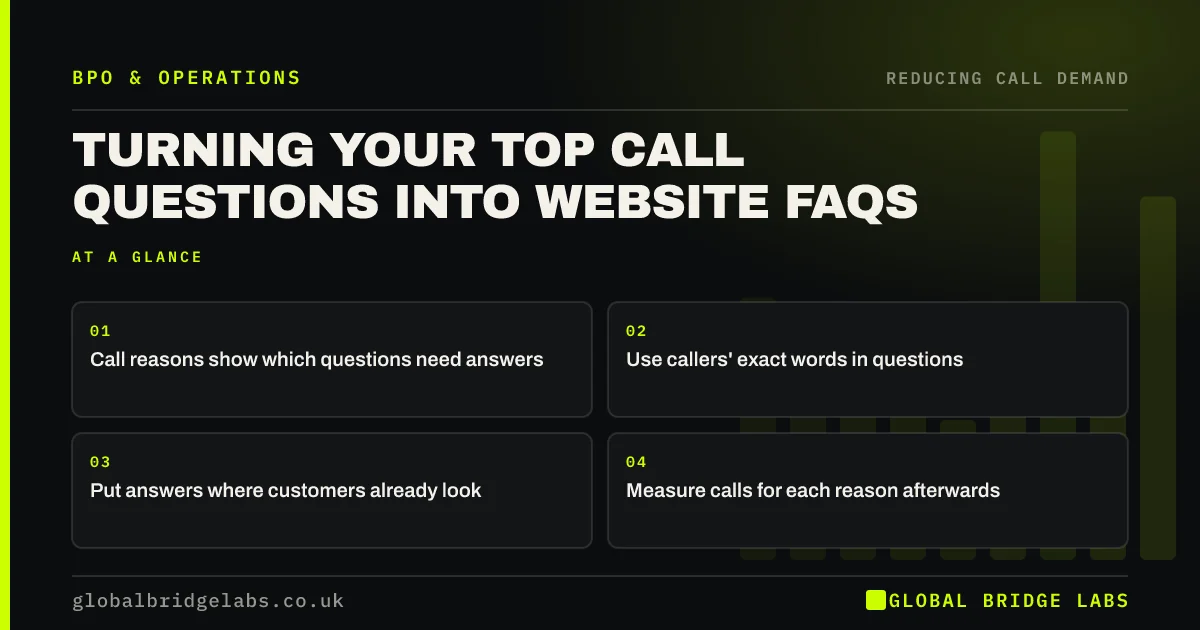
- Call reasons show which questions need answers.
- Use callers' exact words in questions.
- Put answers where customers already look.
- Measure calls for each reason afterwards.
Want FAQs written from your call data? Message us on WhatsApp.
Chat on WhatsApp →Where do you start?
With your Pareto chart of call reasons. For each top reason, ask whether a written answer could fully resolve it. Order tracking, opening hours, returns and simple account questions usually can. Complex or personal issues usually cannot.
How should the questions be worded?
Use the words callers use, taken from call notes and recordings. Customers search for "where is my parcel", not "order fulfilment status". Matching their wording helps them find the answer on your site and in search engines.
Where should answers go?
On the pages where customers already are: order confirmation, account area, contact page and relevant product or service pages, as well as a help page. Link to them from emails and the queue message. A help page nobody can find will not reduce calls.
- Contact page.
- Order and account pages.
- Emails and texts.
- Queue message.
- FAQ pages: when they help the journey and when they hide answers
- Call deflection: when it helps and when it annoys
Want your top call questions turned into web answers? Send them to us on WhatsApp.
Chat on WhatsApp →How do you know it worked?
Track calls for each reason before and after publishing, and page views for each answer. If page views are high but calls do not fall, the answer is probably incomplete or unclear. Ask call handlers what customers say they read.
What does this look like in practice?
A pattern we see: a business publishes 40 FAQs written by marketing, and calls do not change. Rewriting the top eight, using callers' exact questions and linking them from order emails, reduces calls for those reasons within two months.
The same answers also go into the team's phone answer library, so callers who still ring get exactly the same information.
FAQs from calls checklist
- Use your top call reasons.
- Word questions as callers do.
- Write complete answers.
- Place answers where customers look.
- Track calls and page views.
Next step
Take your top five call reasons, write a short web answer for each in callers' words and link them from the pages and emails customers already see.
Message us on WhatsApp to turn call questions into FAQs, or book a 30-minute consultation.
Chat on WhatsApp →Sources and further reading
- Writing to GOV.UK standards: writing guidelines · GOV.UK
- Control your snippets in search results · Google Search Central
Frequently asked questions
How many FAQs should I write?
Start with the five to ten questions behind your top call reasons. A short list of complete answers works better than a long list of thin ones. Add more as new questions appear in your call data, and remove answers nobody reads.
Where do customers look for answers?
Usually on the page or message they are reading when the question arises: an order email, an account page or the contact page. Put answers there, not only on a separate help page. Linking from the queue message also helps callers who are already waiting.
Will FAQs stop all calls on a topic?
Rarely. They reduce calls from customers who want a quick answer, but some people will still call, especially for personal or complex issues. Measure the reduction, keep improving the answers and make sure the phone route stays open for those who need it.
Written by

Global Bridge Labs (GBL) is a UK–Sri Lanka partner for social media, websites and BPO. Everything here comes from client delivery, not theory.