On this page
Key takeaways
Call deflection means steering callers to another way of getting help, such as a web page, text or chat. Done well, it gives people a faster answer and frees the phones for complex calls. Done badly, it blocks people who need a person and creates repeat contacts. Deflect only questions that digital channels answer completely, and keep the phone open.
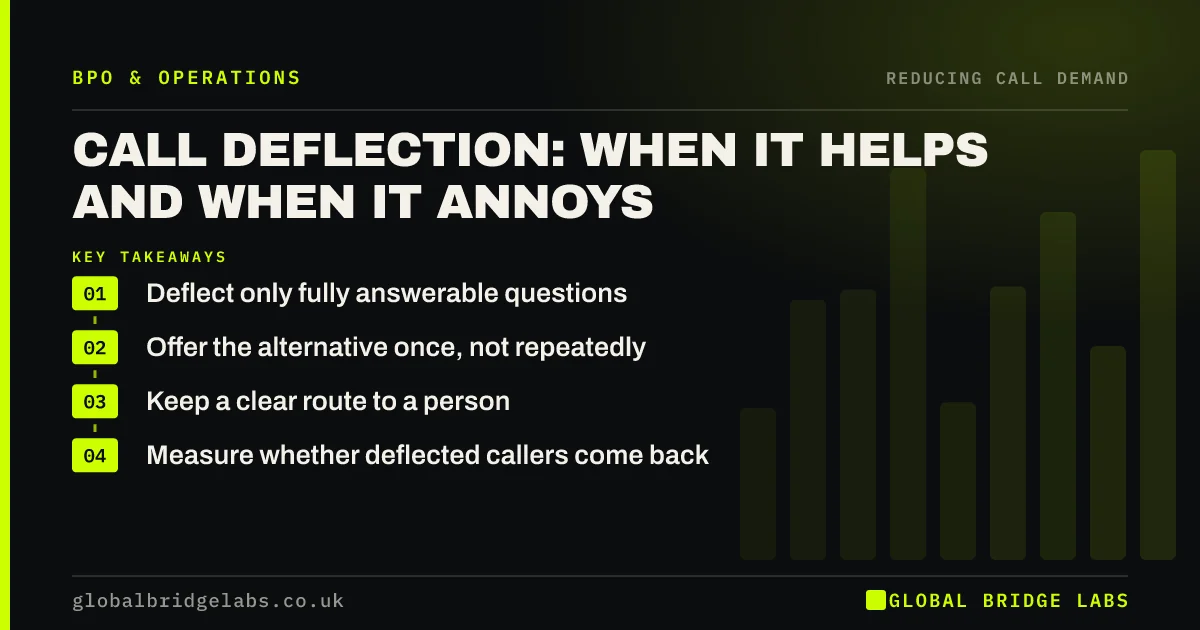
- Deflect only fully answerable questions.
- Offer the alternative once, not repeatedly.
- Keep a clear route to a person.
- Measure whether deflected callers come back.
Want to deflect calls without annoying callers? Message us on WhatsApp.
Chat on WhatsApp →When does deflection help?
When the digital answer is genuinely quicker and complete, such as tracking an order, checking opening hours or downloading a document. Callers with these questions often prefer a link to a queue. Deflecting them shortens the wait for everyone else.
When does it annoy callers?
When the alternative does not answer the question, when the message repeats every few seconds or when callers are told to go online with no way back to a person. These callers try again, call a different option or complain, which adds to demand rather than reducing it.
How do you deflect well?
Pick the top one or two questions your website or text service answers completely. Mention them once in the queue message, with a short web address or text option. Make sure the page is easy to find and use on a phone, and that the help route stays consistent.
- One or two questions only.
- Mention them once.
- Short web address or text link.
- Mobile-friendly answers.
- Text message updates that cut inbound calls
- Self-service on your website: let customers help themselves
Want to check which calls are safe to deflect? Send us your call reasons on WhatsApp.
Chat on WhatsApp →How do you measure it?
Track calls for the deflected reason before and after, visits to the linked page and repeat contacts from people who tried the digital route. If calls fall and repeats do not rise, deflection works. If repeats rise, improve the digital answer before pushing harder.
What does this look like in practice?
A pattern we see: a queue message tells every caller to visit the website, and complaints rise. Narrowing it to one line about order tracking, with a text link, reduces those calls while complaints about being pushed online stop.
The team also checks the tracking page on a phone, finds two confusing steps and fixes them, which makes the deflection work better still.
Call deflection checklist
- Pick fully answerable questions.
- Offer the alternative once.
- Keep a route to a person.
- Test digital answers on a phone.
- Track repeat contacts.
Next step
Choose one call reason your website answers completely, mention it once in your queue message and compare call counts for that reason after a month.
Message us on WhatsApp to plan call deflection, or book a 30-minute consultation.
Chat on WhatsApp →Sources and further reading
Frequently asked questions
Is call deflection good customer service?
It can be, when the alternative is faster and answers the question fully. It becomes poor service when it blocks people who need a person or sends them to pages that do not help. The test is whether deflected customers get their answer without contacting you again.
Which calls should not be deflected?
Complaints, complex account issues, safety concerns and calls from customers who may be vulnerable usually need a person. So do calls where the digital answer is incomplete. Keep these routes open and quick, and focus deflection on simple, repeatable questions.
Does deflection improve service level?
It can, because fewer simple calls reach the queue, leaving more capacity for others. The effect depends on how many calls the alternative fully resolves. Measure calls for the deflected reason and repeat contacts afterwards, so you know whether the improvement is real.
Written by

Global Bridge Labs (GBL) is a UK–Sri Lanka partner for social media, websites and BPO. Everything here comes from client delivery, not theory.