On this page
Key takeaways
Confusing letters and emails are a common hidden cause of calls. Customers ring to ask what a message means, what they need to do or whether it applies to them. Rewriting your highest-volume messages in plain English, with the key point and action first, removes many of these calls and makes the remaining ones shorter.
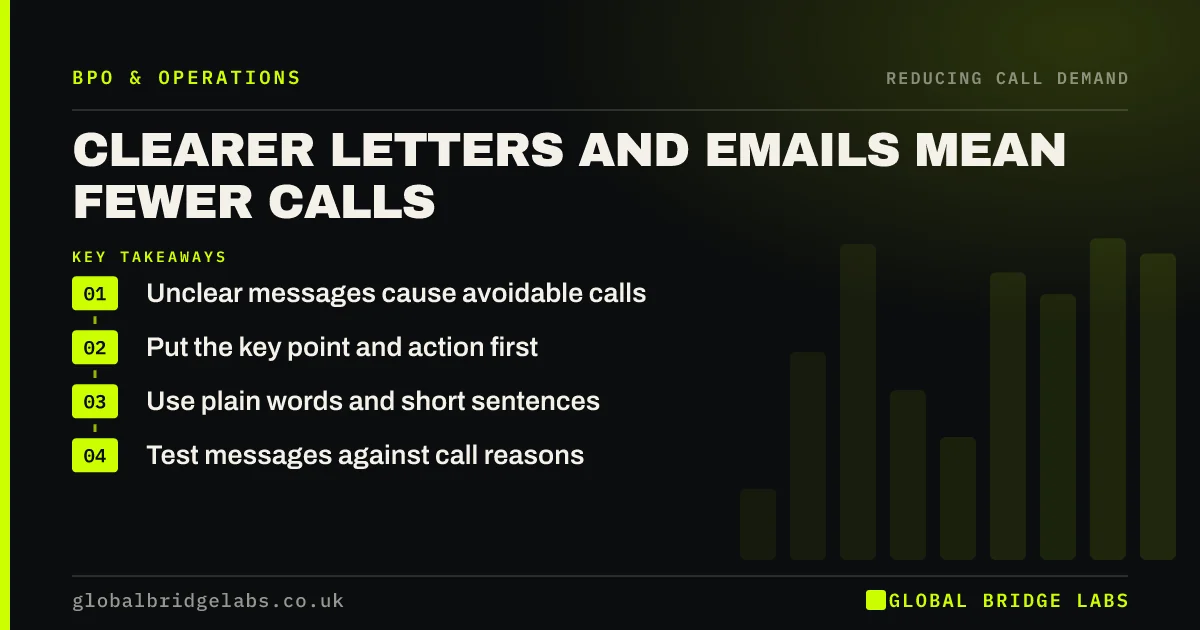
- Unclear messages cause avoidable calls.
- Put the key point and action first.
- Use plain words and short sentences.
- Test messages against call reasons.
Want your customer letters reviewed? Message us on WhatsApp.
Chat on WhatsApp →How do letters cause calls?
Customers call when they cannot tell what a message means, what they must do, by when, or how much it will cost. Jargon, long paragraphs and important information buried at the end all trigger calls. Spikes after a mailing are a sure sign.
Which messages should you fix first?
The ones sent to most customers and followed by most calls: invoices, renewal notices, appointment letters, price change notices and order confirmations. Check call reasons for the week after each mailing to see which messages cause the most calls.
What does a clear message look like?
It starts with what the message is about and what the customer needs to do. It uses short sentences, everyday words and headings. It gives dates, amounts and contact details clearly. GOV.UK guidance on writing for users is a useful model.
- Purpose and action first.
- Short sentences, everyday words.
- Dates and amounts easy to find.
- One clear way to get help.
- Turning your top call questions into website FAQs
- Proactive updates that stop calls before they start
Want a high-volume message rewritten and tested? Send it to us on WhatsApp.
Chat on WhatsApp →How do you test a rewrite?
Send the new version to part of your customers and the old version to the rest, if your system allows, and compare call rates. Or compare calls after the same mailing before and after the change. Ask call handlers what customers still ask about.
What does this look like in practice?
A pattern we see: a renewal notice causes a spike of calls every month, most asking whether the customer needs to do anything. Adding "You do not need to do anything" as the first line removes most of those calls.
Call handlers notice the difference within days, and the team goes on to rewrite the next two highest-volume letters the same way.
Clear message checklist
- List messages by volume sent.
- Check calls after each mailing.
- Rewrite with action first.
- Use plain words and short sentences.
- Test and compare call rates.
Next step
Pick the message that triggers most calls, rewrite the first paragraph so it says what the customer must do and compare calls after the next send.
Message us on WhatsApp to make your customer messages clearer, or book a 30-minute consultation.
Chat on WhatsApp →Sources and further reading
- Writing to GOV.UK standards: writing guidelines · GOV.UK
- Consumer Rights Act 2015 · legislation.gov.uk
Frequently asked questions
How do I know if a letter is causing calls?
Look at call volumes and reasons in the days after it is sent. A spike in calls asking about the same thing usually points to the letter. Ask call handlers what customers say about it, and read a sample of call notes for the exact wording that confused them.
What is plain English for customer letters?
It means writing so most people understand the message the first time: short sentences, everyday words, the main point first and clear actions. Avoid jargon and legal phrasing where you can. GOV.UK publishes guidance on writing for users that applies well to business letters.
Should legal wording be removed from letters?
Not if it is required, but you can often explain it in plain words alongside. Put the plain summary first and the legal detail after it. Check with whoever owns the wording before changing terms, especially where consumer law or regulation sets out what must be said.
Written by

Global Bridge Labs (GBL) is a UK–Sri Lanka partner for social media, websites and BPO. Everything here comes from client delivery, not theory.