On this page
- 01Key takeaways
- 02Why do before-and-after photos convert?
- 03How should before-and-after photos be taken?
- 04How should the section be laid out?
- 05What rules apply to before-and-after images?
- 06When should you not use before-and-after photos?
- 07What does this look like in practice?
- 08Before and after checklist
- 09Next step
- 10Sources and further reading
- 11Frequently asked questions
Key takeaways
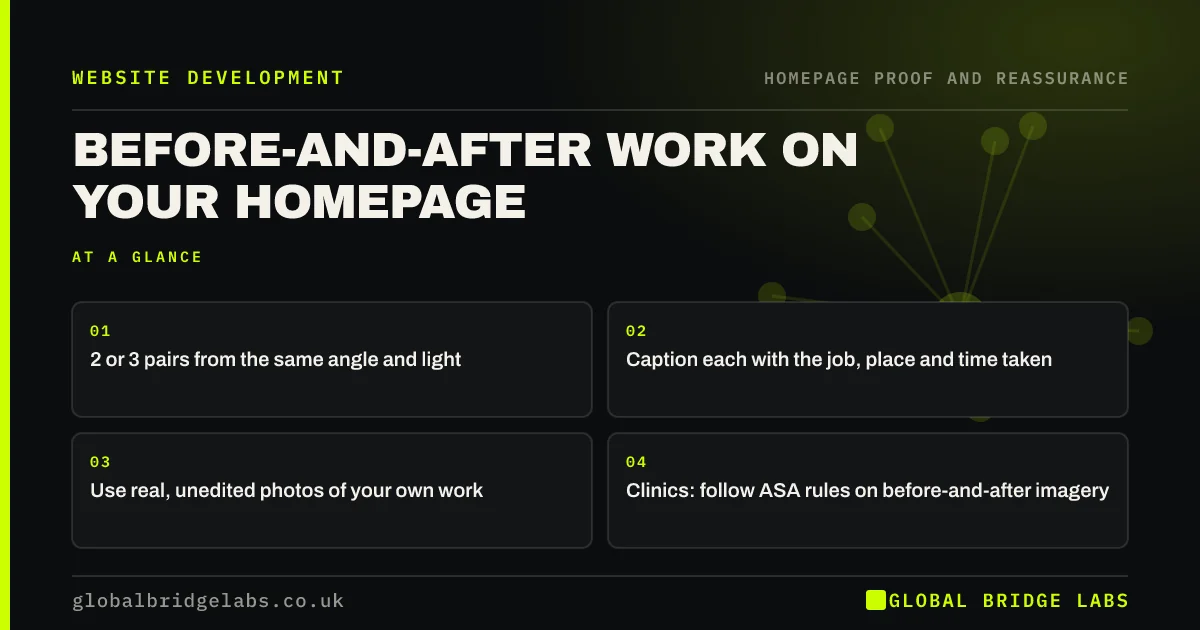
A before and after section on a homepage is one of the strongest kinds of proof for trades, cleaning, design, landscaping and aesthetics, because it shows the result buyers are paying for. Use two or three pairs taken from the same angle, caption each with the job and the time it took, and keep claims honest, especially in regulated sectors.
- 2 or 3 pairs from the same angle and light.
- Caption each with the job, place and time taken.
- Use real, unedited photos of your own work.
- Clinics: follow ASA rules on before-and-after imagery.
Want a before-and-after section planned for your homepage? Message us on WhatsApp.
Chat on WhatsApp →Why do before-and-after photos convert?
Before-and-after photos convert because they show the outcome directly, with no need to trust a claim. A buyer looking at a damp, cracked wall and the finished room understands your work in a second. For visual services, one honest pair can do more than a page of copy.
How should before-and-after photos be taken?
Shoot both from the same spot, height and angle, in similar light, with the same framing. Take the 'before' on the first visit as routine. Avoid filters and heavy editing; small exposure fixes are fine. A phone is enough if the photos are sharp and level.
How should the section be laid out?
Use two or three pairs side by side on desktop and stacked on mobile, each with a caption such as 'Victorian bathroom, Harrogate: 6 days'. A drag slider can work, but test it on phones and keep both images visible without interaction for people who will not drag.
What rules apply to before-and-after images?
Images must not mislead. The ASA has ruled against ads where filters or editing exaggerated results, and clinics must take particular care with treatments, including the ban on advertising prescription-only medicines to the public. Photos of identifiable people are personal data, so get clear consent before using them.
When should you not use before-and-after photos?
Skip them when results are invisible, as in accounting or IT, or when the 'before' could embarrass a customer. In those cases, use short written before-and-after statements with numbers instead, such as 'month-end close: 12 days to 4'.
What does this look like in practice?
A pattern we see with trades: a gallery of 40 finished-job photos that all look similar. Replacing it with three before-and-after pairs, each captioned with place and time, makes the size of the change obvious and usually earns more clicks to the quote form.
Before and after checklist
- Take 'before' photos on every first visit.
- Match angle, height and light for each pair.
- Caption with job, place and time taken.
- Show 2 or 3 pairs on the homepage.
- Get consent for any identifiable person.
- Avoid filters or edits that exaggerate results.
Next step
Make 'before' photos part of your first-visit routine this week, so in a month you have pairs to choose from.
Message us on WhatsApp to plan the section, or book a 30-minute consultation.
Chat on WhatsApp →Sources and further reading
- UK Code of Non-broadcast Advertising and Direct & Promotional Marketing (CAP Code) · ASA / CAP
- Substantiation: advice on backing up marketing claims · ASA and CAP
- Lawful basis for processing personal data · Information Commissioner's Office
Frequently asked questions
Should I put before and after photos on my website?
Yes, if your service changes something visible, such as trades, cleaning, landscaping or design. Use two or three honest pairs from the same angle with captions on the homepage, and link to a fuller gallery or case studies.
Can clinics use before and after photos?
Often yes, but with care. Images must not exaggerate results through filters or editing, claims must be supported and prescription-only medicines cannot be advertised to the public. Get written consent from patients and follow ASA and CAP guidance.
Are before and after sliders good for websites?
They can be engaging on desktop but are often fiddly on phones and hidden from people who do not interact. If you use one, make sure both images can be seen without dragging and that it works with touch and keyboard.
Written by

Global Bridge Labs (GBL) is a UK–Sri Lanka partner for social media, websites and BPO. Everything here comes from client delivery, not theory.