On this page
- 01Key takeaways
- 02What do patients look for on a clinic homepage?
- 03What should the hero and first screen show?
- 04Which trust signals matter for clinics?
- 05What advertising rules apply?
- 06How should booking work?
- 07What does this look like in practice?
- 08Clinic homepage checklist
- 09Next step
- 10Sources and further reading
- 11Frequently asked questions
Key takeaways
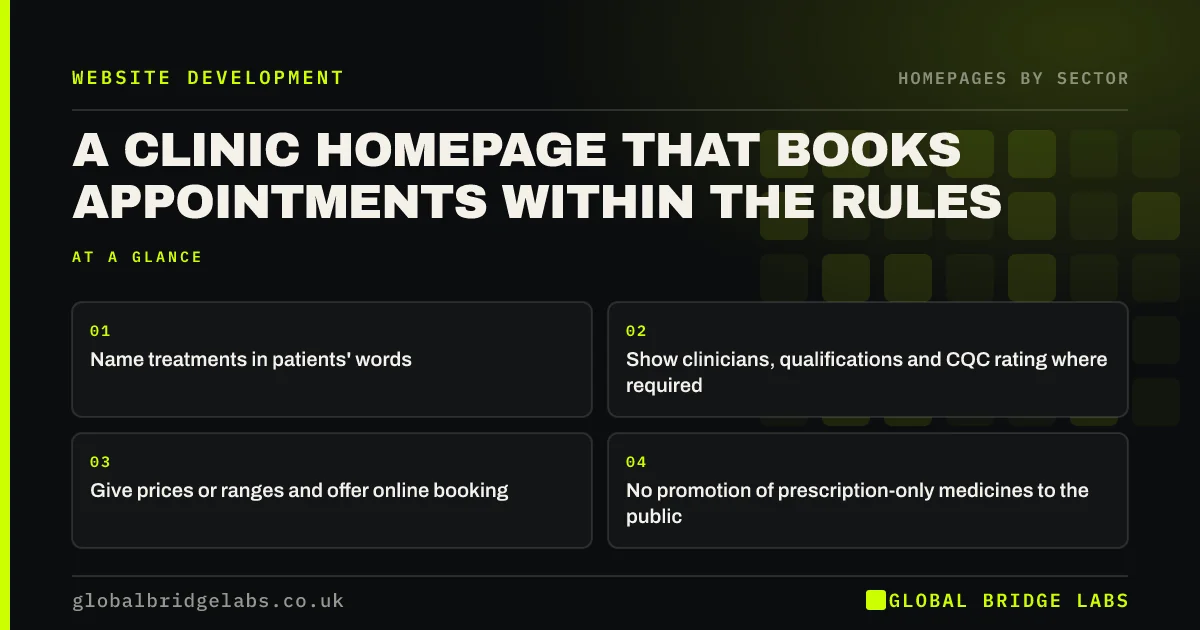
A clinic website homepage books more appointments when it names the treatments, shows the clinicians and their qualifications, displays the CQC rating where the clinic is registered, gives prices or ranges and offers easy online booking. It must also follow advertising rules, including the ban on promoting prescription-only medicines to the public.
- Name treatments in patients' words.
- Show clinicians, qualifications and CQC rating where required.
- Give prices or ranges and offer online booking.
- No promotion of prescription-only medicines to the public.
Want your clinic homepage reviewed? Message us on WhatsApp.
Chat on WhatsApp →What do patients look for on a clinic homepage?
Patients want to know you treat their problem, that clinicians are qualified, what it costs, how soon they can be seen and how to book. Many are anxious, so calm, clear information matters more than marketing language. They often browse on a phone in the evening.
What should the hero and first screen show?
Name the clinic type and main treatments, the location and the next available appointment if you can: 'Physiotherapy and sports injury clinic in Bristol. Appointments this week.' Add a 'Book online' button and a review line.
Which trust signals matter for clinics?
Named clinicians with photos, qualifications and professional registrations, the CQC rating where the clinic is registered (CQC requires registered providers to display their rating on their website), patient reviews and clear prices. Testimonials must not make claims the treatment cannot support.
What advertising rules apply?
Under the CAP Code, prescription-only medicines, such as anti-wrinkle injections, cannot be advertised to the public, which affects how aesthetic clinics describe treatments on a homepage. Claims must be substantiated, and before-and-after images must not mislead. Health information people send you is special category data under UK GDPR.
How should booking work?
Online booking suits most clinics: show available times, the price and any deposit, and confirm immediately. For new patients who need advice first, offer a free short call. Keep any form asking about health conditions minimal and secure.
What does this look like in practice?
A pattern we see: a clinic homepage with a stock spa image, no prices and a 'Call to book' line while reception closes at 5pm. Adding treatment prices, clinician profiles and online booking usually moves bookings into the evening, when many patients browse.
Clinic homepage checklist
- Name treatments in patients' words.
- Show clinicians and registrations.
- Display the CQC rating if registered.
- Give prices or ranges.
- Offer online booking with real availability.
- Check claims against the CAP Code.
Next step
Check your homepage on a phone after 6pm, as a patient would, and try to book an appointment without calling.
Message us on WhatsApp for a clinic homepage review, or book a 30-minute consultation.
Chat on WhatsApp →Sources and further reading
- Display your CQC ratings · Care Quality Commission
- UK Code of Non-broadcast Advertising and Direct & Promotional Marketing (CAP Code) · ASA / CAP
- Special category data · Information Commissioner's Office
Frequently asked questions
What should a private clinic homepage include?
Treatments named in patients' words, clinicians with qualifications and registrations, the CQC rating where required, prices or ranges, reviews, location and an easy booking route. Keep the tone calm and claims accurate.
Do clinics have to show their CQC rating on their website?
CQC-registered providers must display their most recent rating on their website, if they have one, as well as at their premises. Check CQC guidance for the exact requirements and the deadline for updating it.
Can aesthetic clinics advertise Botox on their website?
Prescription-only medicines such as botulinum toxin cannot be advertised to the public under UK advertising rules. Clinics can describe consultations and the conditions they treat, but must avoid promoting the medicine itself.
Written by

Global Bridge Labs (GBL) is a UK–Sri Lanka partner for social media, websites and BPO. Everything here comes from client delivery, not theory.