On this page
- 01Key takeaways
- 02What are dark patterns?
- 03Which conversion tricks can break UK law?
- 04What changed with the DMCC Act 2024?
- 05What are the honest alternatives?
- 06Do dark patterns even work?
- 07What does this look like in practice?
- 08Dark pattern audit checklist
- 09Next step
- 10Sources and further reading
- 11Frequently asked questions
Key takeaways
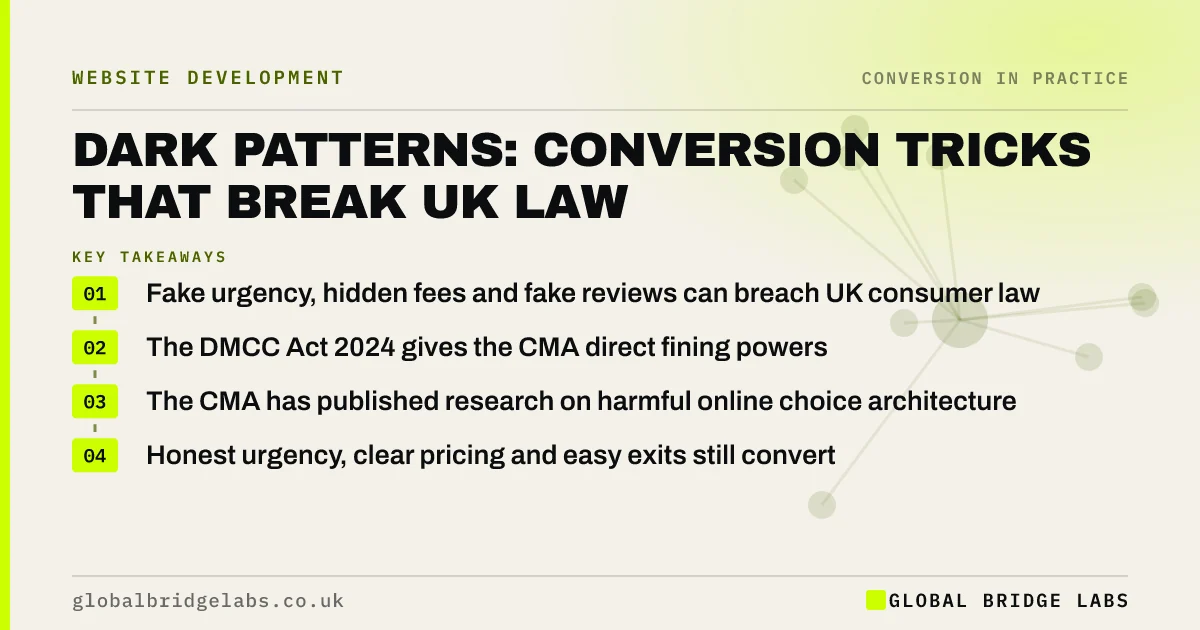
Dark patterns are website designs that push people into decisions they might not otherwise make, such as fake countdown timers, hidden fees, pre-ticked boxes and confusing cancellation. In the UK, many can breach consumer law, and the Digital Markets, Competition and Consumers Act 2024 lets the CMA fine businesses directly. Honest alternatives convert well without the legal or reputational risk.
- Fake urgency, hidden fees and fake reviews can breach UK consumer law.
- The DMCC Act 2024 gives the CMA direct fining powers.
- The CMA has published research on harmful online choice architecture.
- Honest urgency, clear pricing and easy exits still convert.
Want your site checked for risky conversion tactics? Message us on WhatsApp.
Chat on WhatsApp →What are dark patterns?
Dark patterns, also called deceptive design or harmful online choice architecture, are interface designs that steer users towards choices that benefit the business at the user's expense, often by exploiting habits or biases. The Competition and Markets Authority's paper on online choice architecture describes how such design can harm consumers and competition.
Which conversion tricks can break UK law?
These common tactics can amount to unfair commercial practices under UK consumer law, depending on how they are used.
- Fake urgency: countdown timers that reset, false 'offer ends today' claims.
- False scarcity: 'only 2 left' when it is not true.
- Drip pricing: fees revealed only at the end of checkout.
- Fake or selectively hidden reviews.
- Pre-ticked boxes adding extras or marketing consent.
- Hard-to-cancel subscriptions and confusing opt-outs.
- Confirmshaming: 'No thanks, I prefer paying more'.
What changed with the DMCC Act 2024?
The Digital Markets, Competition and Consumers Act 2024 strengthened UK consumer protection. It gives the CMA power to decide that a business has broken consumer law and to impose fines directly, rather than going through the courts, and it bans practices such as fake reviews outright. Small businesses are covered as well as large ones.
Cookie consent and marketing consent have their own rules under UK GDPR and PECR, enforced by the ICO. Pre-ticked consent boxes and 'accept all' designs that make refusal hard can breach them.
Unsure whether a tactic on your site is risky? Ask us on WhatsApp.
Chat on WhatsApp →What are the honest alternatives?
Every dark pattern has an honest version that still helps conversion.
- Real deadlines, stated clearly, instead of fake timers.
- Accurate stock or availability, updated automatically.
- All-in prices shown early, instead of fees at checkout.
- Genuine reviews, including some less than perfect.
- Unticked opt-ins with a clear reason to say yes.
- Easy cancellation, which builds trust for the next purchase.
Do dark patterns even work?
Some lift short-term clicks. The cost comes later: complaints, chargebacks, refunds, poor reviews and customers who do not return. For service businesses built on trust and referrals, the damage usually outweighs any gain. Add the legal risk and the case for dark patterns disappears.
What does this look like in practice?
A UK online course provider used a countdown timer that reset for every visitor and a booking fee added at the final step. We replaced the timer with the real enrolment deadline for each cohort and included the fee in the displayed price. Refund requests fell, and completed enrolments held steady, which meant the tricks had been adding risk without adding sales.
Dark pattern audit checklist
- Check timers and deadlines are real.
- Check stock and scarcity messages are accurate.
- Show all mandatory fees up front.
- Use only genuine reviews, presented fairly.
- Remove pre-ticked boxes for extras and consent.
- Make cancellation and opt-out as easy as sign-up.
- Review cookie banner choices against ICO guidance.
Next step
A high-converting website earns enquiries honestly. We can review your site for risky tactics and replace them with honest versions that still convert. This is general guidance, not legal advice; take legal advice for specific situations.
Message us on WhatsApp for a dark pattern review, or book a 30-minute consultation.
Chat on WhatsApp →Sources and further reading
- Digital Markets, Competition and Consumers Act 2024 · legislation.gov.uk
- Online choice architecture: how digital design can harm competition and consumers · Competition and Markets Authority
- Unfair commercial practices guidance (CMA207) · Competition and Markets Authority
- Cookies and similar technologies under PECR · Information Commissioner's Office
Frequently asked questions
What are dark patterns?
Dark patterns are website designs that push people into choices they might not otherwise make, such as fake countdown timers, hidden fees, pre-ticked boxes, fake reviews and hard-to-cancel subscriptions. Regulators also call this harmful online choice architecture. The CMA can now fine businesses directly.
Are dark patterns illegal in the UK?
Many can be. Misleading or aggressive practices breach UK consumer law, fake reviews are banned under the Digital Markets, Competition and Consumers Act 2024, and consent tricks can breach UK GDPR and PECR. The CMA can now fine businesses directly.
Are countdown timers legal?
Genuine countdowns to a real deadline are legal. Timers that reset, or deadlines that are not real, can mislead consumers and breach UK consumer law. State real deadlines clearly instead. False scarcity messages carry the same risk, so make sure any stock or availability claims are accurate and updated automatically.
What is drip pricing?
Drip pricing is showing a low headline price and revealing mandatory fees later in the buying process. UK law requires the total price, including unavoidable charges, to be clear. Show all mandatory costs up front. Include unavoidable fees in the headline price.
Written by

Global Bridge Labs (GBL) is a UK–Sri Lanka partner for social media, websites and BPO. Everything here comes from client delivery, not theory.