On this page
Key takeaways
Call demand rarely follows a nine-to-five shape. Most teams have peaks in the morning and at lunchtime, and quieter afternoons. Part-time and split shifts let you add people exactly where the peaks are, rather than paying full-time hours for quiet periods. Design them around your interval data and the needs of the people working them.
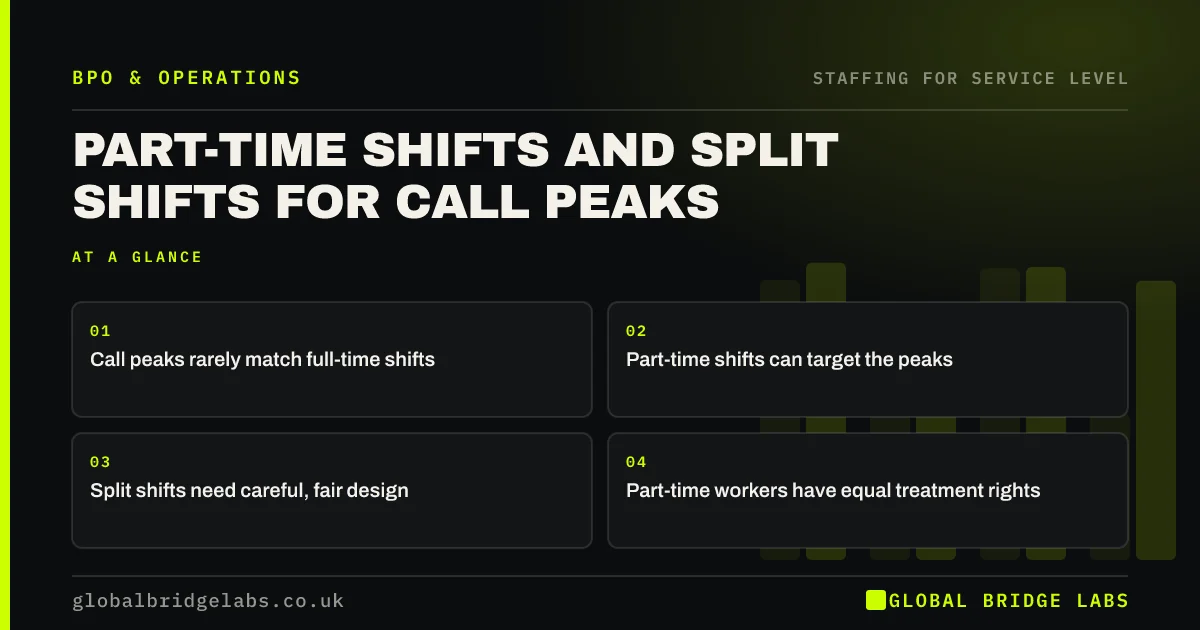
- Call peaks rarely match full-time shifts.
- Part-time shifts can target the peaks.
- Split shifts need careful, fair design.
- Part-time workers have equal treatment rights.
Want shifts designed around your call peaks? Message us on WhatsApp.
Chat on WhatsApp →Why do full-time shifts miss peaks?
A team on identical nine-to-five shifts has the same number of people at 9:30am as at 3:30pm, but calls do not. Either mornings are understaffed or afternoons are overstaffed. Staggered start times help, but part-time shifts match the shape more closely.
What shift patterns work?
Common patterns include a morning shift covering the opening peak, a lunchtime shift from late morning to mid-afternoon, and a short early-evening shift for lines that open late. Split shifts, with a gap in the middle, cover two peaks but can be hard for staff, so offer them by choice.
What about employment rights?
Part-time workers must not be treated less favourably than comparable full-time workers, for example on pay rates, holiday and training, pro rata. Working time rules, including rest breaks, still apply. Check GOV.UK guidance and take advice for complex patterns.
- Equal treatment for part-time workers.
- Pro rata holiday and benefits.
- Rest breaks still apply.
Want a shift plan priced against your peaks? Send us your call data on WhatsApp.
Chat on WhatsApp →Who suits part-time call work?
Many people want part-time hours: parents around school times, students, people with other jobs and those returning to work. Offering hours that fit their lives widens your hiring pool and often improves retention, because people stay longer in roles that work around the rest of their week. Cross-trained office staff can also cover short peak shifts.
What does this look like in practice?
A pattern we see: a team of six full-timers misses its target every morning and is quiet every afternoon. Replacing one full-time vacancy with two part-time morning roles lifts morning service level and costs about the same.
Part-time cover checklist
- Map calls by half hour.
- Compare with people available.
- Design shifts to fill the gaps.
- Check part-time and working time rights.
- Offer split shifts only by choice.
Next step
Plot calls and people available by half hour, mark the gaps and sketch one part-time shift that would fill the biggest one.
Message us on WhatsApp to design part-time cover, or book a 30-minute consultation.
Chat on WhatsApp →Sources and further reading
- Part-time workers' rights · GOV.UK
- Maximum weekly working hours · GOV.UK
Frequently asked questions
Are split shifts legal in the UK?
Split shifts are not banned, but working time rules, contracts and fair treatment still apply. They can be tiring and costly for staff who travel twice, so offer them by agreement. Remote working can make them more practical. Take advice if you plan to introduce them widely.
Do part-time staff need the same training?
Yes. Callers expect the same quality from everyone, and part-time staff should not miss out on training compared with full-time colleagues. Schedule training at times part-time staff can attend, or record it, and pay for the time they spend on it.
Is overflow cheaper than part-time staff?
It depends on how predictable and long your peaks are. Regular, daily peaks often suit part-time staff. Short, irregular spikes often suit overflow, because you pay only when calls exceed your team. Many businesses use both: part-time staff for regular peaks and overflow for the rest.
Written by

Global Bridge Labs (GBL) is a UK–Sri Lanka partner for social media, websites and BPO. Everything here comes from client delivery, not theory.