On this page
Key takeaways
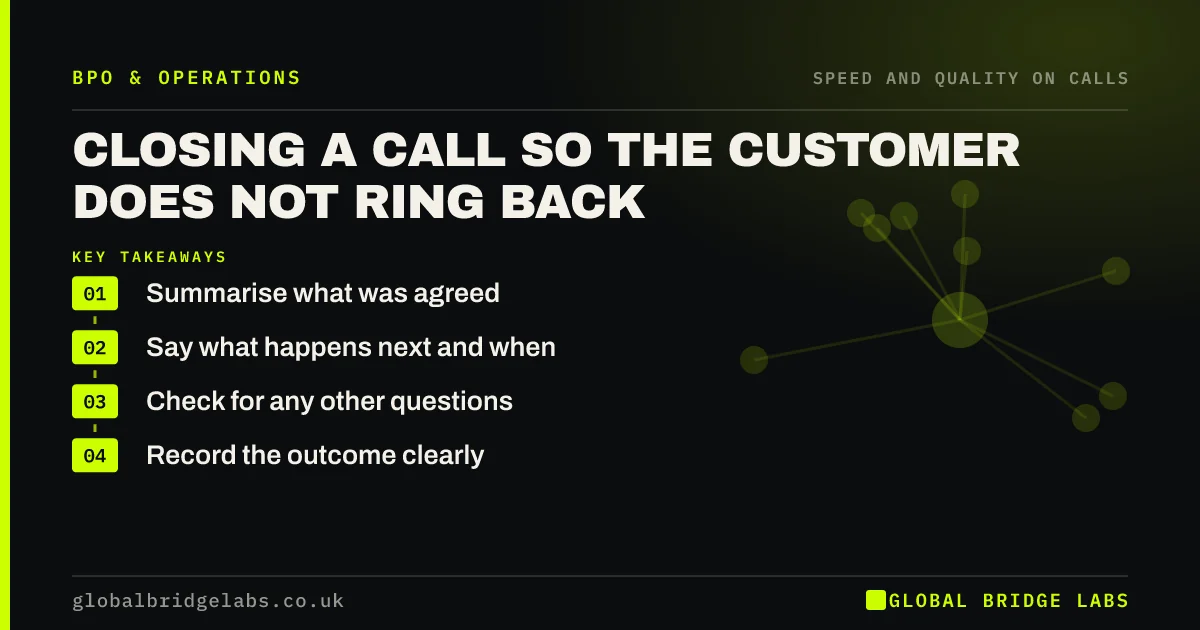
A good close prevents the next call. Summarise what was agreed, say exactly what happens next and by when, check whether there is anything else and thank the caller. Then record the outcome clearly. Most repeat calls come from unclear next steps, so a minute spent closing well saves several later.
- Summarise what was agreed.
- Say what happens next and when.
- Check for any other questions.
- Record the outcome clearly.
Want a better call close for your team? Message us on WhatsApp.
Chat on WhatsApp →Why does the close matter?
Because callers who are unsure what happens next call back to check. Those calls add to the queue and frustrate customers. A clear close also catches misunderstandings while the caller is still on the line, when they are easy to fix.
What should a close include?
A short summary, the next step with a time, and a final check. For example: "So I have booked the engineer for Thursday morning, and you will get a text the day before. Is there anything else I can help with?" Then thank them by name.
How do you avoid promises you cannot keep?
Only promise what you control. Say "you will get an update by Friday" rather than "it will be fixed by Friday" if the fix depends on others. Make sure the promised update is diarised, so it happens even if you are not in.
- Promise only what you control.
- Give a date for the next update.
- Diarise every promise.
Want your closes checked on real calls? Send us a few recordings on WhatsApp.
Chat on WhatsApp →What should be recorded?
Record the reason, what was done, what was promised and by when, in a format the next person can read in seconds. Accurate records are part of handling personal data properly and stop the next caller from having to explain again.
What does this look like in practice?
A pattern we see: many repeat calls start with "I was told someone would ring me". Adding a closing summary with a dated next step, and diarising every promise, cuts these repeat calls within a month.
The team also finds that summarising at the end catches mistakes, such as a wrong address, before they turn into failed visits.
Call closing checklist
- Summarise the outcome.
- Give the next step and a date.
- Ask if there is anything else.
- Thank the caller by name.
- Record the promise and diarise it.
Next step
Agree a three-part close with your team, summary, next step and final check, and track repeat calls for a month after introducing it.
Message us on WhatsApp to improve your call closes, or book a 30-minute consultation.
Chat on WhatsApp →Sources and further reading
- Stop trying to delight your customers (Dixon, Freeman and Toman, 2010) · Harvard Business Review
- Principle (d): Accuracy · Information Commissioner's Office
Frequently asked questions
How do you end a customer service call politely?
Summarise what was agreed, confirm the next step and when it will happen, ask whether there is anything else and thank the caller by name. Let the caller hang up first if you can. It leaves them clear and confident, which reduces calls back to check.
Should agents always ask if there is anything else?
Usually yes, because it catches second questions that would otherwise become a second call. Ask it genuinely, not as a script to rush the ending. If the caller has several issues, deal with them on the same call where possible rather than asking them to call again.
How detailed should the call summary be?
Short and specific: what was done, what happens next and by when. One or two sentences is usually enough. The aim is for the caller to know exactly what to expect, and for the notes to match, so anyone picking up the next contact can see it at once.
Written by

Global Bridge Labs (GBL) is a UK–Sri Lanka partner for social media, websites and BPO. Everything here comes from client delivery, not theory.