On this page
- 01Key takeaways
- 02What is design by committee?
- 03Why does it hurt conversion?
- 04How do you make website decisions better?
- 05How should feedback be judged?
- 06When is wider input valuable?
- 07What does this look like in practice?
- 08Committee-proofing checklist
- 09Next step
- 10Sources and further reading
- 11Frequently asked questions
Key takeaways
Designing a website by committee means every stakeholder's preference is added until the site pleases the team and says little to buyers. The result is often a good-looking website with vague copy, crowded menus and too many buttons. The fix is one decision owner, a brief based on buyers, and feedback judged against evidence rather than taste.
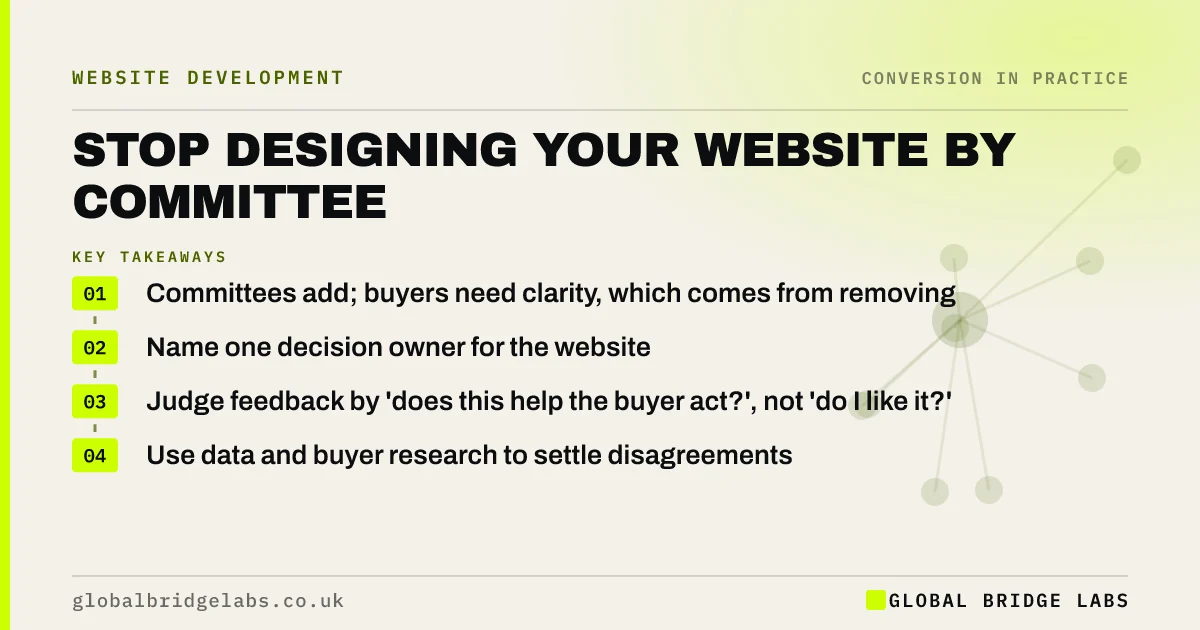
- Committees add; buyers need clarity, which comes from removing.
- Name one decision owner for the website.
- Judge feedback by 'does this help the buyer act?', not 'do I like it?'.
- Use data and buyer research to settle disagreements.
Stuck in website feedback rounds? Message us on WhatsApp.
Chat on WhatsApp →What is design by committee?
Design by committee is when a website, or any design, is shaped by many people's preferences without a single owner or clear criteria. Each person asks for their department, service or favourite idea to be prominent. Every request is reasonable on its own. Together they produce a site that tries to say everything and ends up saying nothing clearly.
Why does it hurt conversion?
Committees tend to add rather than remove: more menu items, more homepage sections, more buttons, softer wording that offends nobody. Buyers need the opposite: one clear offer, relevant proof and one next step. Research on choice, summarised in Hick's Law, shows more options slow decisions. A site built to satisfy everyone in the room often fails the person who matters, the buyer.
How do you make website decisions better?
Separate input from decision. Many people can contribute; one person decides, against an agreed brief.
- Name one decision owner with authority to say no.
- Agree a brief first: buyers, goals, key pages, success measures.
- Collect feedback in writing, in one place, by a deadline.
- Ask reviewers to link each comment to the brief or evidence.
- Settle disputes with data, surveys or a quick user test.
- Limit feedback rounds to two.
Want a feedback process your team will follow? Ask us on WhatsApp.
Chat on WhatsApp →How should feedback be judged?
Replace 'do I like it?' with 'does it help the buyer understand, trust and act?'. Feedback that makes the offer clearer, adds proof or removes friction should win. Feedback about personal taste in colour or imagery should give way unless it affects readability, accessibility or brand consistency.
When is wider input valuable?
Wider input is valuable for facts: sales staff know buyer objections, operations knows lead times, finance knows prices. Gather that knowledge early. The problem is not input; it is treating every opinion as a requirement. Frontline staff often give the most useful feedback of all, because they hear buyers every day.
What does this look like in practice?
A UK engineering consultancy's new homepage had gone through six rounds of feedback from eight partners. It had nine sections, one for each practice area, and a headline that described 'integrated engineering excellence'. We named the marketing lead as decision owner, used sales call notes to rewrite the headline around the three problems clients most often raised, and cut the homepage to four sections. Enquiries rose and the partners stopped debating the homepage.
Committee-proofing checklist
- Name one website decision owner.
- Agree a buyer-based brief before design starts.
- Collect feedback in writing by a deadline.
- Judge feedback against the brief and evidence.
- Limit feedback rounds to two.
- Gather facts from sales and operations early.
Next step
Committees make safe websites; buyers respond to clear ones. We can help you set up a decision process that keeps everyone involved without diluting the site.
Message us on WhatsApp for help with website decisions, or book a 30-minute consultation.
Chat on WhatsApp →Sources and further reading
- Hick's Law: designing long menu lists · Nielsen Norman Group
- User research · GOV.UK Service Manual
- Creating helpful, reliable, people-first content · Google Search Central
Frequently asked questions
What does design by committee mean?
It means a design is shaped by many people's preferences without a single owner or clear criteria. For websites, it usually results in crowded pages, vague wording and too many options, because each stakeholder's request is added rather than weighed.
Who should make decisions about a company website?
One named decision owner, usually the person responsible for marketing or enquiries, working to an agreed brief. Others contribute knowledge and feedback, but the owner decides using the brief and evidence. Gather facts from sales and operations early, because they know buyer objections and lead times.
How many rounds of website feedback are normal?
Two rounds is usually enough when there is a clear brief and a single decision owner. More rounds tend to add changes based on taste rather than evidence, and delay launch. Collect feedback in writing, in one place, by a set deadline.
How do I handle disagreements about website design?
Go back to the brief and the evidence: analytics, sales call notes, on-site surveys or a quick user test. Ask which option better helps the buyer understand, trust and act, and let the decision owner decide. Record the decision so it is not reopened.
Written by

Global Bridge Labs (GBL) is a UK–Sri Lanka partner for social media, websites and BPO. Everything here comes from client delivery, not theory.