On this page
- 01Key takeaways
- 02What is a comparison page?
- 03Why do comparison pages convert well?
- 04Which comparisons should a small business publish?
- 05What should a comparison page include?
- 06What are the rules on comparing with competitors?
- 07When is a comparison page a bad idea?
- 08What does this look like in practice?
- 09Comparison page checklist
- 10Next step
- 11Sources and further reading
- 12Frequently asked questions
Key takeaways
Comparison pages help buyers who are deciding between options, such as your service against a DIY route, a cheaper alternative or a type of competitor. These visitors are close to buying and searching phrases like 'X vs Y'. A fair, specific comparison page meets them at that moment and makes the choice easier, which is why it often converts well.
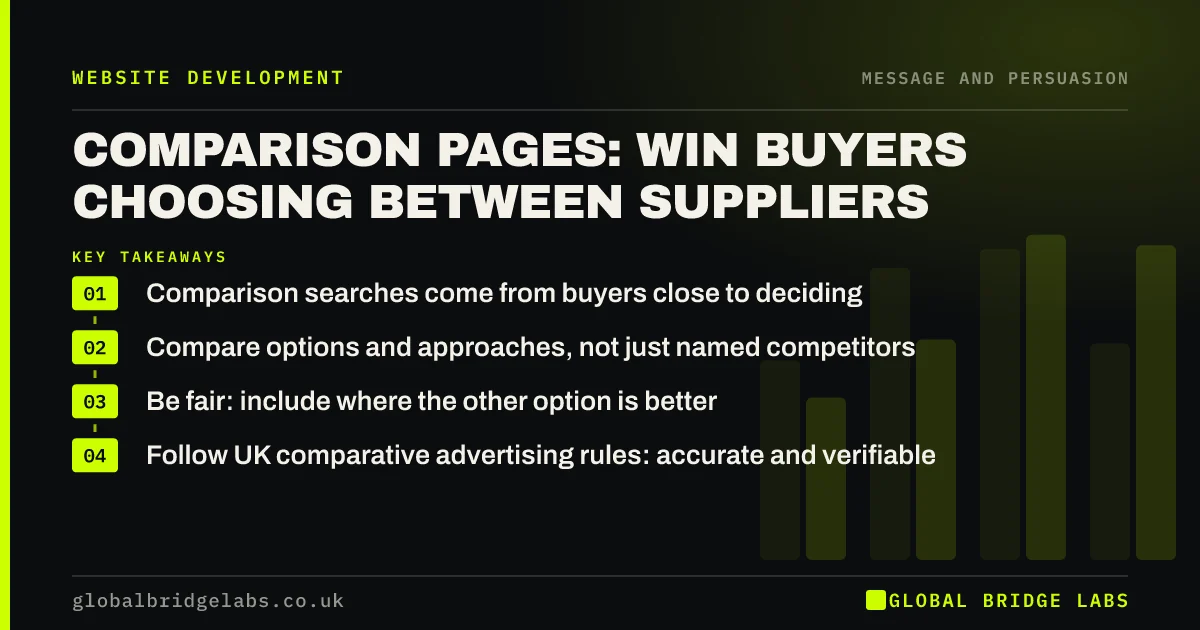
- Comparison searches come from buyers close to deciding.
- Compare options and approaches, not just named competitors.
- Be fair: include where the other option is better.
- Follow UK comparative advertising rules: accurate and verifiable.
Want to know which comparison page would win you most work? Ask us on WhatsApp.
Chat on WhatsApp →What is a comparison page?
A comparison page sets out two or more options side by side so a buyer can choose. For a small business, that might be your service against doing it in-house, one product type against another, or your approach against a common alternative. It targets 'vs', 'alternatives' and 'which is better' searches.
Why do comparison pages convert well?
Visitors searching comparisons have usually defined their need and are choosing a route. They are in the comparing stage of intent, one step from buying. A page that lays out the trade-offs clearly, admits where alternatives win and shows when your option fits builds trust at the exact moment trust decides the sale.
Which comparisons should a small business publish?
Start with the choices your buyers already ask about on sales calls.
- Your service vs doing it themselves.
- Your service vs hiring someone in-house.
- Option A vs option B within your offer (for example, uPVC vs aluminium windows).
- Your type of provider vs another type (independent vs national chain).
- Named competitors only if claims are accurate, verifiable and fair.
Send us the choices your buyers ask about on WhatsApp and we will suggest the first page.
Chat on WhatsApp →What should a comparison page include?
A comparison page should give a short answer first, then a clear side-by-side comparison, then detail on each option, then a recommendation by situation. Include cost ranges, timescales, pros and cons, and who each option suits. End with a next step for buyers who choose you.
- A two- or three-sentence answer at the top.
- A side-by-side comparison on cost, time, quality and risk.
- Honest pros and cons for each option.
- 'Choose A if…, choose B if…' guidance.
- Proof for your option and a clear next step.
What are the rules on comparing with competitors?
Comparative advertising is allowed in the UK if it is not misleading, compares like with like, and compares features that are material, relevant, verifiable and representative. It must not denigrate competitors or create confusion with their brand. The ASA's rules and the CMA's unfair commercial practices guidance apply. If in doubt, compare types of option rather than named firms.
When is a comparison page a bad idea?
Avoid comparison pages when you cannot be fair, because a one-sided comparison destroys trust with exactly the buyers it targets. They are also a poor fit if buyers do not search or ask about the comparison, or if you cannot keep competitor details accurate over time.
What does this look like in practice?
A UK payroll bureau published a page comparing outsourced payroll with running it in-house, including an honest section on when in-house makes more sense. The page ranked for several 'vs' searches and became one of the site's top sources of enquiries, with prospects often quoting the cost comparison on the first call.
Comparison page checklist
- List the choices buyers mention on sales calls.
- Start with a short answer.
- Compare cost, time, quality and risk side by side.
- Include honest pros and cons for every option.
- Give 'choose A if, choose B if' guidance.
- Keep claims accurate and verifiable; review every six months.
Next step
Comparison pages meet buyers at the moment they choose. A fair, well-structured one can become one of your best sources of enquiries. We can help you pick and write the first one.
Message us on WhatsApp to plan a comparison page, or book a 30-minute consultation.
Chat on WhatsApp →Sources and further reading
- Unfair commercial practices guidance (CMA207) · Competition and Markets Authority
- Recognising ads: brand-owned and paid social media · ASA / CAP
- Creating helpful, reliable, people-first content · Google Search Central
Frequently asked questions
What is a comparison page on a website?
A page that sets out two or more options side by side to help buyers choose, such as your service against doing it in-house, or one product type against another. It usually targets 'vs', 'alternatives' and 'which is better' searches.
Can I compare my business to competitors on my website?
Yes, in the UK, if the comparison is accurate, verifiable, compares like with like and does not denigrate or mislead. The ASA and CMA rules apply. Many small businesses compare types of provider or approaches instead, which carries less risk.
Do comparison pages help SEO?
They can, because they target specific 'vs' and 'alternatives' searches with clear intent. They rank best when they answer the comparison directly, give a fair side-by-side view and include details competitors' pages lack. Link them from the relevant service pages so buyers and search engines find them easily.
Should a comparison page admit where competitors are better?
Yes. Buyers comparing options are sceptical, and a one-sided page loses their trust. Showing when the other option is the better choice makes your recommendation more credible when you are the right fit. Honesty also protects you under UK comparative advertising rules.
Written by

Global Bridge Labs (GBL) is a UK–Sri Lanka partner for social media, websites and BPO. Everything here comes from client delivery, not theory.