On this page
- 01Key takeaways
- 02Do customers have a right to know?
- 03What exactly must you disclose?
- 04Do you need to tell each caller?
- 05What must you never do?
- 06What do customers actually care about?
- 07When should you be openly proactive?
- 08What does this look like in practice?
- 09Disclosure checklist
- 10Next step
- 11Sources and further reading
- 12Frequently asked questions
Key takeaways
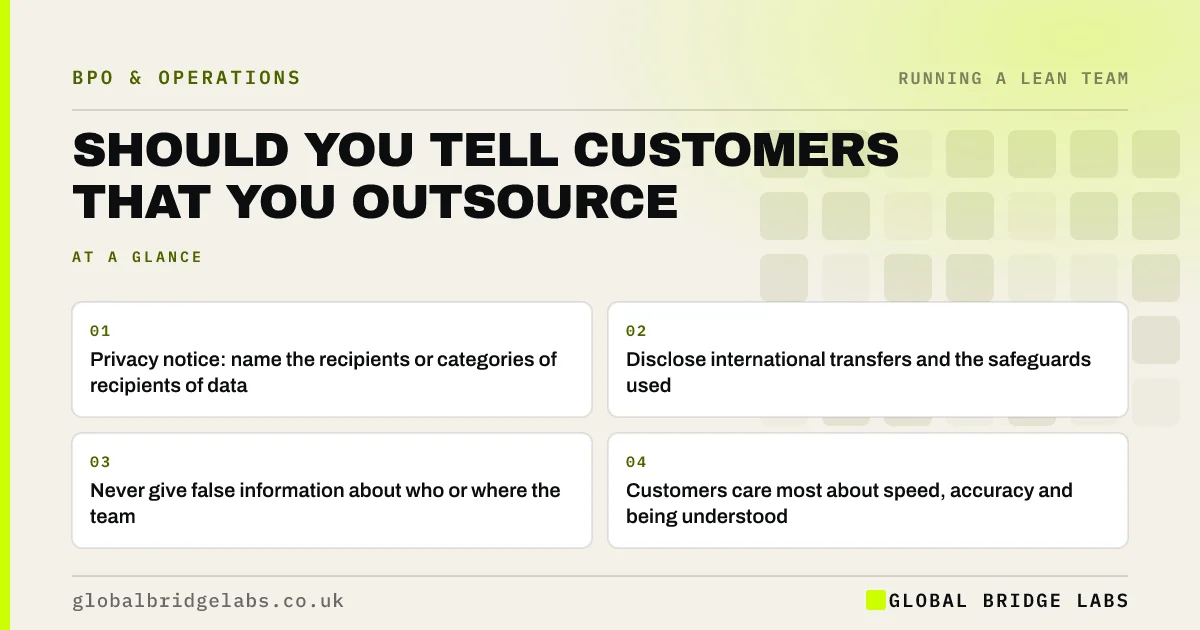
Should you tell customers you outsource? You do not need to announce it in every conversation, but you must not hide it. UK data protection law requires your privacy notice to say who receives personal data and whether it is transferred abroad. Beyond that, be honest if asked and never claim a team is somewhere it is not.
- Privacy notice: name the recipients or categories of recipients of data.
- Disclose international transfers and the safeguards used.
- Never give false information about who or where the team is.
- Customers care most about speed, accuracy and being understood.
Unsure what your privacy notice should say? Message us on WhatsApp.
Chat on WhatsApp →Do customers have a right to know?
Customers have a right to know how their personal data is used. Under UK GDPR, the Information Commissioner's Office (ICO) expects a privacy notice to state the recipients or categories of recipients of personal data, and details of transfers to other countries. If an outsourced team handles customer data, the notice should reflect that.
What exactly must you disclose?
You must disclose who receives the data, at least by category, such as customer service providers, and whether data is sent outside the UK, with the safeguard relied on. You do not have to name every supplier, though you can. You remain the controller and are responsible for what the provider does with the data.
- Recipients or categories of recipients.
- Whether data goes outside the UK.
- The safeguard for any international transfer.
- How people can exercise their rights.
Do you need to tell each caller?
No. There is no general requirement to tell each caller or correspondent that the person helping them works for a partner. Outsourced teams commonly answer in the client's business name. What matters is that nothing said is false. If a customer asks where the team is based, the answer should be truthful.
What must you never do?
Never mislead. Instructing staff to claim they are in a UK office when they are not, or to deny working for a partner, risks breaching consumer protection law on misleading practices and damages trust when discovered. Using a consistent business name and tone is fine. Inventing locations is not.
Want wording for your team if customers ask? Send us your situation on WhatsApp.
Chat on WhatsApp →What do customers actually care about?
Customers care about being answered quickly, getting the right answer and not having to repeat themselves. Those depend on training, system access and authority to resolve issues, not on who employs the person. A well-briefed partner team usually improves the things customers notice.
When should you be openly proactive?
Be proactive in business-to-business relationships where clients have their own compliance duties, in regulated sectors, and wherever a contract restricts subcontracting. Check your customer contracts before outsourcing work for those clients. Some firms also choose to describe their UK and overseas teams openly as a strength.
What does this look like in practice?
A pattern we see with UK firms that worried about telling customers: the question almost never comes up, and when it does, a straightforward answer such as our customer team includes colleagues at our partner in Sri Lanka is accepted without fuss. Global Bridge Labs (GBL) itself works as a UK and Sri Lanka delivery partner and says so.
Disclosure checklist
Complete these before the outsourced team goes live.
- Privacy notice updated with recipients and transfers.
- Processor contract and transfer safeguard in place.
- Customer contracts checked for subcontracting clauses.
- A truthful, agreed answer if customers ask.
- No scripts that state a false location.
- Staff briefed on the same answer.
Next step
Tell us what customer data an outside team would handle. We will outline what your privacy notice and contracts need to cover. This is general information, not legal advice.
Message us on WhatsApp for a disclosure checklist, or book a 30-minute consultation.
Chat on WhatsApp →Sources and further reading
- Right to be informed (privacy information) · Information Commissioner's Office
- International transfers of personal data · Information Commissioner's Office
- Unfair commercial practices guidance (CMA207) · Competition and Markets Authority
Frequently asked questions
Do I have to tell customers I use an outsourced team?
You must tell people, through your privacy notice, who receives their personal data and whether it is transferred overseas. You do not have to announce outsourcing in each interaction. You should answer truthfully if asked and must not make false statements about your team or its location.
Does my privacy notice need to mention outsourcing?
Yes, where an outsourced team handles personal data. The notice should list the recipients or categories of recipients, such as customer support or administration providers, and explain any transfer outside the UK and the safeguard used. Update it before the provider starts.
Can outsourced staff answer in my company name?
Yes. Answering calls and messages in your business name is standard practice and is not misleading, because they are acting on your behalf. They should not claim to be employees or to be in a particular place if that is untrue.
Will customers mind if support is outsourced?
Most customers do not mind if the service is good. They notice response time, accuracy and whether the person could resolve the issue. Problems arise when an outsourced team lacks information or authority, which is a training and access question, not a location question.
Written by

Global Bridge Labs (GBL) is a UK–Sri Lanka partner for social media, websites and BPO. Everything here comes from client delivery, not theory.