On this page
Key takeaways
Schedule adherence measures whether people are available for calls at the times the rota says. A good rota is useless if people are on the phones at different times from the plan. Adherence shows where the gaps are. Use it to fix the plan and support people, not to police every minute, and explain clearly what is measured.
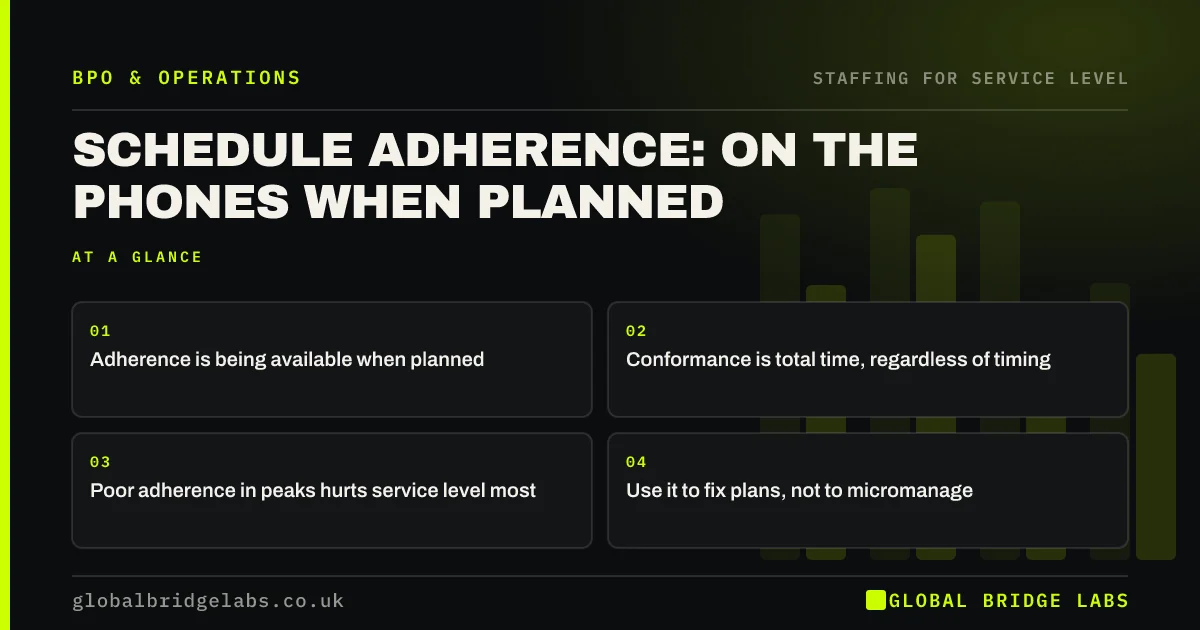
- Adherence is being available when planned.
- Conformance is total time, regardless of timing.
- Poor adherence in peaks hurts service level most.
- Use it to fix plans, not to micromanage.
Want help measuring adherence fairly? Message us on WhatsApp.
Chat on WhatsApp →What is schedule adherence?
It is the share of scheduled time a person spent in the planned activity: on calls when planned to be on calls, on break when planned to be on break. A person who takes lunch 30 minutes late may still work the right total hours, but the team is short at the time it planned to be full.
How is it different from conformance?
Conformance compares total time in each activity with the plan, regardless of when. Adherence checks timing. You can have perfect conformance and poor adherence if people work the right hours at the wrong times. For service level, timing matters more.
What is a reasonable target?
There is no universal figure. Many teams aim high but allow some tolerance, because calls overrun and breaks cannot always start on the minute. Look at adherence in your busiest half hours first, because that is where gaps hurt callers.
- Focus on adherence in peak half hours.
- Allow tolerance for overrunning calls.
- Track team trends, not single days.
- Why a daily service level hides your worst half hours
- Intraday management: fixing the day as it happens
Want to know where adherence gaps hurt service level? Send us your data on WhatsApp.
Chat on WhatsApp →How do you improve it fairly?
Explain why timing matters, share the interval report so people see the effect, and ask what gets in the way. Common causes are unclear rotas, admin tasks with no set time and meetings that overrun. Be open about what is monitored, as the ICO expects for workplace monitoring.
What does this look like in practice?
A pattern we see: service level drops every day at 11am even though the rota looks right. Adherence data shows several people do admin at that time because it is the only quiet moment they see. Giving admin a set slot in the afternoon fixes the 11am gap.
Schedule adherence checklist
- Publish a clear rota by half hour.
- Measure adherence in peak half hours.
- Allow sensible tolerance.
- Ask what gets in the way.
- Tell staff what is monitored and why.
Next step
Compare planned and actual availability for your three busiest half hours last week, and talk to the team about the biggest gap.
Message us on WhatsApp to improve schedule adherence, or book a 30-minute consultation.
Chat on WhatsApp →Sources and further reading
- What are the Management Standards for work-related stress? · Health and Safety Executive
- Employment information · Information Commissioner's Office
Frequently asked questions
How is schedule adherence calculated?
Divide the minutes a person was in the planned activity at the planned time by their total scheduled minutes, and multiply by 100. Many phone systems calculate it from login and status data. Agree in advance how overrunning calls and short tolerances are treated, so the figure is fair.
Is monitoring adherence allowed under UK GDPR?
Monitoring staff can be lawful if it is necessary, proportionate and transparent. Tell staff what is measured, why and how it is used, and avoid more intrusive monitoring than you need. The ICO publishes guidance on monitoring workers that is worth reading before you start.
Should adherence be used in performance reviews?
Use it carefully. Team-level trends help fix rotas and processes. Individual figures can help in supportive conversations, but they should not be judged without context, such as long complex calls or helping colleagues. Focus on patterns over weeks, not single bad days.
Written by

Global Bridge Labs (GBL) is a UK–Sri Lanka partner for social media, websites and BPO. Everything here comes from client delivery, not theory.