On this page
- 01Key takeaways
- 02Why is a big contract a capacity risk?
- 03How do you size the extra workload?
- 04What should you outsource and what should you hire?
- 05How quickly can you add capacity?
- 06How do you protect existing customers?
- 07How should outsourcing terms match the contract?
- 08What are the risks of outsourcing for a new contract?
- 09What should the first 30 days of a new contract look like?
- 10What does this look like in practice?
- 11New contract checklist
- 12Next step
- 13Sources and further reading
- 14Frequently asked questions
Key takeaways
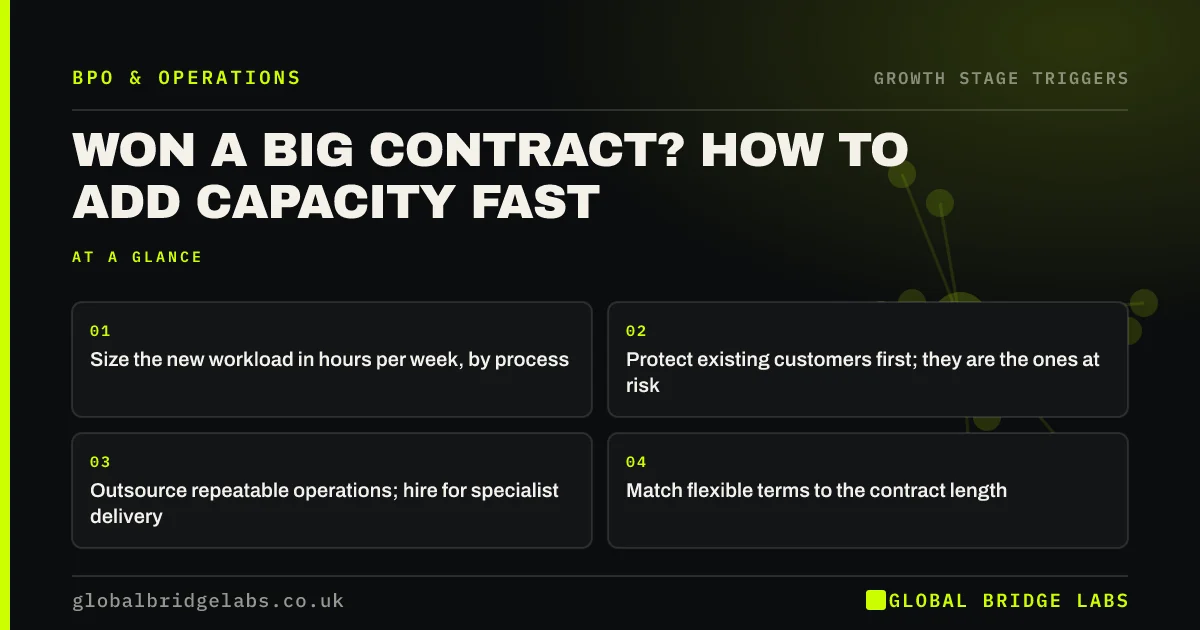
If you have won a big contract and need staff, size the extra workload first, then split it: specialist delivery goes to hires or your best people, and repeatable operations such as customer contact, reporting and admin go to flexible capacity. Outsourcing can add that capacity in about 2 weeks, so existing customers do not suffer while you recruit.
- Size the new workload in hours per week, by process.
- Protect existing customers first; they are the ones at risk.
- Outsource repeatable operations; hire for specialist delivery.
- Match flexible terms to the contract length.
Just won something big? Message us on WhatsApp and tell us what it involves.
Chat on WhatsApp →Why is a big contract a capacity risk?
A big contract adds a step change in work on a fixed start date, usually with tight service levels. The risk is not only failing the new client: it is existing customers getting slower service while the team focuses on the new one. Both damage reputation at the moment it matters most.
How do you size the extra workload?
Break the contract down into processes and estimate weekly volume and handling time for each. Include the hidden work: onboarding, reporting, account management, invoicing and queries. Compare the total with current spare capacity to find the gap in hours per week.
- Delivery work by type, in hours per week.
- Customer contact and queries expected.
- Reporting and account management.
- Invoicing, data entry and admin.
- Onboarding effort in the first month.
Send us the contract scope on WhatsApp and we will help you size the gap.
Chat on WhatsApp →What should you outsource and what should you hire?
Hire or reassign your best people for the specialist delivery and the client relationship, because that is what the client bought. Outsource the repeatable operations around it: customer queries, order processing, data entry, reporting preparation and invoicing. That keeps delivery quality high and admin capacity flexible.
How quickly can you add capacity?
A managed seat on a documented process can start in about two weeks; larger scopes take four to eight. Recruiting typically takes 4 to 12 weeks including notice periods. If the contract starts in a month, outsourcing is often the only way to have trained capacity in place on day one.
How do you protect existing customers?
Ring-fence their service. Keep the people they know on their accounts, and move repeatable contact and admin for everyone to the new capacity. Watch reply times and complaints for existing customers weekly during the ramp-up. If they slip, rebalance before the new contract's go-live pressure takes over.
How should outsourcing terms match the contract?
Match notice periods to the contract's length and break clauses. If the client can end the contract with three months' notice, avoid a provider commitment longer than that. Check also whether the client's contract has requirements on subcontracting, data location or security that your provider must meet.
What are the risks of outsourcing for a new contract?
The main risks are a rushed handover, a client contract that restricts subcontracting, and a provider that cannot meet the client's security standards. Read the client contract first, give the provider a written process, and plan a short shadowing period before go-live.
What should the first 30 days of a new contract look like?
Plan the first month as a controlled ramp-up rather than a switch. Set up access and processes before day one, run a short shadowing period, and review volumes and service levels daily in the first week and weekly after that. The first month sets the client's impression, so it deserves more checking than any other.
- Before day one: access, written process, escalation contacts.
- Week 1: daily review of volumes, reply times and errors.
- Weeks 2 to 4: weekly reviews and adjustments to capacity.
- Day 30: review with the client against the agreed service levels.
What does this look like in practice?
A pattern we see in UK logistics firms winning a regional distribution contract: the transport team can handle the vehicles, but not the extra delivery queries and proof-of-delivery chasing. A managed team takes those from day one, trained during the month before go-live, and the planners stay focused on routes.
New contract checklist
Use this in the weeks after winning.
- Size the workload by process in hours per week.
- Assign specialist delivery to your best people or new hires.
- Outsource repeatable operations around it.
- Check the client contract for subcontracting and data rules.
- Match provider notice terms to the contract length.
- Monitor existing customers' service weekly.
Next step
Tell us about the contract and its start date. We will tell you what capacity you need and how quickly it can be in place.
Message us on WhatsApp about your new contract, or book a 30-minute consultation.
Chat on WhatsApp →Sources and further reading
- Contracts and liabilities between controllers and processors · Information Commissioner's Office
- International transfers of personal data · Information Commissioner's Office
- National Minimum Wage and National Living Wage rates · GOV.UK
Frequently asked questions
How do I get staff quickly for a new contract?
Split the work. Assign specialist delivery to your best people or new hires, and outsource repeatable operations such as queries, data entry and invoicing. A managed seat on a documented process can start in about two weeks; recruitment usually takes 4 to 12.
Can I subcontract work on a client contract?
Check the client contract. Some restrict subcontracting, require consent, or set rules on data location and security. If personal data is involved, you also need a processor contract with the provider under UK GDPR. Read the terms before choosing a provider.
How do I stop existing customers suffering when I win a big client?
Ring-fence their service: keep familiar people on their accounts, add capacity for repeatable work across all customers, and monitor their reply times and complaints weekly during the ramp-up. Rebalance quickly if their service slips.
Written by

Global Bridge Labs (GBL) is a UK–Sri Lanka partner for social media, websites and BPO. Everything here comes from client delivery, not theory.