On this page
Key takeaways
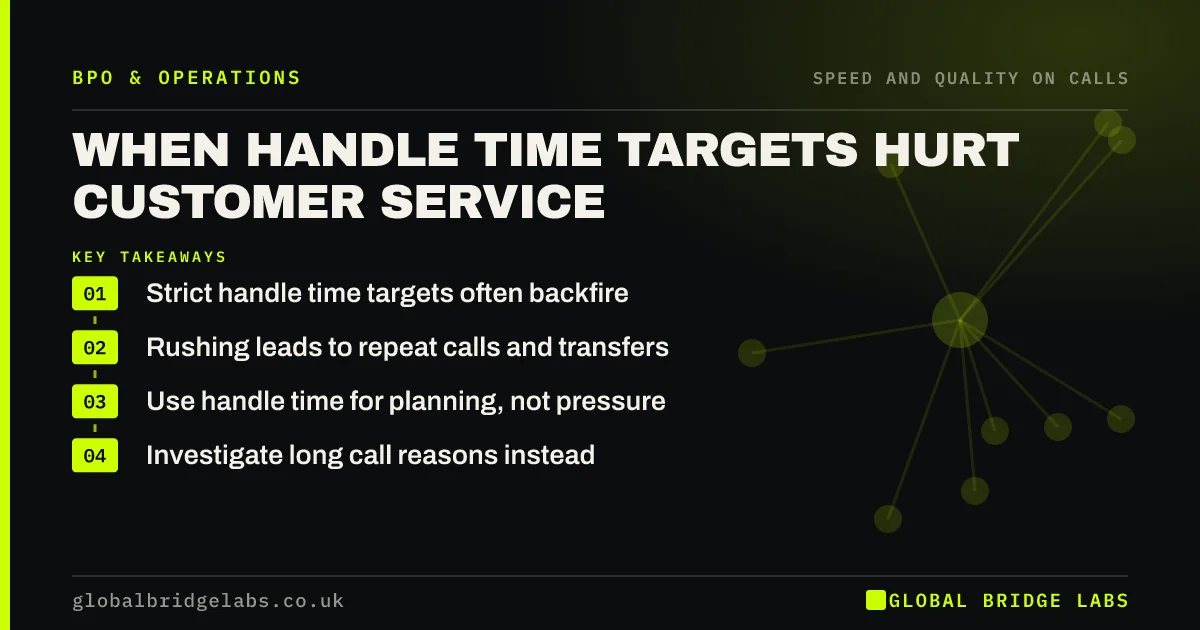
Handle time targets aim to keep calls efficient, but strict individual targets often backfire. People rush, transfer, avoid difficult calls or end calls early, and customers ring back. Use handle time to plan staffing and spot process problems, not as a target each person must hit. Look at the reasons behind long calls instead.
- Strict handle time targets often backfire.
- Rushing leads to repeat calls and transfers.
- Use handle time for planning, not pressure.
- Investigate long call reasons instead.
Concerned your call targets are causing problems? Message us on WhatsApp.
Chat on WhatsApp →Why do handle time targets backfire?
Because the easiest way to shorten a call is to end it before the problem is solved. People under pressure may transfer callers, promise a callback they cannot keep or skip notes. Handle time falls and repeat calls rise. It can also add stress, which affects sickness and staff turnover.
What are the warning signs?
Watch for repeat calls rising, more transfers, very short calls that end without resolution and notes getting thinner. Ask staff directly whether they feel pressure to end calls early. If handle time falls while satisfaction or resolution falls too, the target is doing harm.
- Repeat calls rising.
- More transfers and callbacks.
- Short, unresolved calls.
- Thinner notes.
How should handle time be used?
Use it at team level to plan staffing, because it drives the Erlang calculation. Use it by call reason to spot processes that take too long. And use it in coaching only alongside quality, to help someone who struggles with a specific type of call rather than to push everyone faster.
Want help rethinking your call targets? Send them to us on WhatsApp.
Chat on WhatsApp →What should you measure instead?
Measure resolution on the first contact, repeat calls, quality from a sample of calls and customer feedback. These show whether calls achieve their purpose. Handle time then becomes a background figure that improves naturally as processes and tools get better.
What does this look like in practice?
A pattern we see: an individual handle time target leads to shorter calls and a steady rise in repeat calls. Dropping the individual target and reviewing the three longest call reasons as a team brings handle time back down, this time without the repeats.
The team also reports feeling less pressured, and short-notice absence falls over the following months.
Handle time checklist
- Stop using handle time as an individual target.
- Watch repeat calls and transfers.
- Review handle time by call reason.
- Fix slow processes and tools.
- Pair any handle time figure with quality.
Next step
Compare handle time with repeat calls for the last three months. If one fell while the other rose, review how the target is used.
Message us on WhatsApp to set better call targets, or book a 30-minute consultation.
Chat on WhatsApp →Sources and further reading
- Stop trying to delight your customers (Dixon, Freeman and Toman, 2010) · Harvard Business Review
- Work-related stress and how to manage it · Health and Safety Executive
Frequently asked questions
Should I set an average handle time target for staff?
It is usually better not to set individual targets. Use handle time at team level for staffing and by call reason to find process problems. If you use it in coaching, always pair it with quality and resolution, so people are not encouraged to end calls before the customer's problem is solved.
How can I reduce handle time without rushing calls?
Give staff faster access to answers, reduce the number of systems they use, cut hold time to ask colleagues and make notes quicker with templates. Removing avoidable call reasons also helps. These changes shorten calls by removing wasted time rather than squeezing the conversation.
Why do repeat calls rise when handle time falls?
Because some calls are shortened by ending them before the problem is fully solved. The customer then calls back, often more frustrated. If you see both trends together, review how handle time is being measured and used, and whether people feel pressured to finish calls quickly.
Written by

Global Bridge Labs (GBL) is a UK–Sri Lanka partner for social media, websites and BPO. Everything here comes from client delivery, not theory.