On this page
Key takeaways
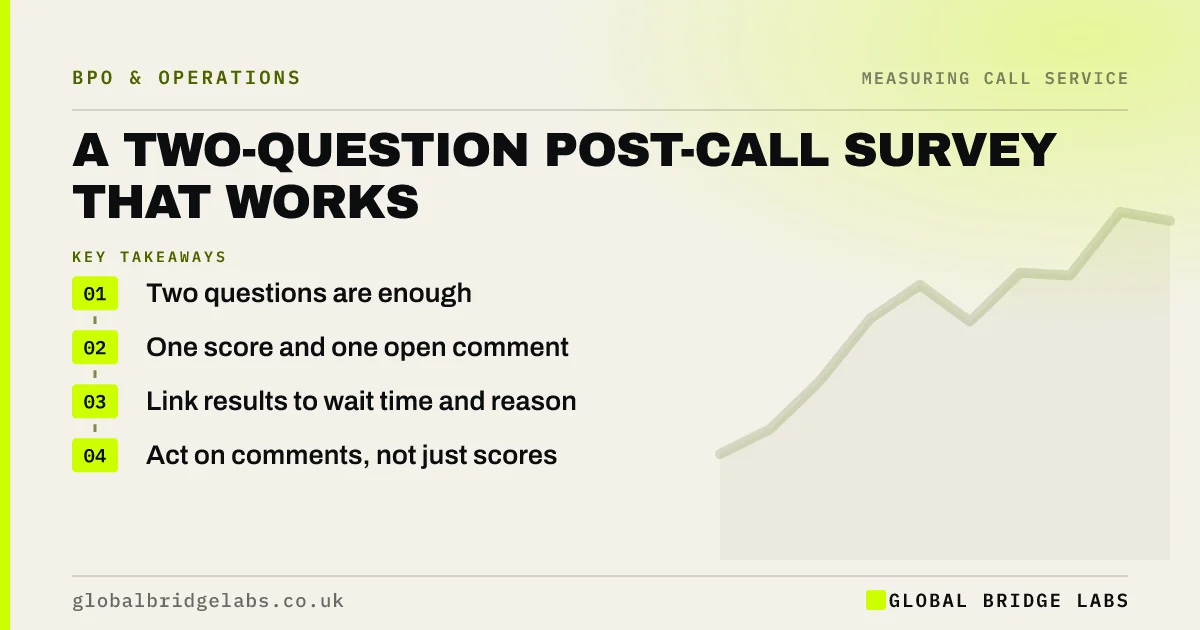
A post-call survey asks callers a short question about their call, usually by text, email or a quick automated phone question. Two questions are enough: one score and one open comment. Link answers to wait time, call reason and outcome, so you can see what drives satisfaction and where service level matters most to callers.
- Two questions are enough.
- One score and one open comment.
- Link results to wait time and reason.
- Act on comments, not just scores.
Want a post-call survey set up? Message us on WhatsApp.
Chat on WhatsApp →Which two questions work best?
A rating question, such as "How easy was it to get help today?" on a short scale, and an open question, "What is one thing we could have done better?" The first shows trend, the second shows causes. Keep wording the same so results can be compared over time.
How should the survey be sent?
By text or email shortly after the call, or as an automated question at the end. Text surveys often get better response rates for phone customers. Make sure customers have agreed to be contacted where needed, and keep it short.
- Send within an hour of the call.
- Keep it to two questions.
- Check consent for follow-up contact.
How do you link results to service level?
Match each answer to the call's wait time, reason and outcome. Then compare scores across wait bands and reasons. You will often see that scores fall sharply above a certain wait and that some reasons score poorly whatever the wait.
Want help analysing survey results against wait times? Send us your data on WhatsApp.
Chat on WhatsApp →What should you do with the results?
Read the comments weekly and group them. Share good comments with the team and act on the most common complaints. Use the score trend to check whether changes, such as a callback offer or a shorter menu, made a difference.
What does this look like in practice?
A pattern we see: an owner assumes callers care most about answer speed. Survey comments show transfers and unclear next steps are the main complaints. The team fixes routing and closing, and scores improve without changing the service level target.
Matching scores to wait times also shows that satisfaction only falls noticeably once waits pass about two minutes, which helps the team set a sensible maximum wait.
Post-call survey checklist
- Use two fixed questions.
- Send within an hour of the call.
- Check consent for contact.
- Link answers to wait and reason.
- Read and group comments weekly.
Next step
Write your two questions, set up a text survey for a sample of calls and review the first month of results against wait times.
Message us on WhatsApp to set up a post-call survey, or book a 30-minute consultation.
Chat on WhatsApp →Sources and further reading
- Measuring success · GOV.UK Service Manual
- Rating scales in UX research: Likert or semantic differential? · Nielsen Norman Group
Frequently asked questions
How many questions should a post-call survey have?
Two is usually enough: one rating and one open comment. Short surveys get more responses and are easier to act on. If you need more detail, follow up with a small number of customers by phone rather than making every survey longer.
Should I survey every caller?
Not necessarily. A random sample can give reliable trends without over-surveying regular customers. Avoid surveying the same person after every call. Make sure the sample includes busy and quiet times, so results reflect the whole day, not just easy calls.
What response rate should I expect?
It varies by channel, customer type and how soon the survey is sent. Text surveys sent shortly after the call often do better than emails sent days later. Track your own response rate and check that responses are not coming only from very happy or very unhappy callers.
Written by

Global Bridge Labs (GBL) is a UK–Sri Lanka partner for social media, websites and BPO. Everything here comes from client delivery, not theory.