On this page
- 01Key takeaways
- 02What makes a test fair?
- 03What is the minimum for social media?
- 04What is the minimum for traditional media?
- 05Why do small tests give wrong answers?
- 06How do you size a test from your own numbers?
- 07What if you cannot afford the minimum?
- 08Is there a maximum for a test?
- 09What does this look like in practice?
- 10Checklist before starting a test
- 11Next step
- 12Sources and further reading
- 13Frequently asked questions
Key takeaways
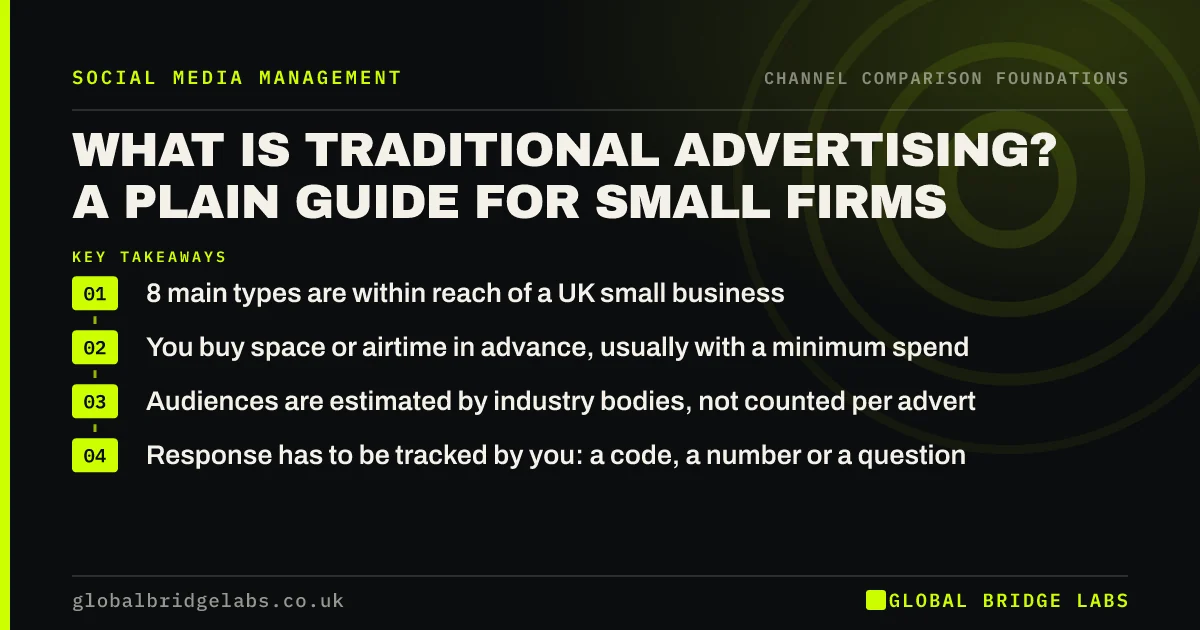
The minimum advertising budget for a fair test is the smallest sum that can produce about 20 enquiries, or at least six weeks of exposure. Below that, you are buying an anecdote. Social media has the lowest floor, which is why it is the usual place to start.
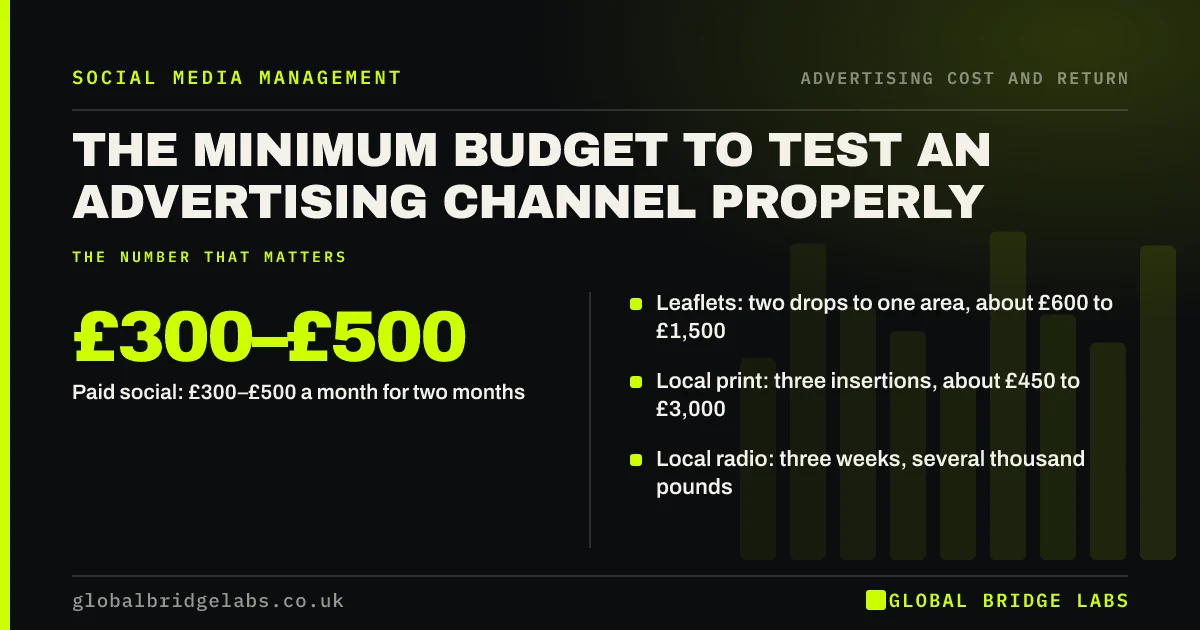
- Paid social: £300–£500 a month for two months.
- Leaflets: two drops to one area, about £600 to £1,500.
- Local print: three insertions, about £450 to £3,000.
- Local radio: three weeks, several thousand pounds.
Not sure your test budget is big enough? Message us on WhatsApp before you spend it.
Chat on WhatsApp →What makes a test fair?
A fair test gives a channel enough exposure to work and enough responses to read. One advert shown once tests your luck. As a working rule, aim for about 20 tracked enquiries or six to eight weeks, whichever comes later, with the same offer throughout.
What is the minimum for social media?
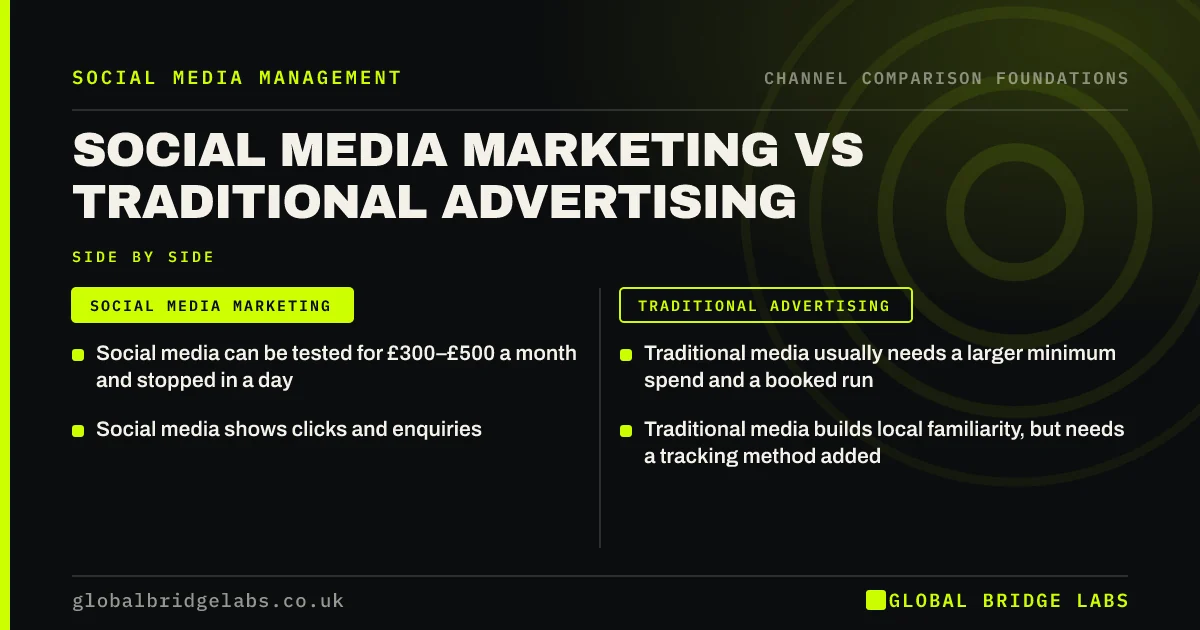
For paid social, a practical floor is £300–£500 a month in advertising spend for two months. Platforms accept far smaller daily budgets, but very low spend reaches too few people to learn from. Unpaid posting needs no media budget and about three months of steady effort.
What is the minimum for traditional media?
Traditional media need enough repetition to be noticed, which raises the floor. Using indicative UK ranges, these are sensible minimums.
- Leaflets: two drops to 5,000 homes, £600 to £1,500.
- Local newspaper or magazine: three insertions.
- Local radio: three weeks of airtime plus production.
- Outdoor: one well-placed site for four weeks.
- Direct mail: 300 to 500 letters to a chosen list.
Why do small tests give wrong answers?
Small tests give wrong answers because chance dominates. If a £100 advert brings two calls, was that the advert or the weather? One more or one fewer call would halve or double the result. Too small a test usually ends with a good channel being written off.
How do you size a test from your own numbers?
Work backwards from the enquiries you need. If you expect to pay about £25 an enquiry and want 20 to judge, budget £500. If you have no idea of the cost per enquiry, run the cheapest channel first to get one, then use it as a yardstick for the others.
- 1. Estimate cost per enquiry.
- 2. Multiply by 20.
- 3. Add production and time.
- 4. Check you can afford to lose the total.
Want help sizing a first test? Message us on WhatsApp and we will discuss your requirements.
Chat on WhatsApp →What if you cannot afford the minimum?
If you cannot afford the minimum for a channel, do not buy a smaller version of it. Choose a cheaper channel and test that properly. A full test of social media teaches more than a third of a radio campaign.
Is there a maximum for a test?
Yes: never test with money you cannot afford to lose. A common working rule is to keep about 10% of the advertising budget for tests, with the rest behind channels that already pay. A test is finished when it has answered its question, not when the money runs out.
What does this look like in practice?
A pattern we see with cautious first-time advertisers: £50 is spent on a boosted post, nothing obvious happens, and paid social is dismissed for a year. The channel was never tested. It was sampled at a size that could not have shown anything either way.
Checklist before starting a test
- One channel, one area, one offer.
- A budget large enough for about 20 enquiries.
- A tracking method in place before day one.
- A fixed end date and a decision rule.
- Money you can afford to lose.
Next step
Pick the channel you are most curious about and write down the smallest budget that could bring 20 enquiries. If you cannot afford it, pick a cheaper channel.
Message us on WhatsApp to plan the test, or book a 30-minute consultation.
Chat on WhatsApp →Sources and further reading
Frequently asked questions
What is the minimum budget for social media advertising?
Platforms allow very small daily budgets, but a practical floor for a readable test is about £300–£500 a month for two months. Less than that reaches too few people to tell whether the advert, the audience or chance produced the result.
How much should I spend to test a new advertising channel?
Enough to produce about 20 tracked enquiries, or to run for six to eight weeks. Estimate what an enquiry is likely to cost, multiply by 20 and add production. If the total is more than you can afford to lose, test a cheaper channel.
Can I advertise with a £100 budget?
You can, but treat it as a trial of the mechanics, not a test of whether the channel works. With £100, a small social media advert aimed at a tight local area is the most sensible use, alongside free methods such as reviews and referrals.
How long should an advertising test run?
Six to eight weeks suits most channels. That allows for repetition, for slow responders and for a quiet week. Shorter tests can work for paid social with higher budgets. Longer ones are needed for brand activity such as radio.
Written by

Global Bridge Labs (GBL) is a UK–Sri Lanka partner for social media, websites and BPO. Everything here comes from client delivery, not theory.