On this page
- 01Short answer
- 02What does in-house really cost?
- 03What does each model genuinely do better?
- 04What does the hybrid look like in practice?
- 05When should you hire rather than outsource?
- 06What makes outsourcing fail?
- 07How do you transition between models without losing momentum?
- 08What does a good working rhythm look like?
- 09Next step
- 10Sources and further reading
- 11Frequently asked questions
Short answer
Keep strategy and brand voice in-house because they depend on knowing your customers. Outsource production, publishing and reporting because they are repeatable and consume the most hours. For most UK SMEs that hybrid costs less than a hire and produces more than a pure agency arrangement.
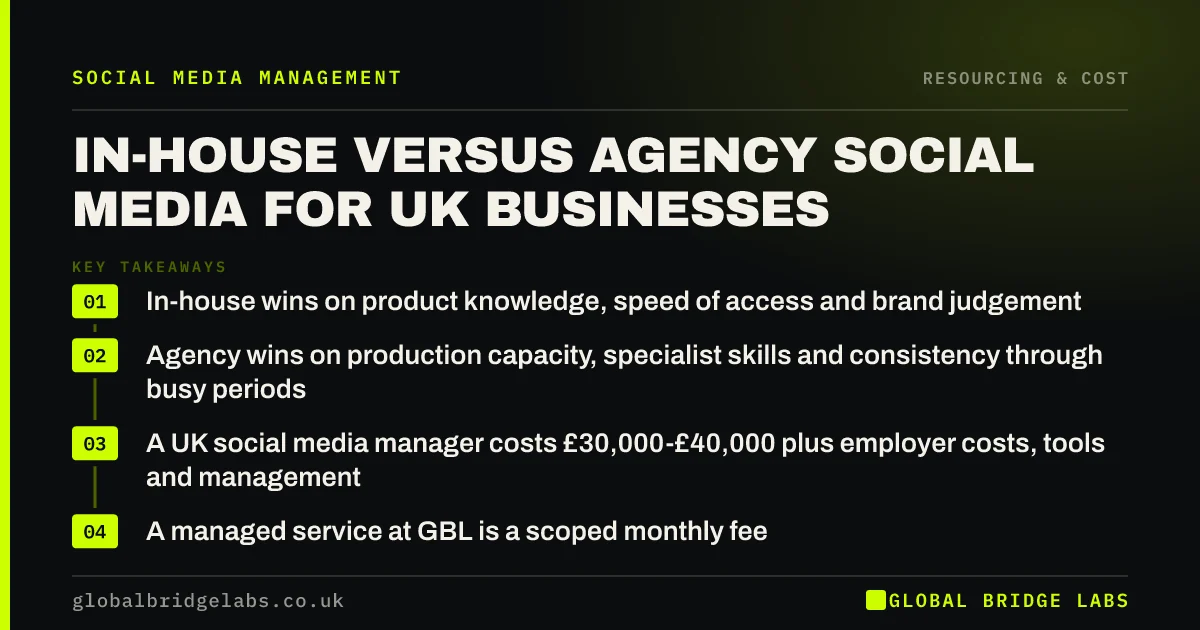
- In-house wins on product knowledge, speed of access and brand judgement.
- Agency wins on production capacity, specialist skills and consistency through busy periods.
- A UK social media manager costs £30,000-£40,000 plus employer costs, tools and management.
- A managed service at GBL is a scoped monthly fee, with no recruitment or cover risk.
- Hybrid: your voice and your access, their production and consistency.
Want the comparison run against your actual numbers? Message us on WhatsApp.
Chat on WhatsApp →What does in-house really cost?
More than the salary. A social media manager in the UK typically costs £30,000-£40,000 depending on experience and location, and the true cost is roughly 20-30% higher once employer National Insurance, pension, equipment, software and holiday cover are included.
Then add management time and recruitment cost, plus the risk that a single-person function stops entirely when that person leaves or is ill. For a small business, that concentration of risk is often the deciding factor rather than the money.
What does each model genuinely do better?
Be honest about both sides, because the failure mode is choosing on price and discovering the capability gap later.
- In-house: knows the product, can walk to the job, judges brand risk instinctively, available immediately.
- In-house: weaker on specialist skills, holiday cover, and staying current across platforms.
- Agency: production capacity, video and paid specialists, consistency through your busy periods.
- Agency: weaker on internal access, cannot photograph work nobody tells them about, needs a brief.
What does the hybrid look like in practice?
You own the strategy document, the brand voice guide and the approval of anything commercially sensitive. Your team supplies raw material: job photos, customer questions, the thing that happened this week.
The partner handles production, publishing, community management inside working hours, and reporting. The interface is a monthly planning call and a shared folder, and the whole thing takes two to three hours a month of your time.
- You own: goals, voice, approval of pricing and claims, supply of raw material.
- They own: production, publishing, community response, reporting.
- Shared: monthly planning, quarterly strategy review.
- Measured on: conversations, enquiries and cost per enquiry, not post counts.
We run this hybrid model with UK clients on a scoped monthly fee. Message us on WhatsApp for what it covers.
Chat on WhatsApp →When should you hire rather than outsource?
Three situations. When social media is your primary acquisition channel and volume justifies a full-time role. When the work requires constant physical presence, such as daily content from a venue or site. And when confidentiality genuinely prevents external access to the material.
If none of those apply, the hire is usually the more expensive route to the same outcome, and it carries the cover risk that a partner does not.
What makes outsourcing fail?
Almost always the same three things, and all of them are on the client side.
No supply of raw material, so the partner produces generic content. No named internal owner, so approvals stall. And measurement by post count, which lets a weak arrangement look busy for a year. Fix those three and the model works; leave them and no agency will succeed.
How do you transition between models without losing momentum?
Overlap by a month and move the documentation before you move the work. The transitions that fail are the ones where the outgoing party stops and the incoming one starts from nothing, which typically costs a quarter of momentum.
Transfer five things: the one-page strategy, the brand voice guide, the saved replies, the content bank and raw asset library, and the reporting history with its definitions. The last one matters more than people expect, because without it nobody can say whether the new arrangement is better or worse.
Keep publishing throughout at a reduced cadence rather than pausing. A visible gap during a handover is the one cost of the transition that your audience actually sees.
- One month of overlap, minimum.
- Transfer strategy, voice guide, saved replies, asset bank and reporting history.
- Move documentation before moving the work.
- Reduce cadence during transition rather than pausing.
What does a good working rhythm look like?
Three touchpoints a month, totalling around three hours of your time, is enough for a hybrid arrangement to work properly.
A monthly planning call of forty-five minutes covering what is coming up commercially and what material the business can supply. A fortnightly ten-minute check on anything topical or time-sensitive. And a monthly report with a decision, reviewed in fifteen minutes.
Between those, the interface is a shared folder and a single message thread. Arrangements that require more than this are usually compensating for an unclear strategy, and arrangements that require less almost always drift into generic content within a quarter.
- Monthly 45-minute planning call.
- Fortnightly 10-minute topical check.
- Monthly 15-minute report review with one decision.
- Shared folder and one message thread between calls.
Next step
The decision is about which hours you want to own, not about which model is better. Run the cost comparison honestly and the answer is usually obvious.
Message us on WhatsApp and we will run the in-house versus outsourced comparison for your business.
Chat on WhatsApp →Sources and further reading
- Employee earnings in the UK (Annual Survey of Hours and Earnings) · Office for National Statistics
- Business population estimates for the UK and regions 2025 · Department for Business and Trade
Frequently asked questions
Is it cheaper to hire or outsource social media?
A UK social media manager costs £30,000-£40,000 plus roughly 20-30% in employer costs, tools and cover. A managed service is a scoped monthly fee, usually well below the fully loaded cost of a hire. For most SMEs outsourcing production while keeping strategy in-house costs less and removes single-person risk.
What should stay in-house if we outsource social media?
Strategy, brand voice, approval of pricing and claims, and the supply of raw material from your work. Those depend on knowing your customers and having access to the business, which no external partner can replicate.
When should a business hire a social media manager?
When social is your main acquisition channel with volume to justify a full-time role, when content requires constant physical presence at a site or venue, or when confidentiality prevents external access to the material.
Why do social media outsourcing arrangements fail?
Usually on the client side: no supply of raw material from the business, no named internal owner so approvals stall, and measurement by post count rather than enquiries. Fix those three and most partnerships work.
Written by

Global Bridge Labs (GBL) is a UK–Sri Lanka partner for social media, websites and BPO. Everything here comes from client delivery, not theory.