On this page
- 01Key takeaways
- 02What is free about social media?
- 03What does the time cost?
- 04What other costs appear?
- 05Why is paid reach usually needed?
- 06What does the owner's time really cost?
- 07How does that compare with paying someone?
- 08Is it still cheaper than traditional advertising?
- 09When is 'free' social media a false economy?
- 10What does this look like in practice?
- 11Next step
- 12Sources and further reading
- 13Frequently asked questions
Key takeaways
Social media marketing is free to join and never free to do. The account costs nothing. The posts, replies, photos, tools and advert spend all cost time or money, and for most small firms the yearly total runs to thousands of pounds.
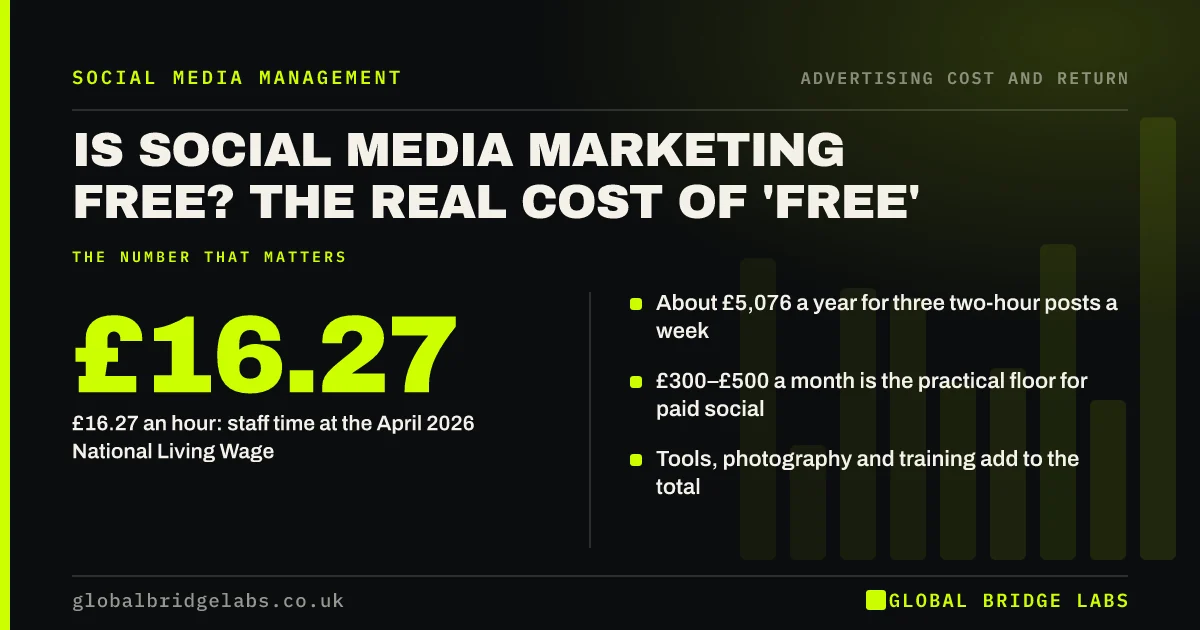
- £16.27 an hour: staff time at the April 2026 National Living Wage.
- About £5,076 a year for three two-hour posts a week.
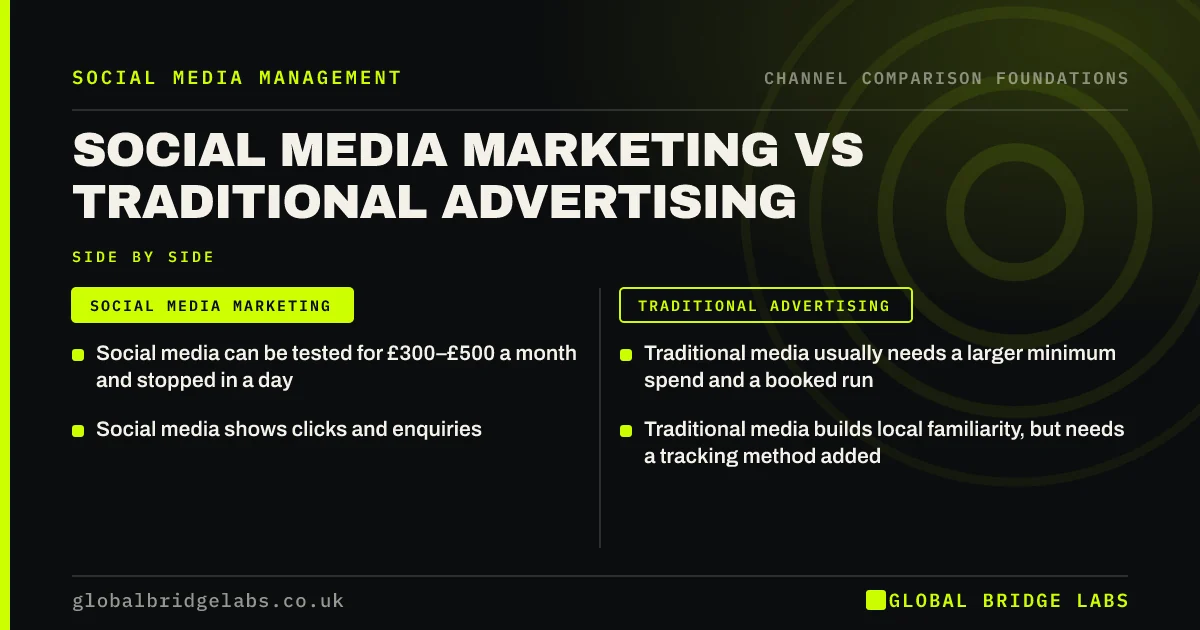
- £300–£500 a month is the practical floor for paid social.
- Tools, photography and training add to the total.
Want your real social media cost worked out? Message us on WhatsApp.
Chat on WhatsApp →What is free about social media?
Opening a business profile, posting, replying and reading basic statistics are free on the main platforms. That is a real advantage over traditional advertising, where nothing appears until you have paid. It is also why the true cost is so easy to overlook.
What does the time cost?
Time is the main cost. At the April 2026 National Living Wage of £12.71, an hour of staff time costs about £16.27 once employer National Insurance, pension and paid holiday are included. A post that takes two hours costs about £33. Three a week is 312 hours a year, or roughly £5,076.
What other costs appear?
Four other costs appear once social media is taken seriously.
- Content: photography, video and design.
- Tools: scheduling, editing and reporting software.
- Advert spend: to reach people beyond your followers.
- Training: keeping up as formats and rules change.
Why is paid reach usually needed?
Paid reach is usually needed because unpaid posts are shown mainly to a portion of your existing followers. To reach new households in your area, some advertising spend is the dependable route. A practical floor is £300–£500 a month, which is still below the entry cost of most traditional media.
What does the owner's time really cost?
If the owner does the posting, the true cost is what that hour would have earned elsewhere. An owner whose time is worth £40 an hour spends £160 on a four-hour week of social media. That is the opportunity cost, and it is why handing the work over can be cheaper than it looks.
How does that compare with paying someone?
Most UK SMEs that use an agency pay £950–£2,500 a month for managed social media. Set that against in-house hours at their real cost, plus tools and the cost of weeks when nothing gets posted. For some firms doing it themselves is cheaper. For many it only appears to be.
Want the two options costed side by side? Message us on WhatsApp and we will discuss your requirements.
Chat on WhatsApp →Is it still cheaper than traditional advertising?
Usually, yes, and it is more flexible. A leaflet drop to 5,000 homes costs roughly £300 to £750, and a local radio test several thousand pounds. Social media costs can be raised, lowered or paused weekly. The fair comparison is cost per enquiry in each.
When is 'free' social media a false economy?
It is a false economy when posting is irregular, when nobody replies to messages, or when the owner's best hours go into it. A neglected profile can put buyers off. If you cannot keep it up, a smaller presence done properly beats a large one done badly.
What does this look like in practice?
A pattern we see with owner-run accounts: social media is described as costing nothing, yet it takes most of a Sunday evening every week. Putting an hourly value on that time often changes the conversation from 'can we afford help?' to 'can we afford not to have it?'
Next step
Log the hours you and your team spend on social media for two weeks. Multiply by the real hourly cost and by 26 to get a yearly figure.
Message us on WhatsApp with the figure and we will show how it compares, or book a 30-minute consultation.
Chat on WhatsApp →Sources and further reading
- National Minimum Wage and National Living Wage rates · GOV.UK
- Rates and thresholds for employers 2026 to 2027 · HM Revenue & Customs
- Workplace pensions: what you, your employer and the government pay · GOV.UK
- Holiday entitlement · GOV.UK
- Meta Business Help Centre · Meta
Frequently asked questions
Is social media marketing free for businesses?
Creating a profile and posting are free. Doing it well is not. It takes staff or owner time every week, and most businesses also pay for content, tools and some advertising. Count the hours at their real cost to see the true figure.
How much does social media marketing cost per month?
Doing it in-house costs the hours involved, often £300 to £500 a month in staff time for regular posting. Most UK SMEs using an agency pay £950–£2,500 a month, with paid advertising of £300–£500 a month or more on top.
Can I grow a business on social media without paying for ads?
Yes, slowly. Good content, replies and reviews can build a local following without advert spend. Unpaid posts mostly reach existing followers, so growth beyond that circle is gradual. A modest advert budget speeds it up considerably.
What are the hidden costs of social media marketing?
The hidden costs are staff or owner time, photography and video, software, training, advertising spend and the business lost when an account goes quiet or messages go unanswered. Time is nearly always the largest. Log the hours for a fortnight and multiply by the real hourly cost to see it.
Written by

Global Bridge Labs (GBL) is a UK–Sri Lanka partner for social media, websites and BPO. Everything here comes from client delivery, not theory.