On this page
- 01The template, in nine lines
- 02Why does a one-page strategy beat a long one?
- 03What does a good answer look like on each line?
- 04Who should fill it in?
- 05How do you review it?
- 06What to leave out
- 07What do the nine lines look like filled in?
- 08What do you do when the strategy and reality diverge?
- 09Next step
- 10Sources and further reading
- 11Frequently asked questions
The template, in nine lines
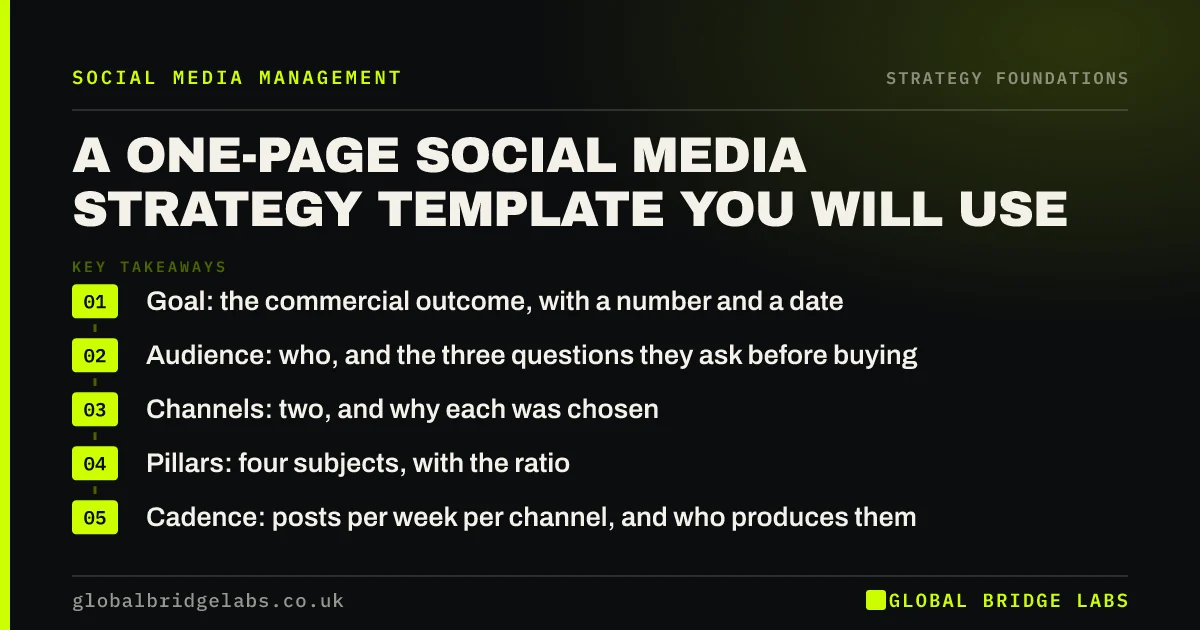
Copy these nine lines into a single document. If the answers do not fit on one page, they are not decisions yet.
- Goal: the commercial outcome, with a number and a date.
- Audience: who, and the three questions they ask before buying.
- Channels: two, and why each was chosen.
- Pillars: four subjects, with the ratio.
- Cadence: posts per week per channel, and who produces them.
- Owner: one named person and their protected hours.
- Budget: monthly figure split across production, tools and paid.
- KPIs: one leading, one lagging, with definitions.
- Review: the date of the next 90-day review, in the calendar now.
We will fill this in with you in 30 minutes. Message us on WhatsApp.
Chat on WhatsApp →Why does a one-page strategy beat a long one?
Because length is not the constraint, use is. A 30-page deck is presented once and never opened again, which means the decisions inside it are not available to the person writing posts three months later.
A one-page strategy can be pinned above a desk, sent to a freelancer, and read in two minutes by a new starter. That is what makes it operate rather than sit.
What does a good answer look like on each line?
The test for every line is whether it rules something out. A goal of grow brand awareness rules nothing out. A goal of 25 qualified enquiries a month from social by December rules out most of what you were going to do, which is exactly its value.
Same for channels. Instagram and LinkedIn is a list. Instagram, because our finished work is visual and buyers check it before calling, and LinkedIn, because facilities managers are there during the working day, is a decision with a reason attached, and it can be reviewed against evidence later.
Who should fill it in?
The person who owns the commercial number, with the person who will do the work in the room. Strategies written by one and executed by the other fail at the cadence line, because nobody who has actually produced content would sign up to five posts a week across four channels.
For a small business, that is usually the owner plus whoever will publish. It should take under an hour once the research exists.
How do you review it?
Quarterly, against the KPI lines only. The review asks three questions: did the number move, did we hold the cadence, and what did we learn about the audience?
If the cadence was not held, that is the finding. Judging content quality when only half the planned posts went out tells you nothing, and it is the most common way businesses wrongly conclude that a channel does not work for them.
- Cadence held and number moved: increase budget on what worked.
- Cadence held and number flat: change the offer or the destination, not the channel.
- Cadence missed: fix resourcing before judging anything else.
- Cadence held, reach fine, enquiries zero: the destination page is usually the problem.
Send us your filled-in page on WhatsApp and we will mark it up honestly, free.
Chat on WhatsApp →What to leave out
Leave out competitor analysis, persona documents, mood boards and platform feature lists. Those are inputs. They inform the nine lines, and then they go in a separate folder.
Also leave out anything you cannot resource. A strategy that includes a podcast you will never record is not ambitious, it is a document that has already been partly abandoned on the day it was written.
What do the nine lines look like filled in?
A worked example for a nine-person electrical contractor, so the level of specificity is clear.
Goal: 20 domestic enquiries a month from social by March. Audience: homeowners in three postcodes, aged 35 to 65, who have been let down by a contractor before and want an idea of price before they call. Channels: Facebook for local recommendation threads, Instagram for the visual proof people check before hiring.
Pillars: proof 40%, teaching 30%, people 20%, offer 10%. Cadence: three posts a week per channel, batched on the first Monday. Owner: the office manager, four protected hours a week. Budget: £400 paid, £60 tools, four hours of internal time. KPIs: conversations started weekly, enquiries tagged social monthly. Review: the first Friday of the new quarter.
Every line rules something out. That is the test, and it is why a short document is worth writing carefully.
What do you do when the strategy and reality diverge?
Change the document, do not quietly ignore it. A strategy that no longer describes what you are doing is worse than no strategy, because it gives everyone a shared reference that is misleading.
The common divergences are predictable: the cadence was set too high, the owner's protected hours never materialised, or a channel was added informally without anything being removed. Each of those is a resourcing decision that should be made openly and written down.
Update at the quarterly review, note what changed and why in two lines at the bottom, and keep the previous version. After a year that change log tells you more about your business than the current version does, because it records which assumptions kept being wrong.
- Update the document rather than drifting from it.
- Most divergence is cadence, owner hours or an unplanned channel.
- Record what changed and why, in two lines.
- Keep old versions. The change log is the most useful part after a year.
Next step
The nine lines take under an hour with someone who has asked the questions before, and they are the difference between a year of compounding work and a year of activity.
Message us on WhatsApp and we will complete the one-page strategy with you in 30 minutes.
Chat on WhatsApp →Sources and further reading
- Online Nation: how the UK uses online services · Ofcom
- Business population estimates · Department for Business and Trade
Frequently asked questions
What should be in a social media strategy document?
Nine things: goal, audience, channels, content pillars, cadence, owner, budget, KPIs and review date. Anything else is an input that informs those decisions rather than a decision itself, and it belongs in a separate research folder.
How long should a social media strategy take to write?
Under an hour, once the audience research exists. The time cost sits in the research and in agreeing the commercial goal internally. If writing the document itself takes days, the disagreement is about the goal, not about social media.
Should a small business strategy cover a year?
Set the goal annually and review the plan quarterly. Channel behaviour, formats and costs change too quickly for a fixed twelve-month plan, but changing the goal every quarter means nothing ever accumulates long enough to be judged.
Do I need a different strategy for each platform?
No. One strategy, with the cadence and format lines differing by channel. Separate strategies per platform is how businesses end up with two different brands and no shared view of whether any of it produced revenue.
Written by

Global Bridge Labs (GBL) is a UK–Sri Lanka partner for social media, websites and BPO. Everything here comes from client delivery, not theory.