On this page
- 01Key takeaways
- 02What is insourcing?
- 03When does insourcing make sense?
- 04What does insourcing cost?
- 05Does TUPE apply when you insource?
- 06How do you insource without losing service?
- 07Is partial insourcing an option?
- 08What are the signs insourcing is the wrong answer?
- 09What does this look like in practice?
- 10Insourcing checklist
- 11Next step
- 12Sources and further reading
- 13Frequently asked questions
Key takeaways
Insourcing vs outsourcing is the reverse decision: bringing outsourced work back in-house. It pays when volume has grown enough to keep an in-house team fully used, when the work has become core, or when a provider cannot meet the standard. Cost the move properly: recruitment, training, overlap and possible TUPE obligations.
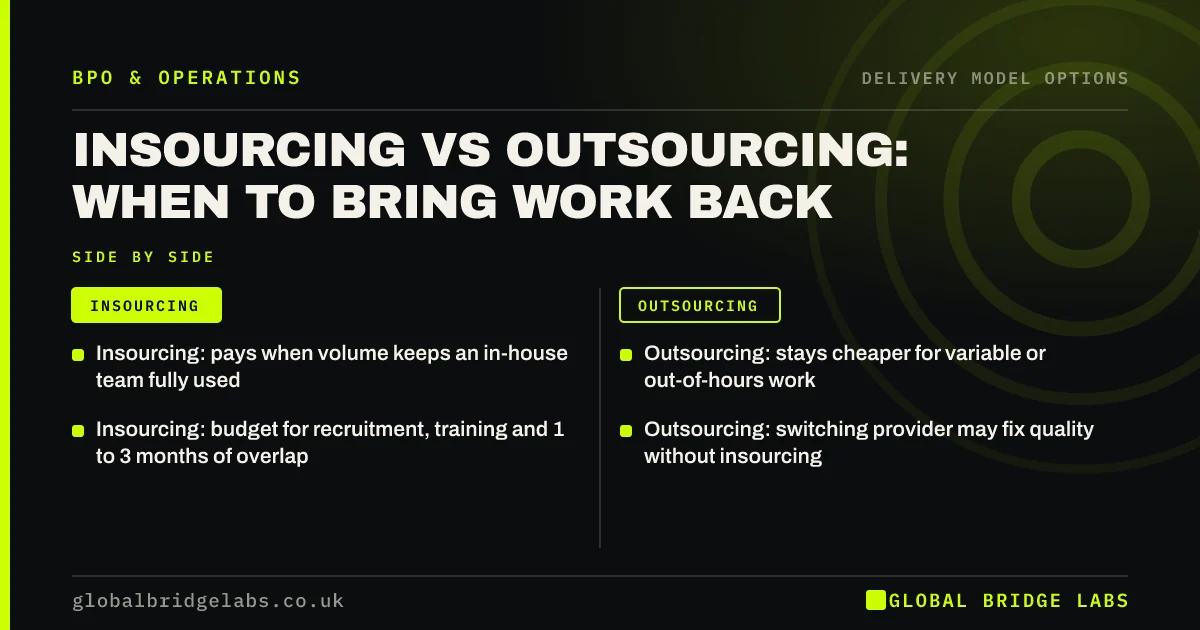
- Insourcing: pays when volume keeps an in-house team fully used.
- Outsourcing: stays cheaper for variable or out-of-hours work.
- Insourcing: budget for recruitment, training and 1 to 3 months of overlap.
- Outsourcing: switching provider may fix quality without insourcing.
Thinking of bringing work back in-house? Message us on WhatsApp for an honest view.
Chat on WhatsApp →What is insourcing?
Insourcing is moving work that was outsourced back to your own employees. It is the opposite of outsourcing and is decided on the same basis: which model delivers the work at the quality you need for the lowest total cost, with acceptable risk.
When does insourcing make sense?
Insource when volume has grown so that an in-house team would be fully used, when the work has become central to how you compete, or when you need tighter integration with other teams. Insourcing because of one bad provider is often a mistake; a better provider may fix it for less.
- Volume now fills full-time roles all year.
- The work has become a competitive advantage.
- It needs daily collaboration with in-house teams.
- Regulation or client contracts now require it.
What does insourcing cost?
Beyond ongoing employment costs, budget for recruitment, training, equipment and a period of overlap while the provider still runs the service. For a two-person team on £28,000 each, recruitment and training alone can cost about £11,000, and one to three months of overlap adds the provider's fee on top.
Want the cost of insourcing worked out? Send us the service and volumes on WhatsApp.
Chat on WhatsApp →Does TUPE apply when you insource?
It can. When a service moves from a provider back to you, the Transfer of Undertakings (Protection of Employment) Regulations (TUPE) may transfer employees in Great Britain who were assigned to that service to your employment. It does not usually apply to an offshore team employed abroad. Take advice early.
How do you insource without losing service?
Get the provider's process documentation, recruit and train before the notice period ends, run both in parallel for a few weeks, and move one part of the work at a time. Agree data return and account handover in writing.
Is partial insourcing an option?
Often the best one. Bring the core or complex part in-house and keep the provider for volume, peaks and out-of-hours. That captures most of the benefit of insourcing while keeping cover and flexibility.
What are the signs insourcing is the wrong answer?
If the frustration is about one provider's quality, response or attitude, the model may be fine and the provider wrong. If volume is still variable or needs extended hours, an in-house team will have idle time and gaps. And if nobody in-house has time to recruit, train and manage, insourcing will create a new problem.
What does this look like in practice?
A pattern we see in growing UK e-commerce brands: customer support volume doubles, and the brand hires an in-house team lead and two agents for weekday complex cases, keeping the managed team for weekends, peaks and routine tickets. Cost per contact stays low and knowledge builds in-house.
Insourcing checklist
Answer these before bringing work back.
- Would the in-house team be fully used all year?
- Is the problem the model or the provider?
- Have you costed recruitment, training and overlap?
- Does TUPE apply to any UK staff?
- Do you have the process documentation?
- Could partial insourcing work better?
Next step
Tell us what you are thinking of bringing back. We will compare insourcing, partial insourcing and switching provider in a 30-minute call.
Message us on WhatsApp for an insourcing comparison, or book a 30-minute consultation.
Chat on WhatsApp →Sources and further reading
- Business transfers, takeovers and TUPE · GOV.UK
- Employment contracts and conditions: notice periods · GOV.UK
- Rates and thresholds for employers 2026 to 2027 · HM Revenue & Customs
Frequently asked questions
When should you bring outsourced work back in-house?
When volume keeps an in-house team fully used all year, when the work has become a competitive advantage, or when it needs daily collaboration with other teams or regulation requires it. If the issue is one provider's quality, switching provider may be cheaper and faster.
Does TUPE apply to insourcing?
It can. When a service moves back in-house, employees in Great Britain who were assigned to that service may transfer to your employment under TUPE. It does not usually apply to offshore staff employed abroad. Take employment advice early in the planning.
What does it cost to insource?
Ongoing employment costs plus recruitment, training, equipment and an overlap period with the provider while your team learns. For a two-person team on £28,000 each, recruitment and training alone can cost around £11,000 before any overlap fees are counted. Plan the budget before giving notice.
How long does insourcing take?
Usually two to four months: recruiting and training the in-house team, then running both in parallel for a few weeks before the provider's notice ends. Complex or regulated work can take longer. Start recruiting before giving notice so there is no gap in service.
Written by

Global Bridge Labs (GBL) is a UK–Sri Lanka partner for social media, websites and BPO. Everything here comes from client delivery, not theory.