On this page
- 01Key takeaways
- 02Do most visitors start on the homepage?
- 03Do buyers move through the journey in a straight line?
- 04Do you need detailed personas for every customer type?
- 05Is journey mapping only for large companies?
- 06Does a better design fix a broken journey?
- 07Does the journey end when the customer buys?
- 08Which customer journey beliefs are actually true?
- 09What does this look like in practice?
- 10Myth-check checklist
- 11Next step
- 12Sources and further reading
- 13Frequently asked questions
Key takeaways
Customer journey myths lead businesses to build the wrong website: a perfect homepage nobody sees, a straight funnel buyers never follow, or a stack of personas nobody uses. The truth is simpler. Most buyers start on inner pages, loop back and forth, and want plain answers. A small amount of real customer research beats a large amount of theory.
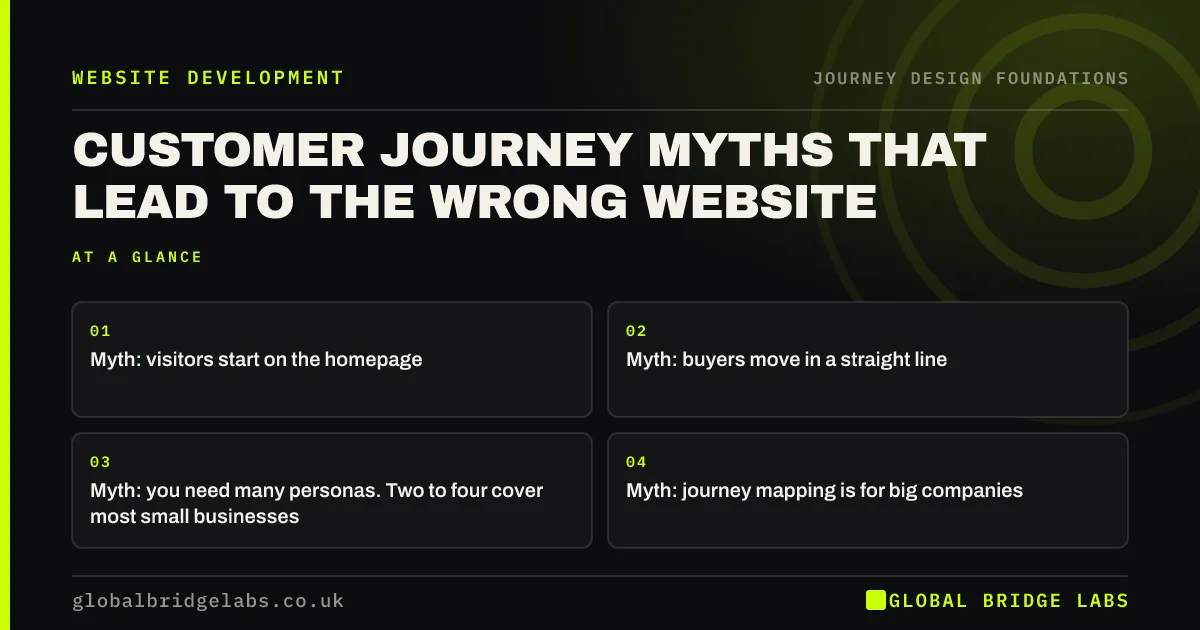
- Myth: visitors start on the homepage. Most land on inner pages.
- Myth: buyers move in a straight line. They loop between research and comparison.
- Myth: you need many personas. Two to four cover most small businesses.
- Myth: journey mapping is for big companies. One day is enough for a small one.
Want to check which assumptions your website rests on? Ask us on WhatsApp.
Chat on WhatsApp →Do most visitors start on the homepage?
No. On most small business sites, a large share of visitors land on inner pages: service pages and articles from search, posts linked from social media, and pages shared in messages. The homepage is one entry point among many. Check GA4's landing pages report; it often shows the homepage receiving well under half of first visits.
Do buyers move through the journey in a straight line?
No. Buyers loop. Google's research on what it called the messy middle described people moving back and forth between exploring options and evaluating them until something tips them into buying. A buyer can read your guide, check a competitor, come back to your pricing a week later on a laptop, then phone. Design each page so a returning buyer can pick up where they left off.
Do you need detailed personas for every customer type?
No. Personas are useful when they are based on research and few enough to remember. Nielsen Norman Group describes a persona as a fictional yet realistic description of a typical or target user, and stresses that it must be based on user research. Invented personas with names, hobbies and stock photos often add nothing. Two to four research-based customer types cover most small businesses.
Is journey mapping only for large companies?
No. Large companies run long mapping programmes because they have many products and channels. A small business has fewer buyer types and a shorter journey, so mapping is faster: a week of interviews and inbox reading, and one day to build the map. The return is often higher, because each lost enquiry matters more.
Does a better design fix a broken journey?
Not on its own. A new visual design on the same structure, with the same missing answers and the same long form, usually produces the same results. Journey problems are mostly about content, routes and follow-up: whether the page answers the buyer's question and shows the next step. Fix those first; restyle second.
Does the journey end when the customer buys?
No. The journey continues through confirmation, delivery, support, re-ordering and referral. For many small businesses, repeat customers and referrals are the largest source of work. A site that ignores existing customers forces them to phone for basics and makes it harder for them to recommend you.
Which customer journey beliefs are actually true?
Some popular ideas hold up. Buyers do judge quickly: NN/g research found visitors often leave a page within 10 to 20 seconds unless it shows clear value. Answering questions before buyers ask them does reduce effort. And a few real conversations reveal most of the gaps: NN/g's finding that five users reveal about 85% of usability problems is a useful guide for research effort too.
What does this look like in practice?
A pattern we see in redesign briefs: most of the budget goes on the homepage, because everyone assumes it is the front door. GA4 then shows most visitors arriving on four service pages and two articles, none of which had been rewritten.
Moving effort to the pages people actually land on, and giving each one a next step, changes results more than the homepage could. Across our client work we have seen a 2.4x enquiry rate from conversion changes of this kind. Global Bridge Labs (GBL) checks the landing pages report before the brief is signed.
Myth-check checklist
- Check what share of visits land on the homepage.
- Check how many enquiries come after more than one visit.
- Count how many personas you actually use in decisions.
- List the questions buyers still phone to ask.
- Check whether existing customers have anything on the site.
- Test one assumption with five customer conversations.
Next step
Most website projects rest on two or three untested beliefs about customers. We will help you test them against your data before you spend.
Message us on WhatsApp to test your customer journey assumptions, or book a 30-minute consultation.
Chat on WhatsApp →Sources and further reading
- Personas make users memorable for product team members · Nielsen Norman Group
- How long do users stay on web pages? · Nielsen Norman Group
- Why you only need to test with 5 users · Nielsen Norman Group
Frequently asked questions
Is the customer journey linear?
Rarely. Buyers move back and forth between researching and comparing, switch devices and return days later. Google's research described this as the messy middle. Design pages so buyers can enter at any point and find the next step, rather than assuming a fixed sequence.
Do small businesses need customer journey maps?
Most benefit from a simple one. A small business has fewer buyer types and a shorter journey, so a map takes about a day after a week of interviews and inbox reading. The value is in spotting the steps where buyers drop out and fixing them on the website.
How many personas should a small business have?
Two to four is enough for most small businesses, each based on real customer research rather than invention. More than that tends to go unused. Group buyers by what they are trying to get done and what they need to know, not by demographics.
Written by

Global Bridge Labs (GBL) is a UK–Sri Lanka partner for social media, websites and BPO. Everything here comes from client delivery, not theory.