On this page
- 01Key takeaways
- 02How much time does a website redesign take from you?
- 03Where do the hours go?
- 04Why does content take so long?
- 05How do you reduce your time without slowing the project?
- 06What happens when the client side is late?
- 07When should you not start a redesign?
- 08Which tasks can be delegated?
- 09What does this look like in practice?
- 10Owner time checklist
- 11Next step
- 12Sources and further reading
- 13Frequently asked questions
Key takeaways
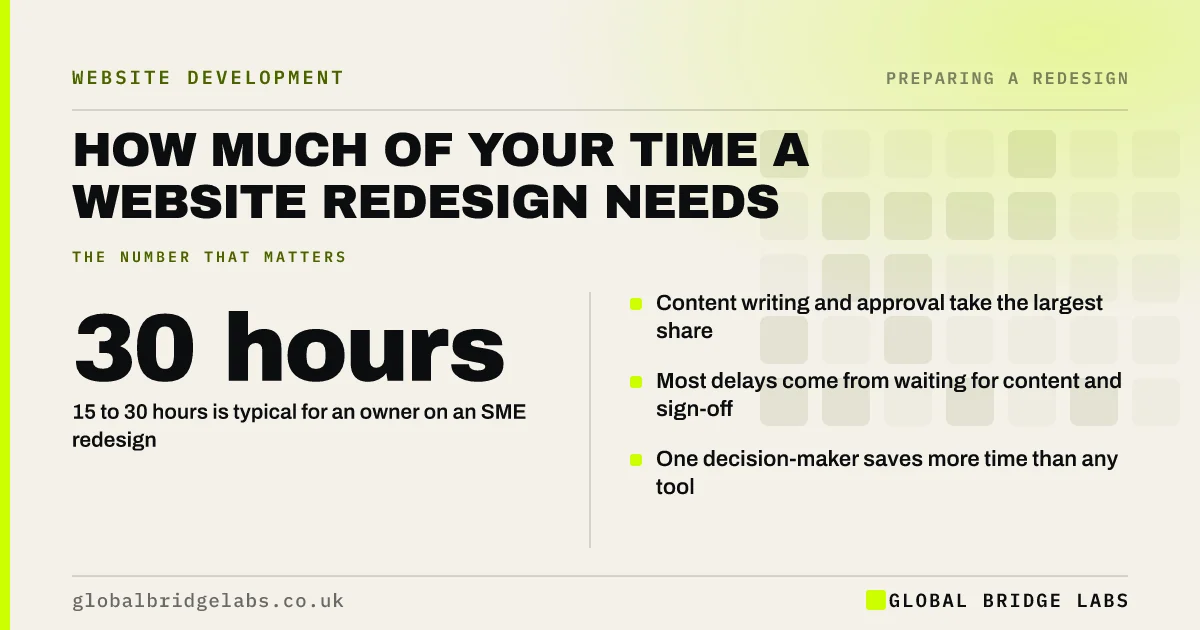
A small business owner typically spends 15 to 30 hours over a redesign: workshops, content, photography, reviews and testing. Content takes the most time. Named deadlines for your own tasks keep the project on schedule; most redesign delays come from the client side, not the supplier.
- 15 to 30 hours is typical for an owner on an SME redesign.
- Content writing and approval take the largest share.
- Most delays come from waiting for content and sign-off.
- One decision-maker saves more time than any tool.
Want to know how much time your redesign will need? Ask us on WhatsApp.
Chat on WhatsApp →How much time does a website redesign take from you?
For a typical UK small business redesign, the owner or lead contact spends around 15 to 30 hours across two to four months. That covers the kick-off, providing content and photos, reviewing designs and pages, and testing before launch. More if you write all the content yourself.
Where do the hours go?
These are typical ranges from our delivery work on small business sites.
- Kick-off and goal setting: 2 to 3 hours.
- Content: writing or reviewing, 6 to 15 hours.
- Photos, case studies and proof gathering: 2 to 5 hours.
- Design and page reviews: 3 to 5 hours.
- Testing and launch checks: 2 to 3 hours.
Want a time plan for your team? We will map it with you on WhatsApp.
Chat on WhatsApp →Why does content take so long?
Because it needs decisions: what you offer, for whom, at what price, with what proof. Writing reveals those questions, and answering them takes time. Owners who outsource copywriting still need to supply knowledge and approve drafts, typically 4 to 8 hours.
How do you reduce your time without slowing the project?
Prepare before it starts and decide quickly during it.
- Answer the planning questions before kick-off.
- Gather photos, reviews and case studies in advance.
- Name one decision-maker with authority to approve.
- Block review time in the diary at agreed dates.
- Give consolidated feedback, not a stream of emails.
What happens when the client side is late?
The launch slips, sometimes into peak season, and the supplier's team moves to other work, adding further delay. Agree dates for your own deliverables in the project plan, just as you would expect the supplier to meet theirs.
When should you not start a redesign?
When nobody can give it the time over the next three months. A redesign started in a busy period drifts, costs more and launches with weaker content. It is better to wait for a quieter window or phase the work.
Which tasks can be delegated?
Gathering photos, reviews and case study details, testing forms and pages, and coordinating feedback can all be delegated to a capable team member. Setting goals, approving the message and signing off pricing guidance usually cannot, because they are business decisions.
Delegating the practical tasks can halve the owner's time. The key is a single coordinator who collects feedback from everyone and sends it to the supplier in one consolidated message, so the owner reviews a short list of decisions rather than every detail.
- Delegate: photos, reviews, case study details.
- Delegate: testing and feedback coordination.
- Keep: goals, message and pricing decisions.
- Use one coordinator for all feedback.
What does this look like in practice?
A pattern in UK professional services: design is finished in six weeks, then the project waits three months for partners to approve service page copy. Naming one partner as approver with a two-week deadline per batch would have launched the site a quarter earlier.
Owner time checklist
Set these up before kick-off.
- Block 15 to 30 hours across the project in the diary.
- Name one decision-maker.
- Decide who writes content.
- Gather photos and proof in advance.
- Agree deadlines for your own deliverables.
- Consolidate feedback into single rounds.
Next step
If you are worried about the time a redesign will take, we will plan your part of it with you in 30 minutes.
Message us on WhatsApp for a redesign time plan, or book a 30-minute consultation.
Chat on WhatsApp →Sources and further reading
- Writing to GOV.UK standards: writing guidelines · GOV.UK
- User research · GOV.UK Service Manual
- The Sourcing and Consultancy Playbooks · Cabinet Office
Frequently asked questions
How much time does a website redesign take for the client?
Typically 15 to 30 hours for the owner or lead contact on a small business redesign, spread over two to four months. Writing all the content yourself adds more. Content, reviews and gathering proof take most of the time. Plan the time in the diary before the project starts.
Why do website projects get delayed?
Most often because content and approvals arrive late, several people give conflicting feedback, or scope grows during the project. Naming one decision-maker and agreeing deadlines for client deliverables prevents most delays. Put client deadlines in the project plan. Review progress against them weekly.
Can the web designer write the content for me?
Many suppliers offer copywriting, but they still need your knowledge of services, buyers, pricing and proof, and your approval. Expect to spend several hours in interviews and reviews even when content is outsourced. Allow time for review rounds too. Book the review sessions in advance.
How can I make my website redesign go faster?
Answer planning questions before kick-off, gather photos and case studies in advance, name one decision-maker, block review time in the diary and give consolidated feedback. Being ready on the client side is the biggest speed factor. Preparation saves more time than any tool.
Written by

Global Bridge Labs (GBL) is a UK–Sri Lanka partner for social media, websites and BPO. Everything here comes from client delivery, not theory.