On this page
- 01Key takeaways
- 02Why does sample size matter?
- 03How much traffic do you need?
- 04What should low-traffic sites do instead?
- 05What are the common testing mistakes?
- 06When is testing worth it for a small business?
- 07What does this look like in practice?
- 08Testing checklist
- 09Next step
- 10Sources and further reading
- 11Frequently asked questions
Key takeaways
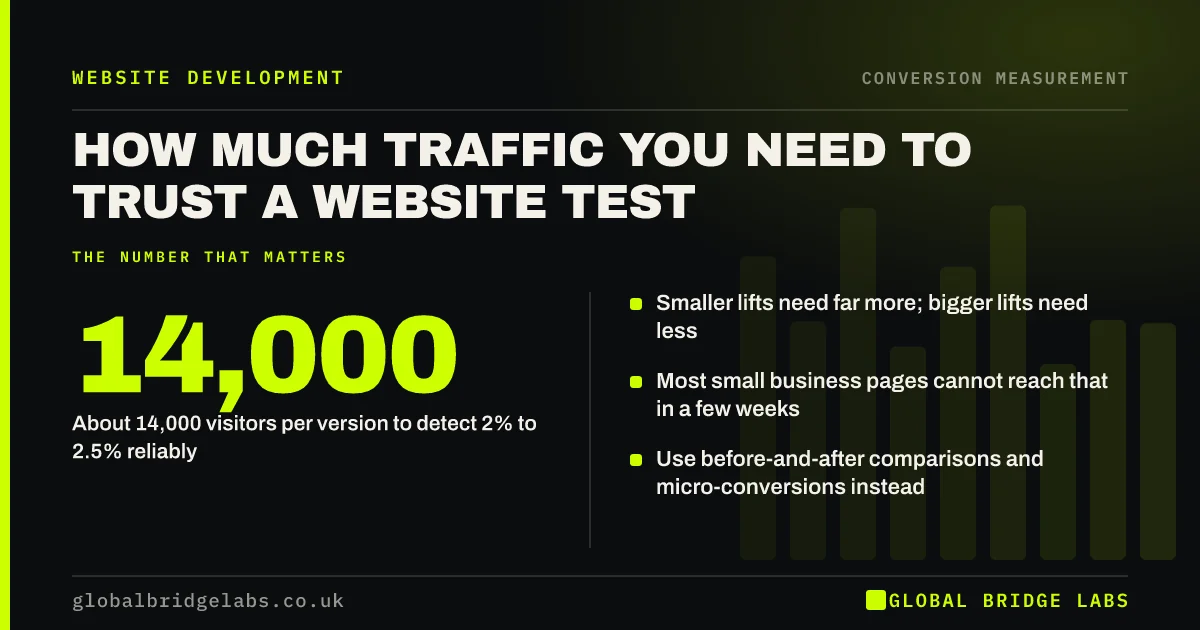
Trusting a website test needs far more traffic than most owners expect. To detect a lift from 2% to 2.5% conversion with standard confidence, you need roughly 14,000 visitors per version. Most small business pages do not get that in a reasonable time, so they should fix clear problems directly and compare periods carefully instead of running A/B tests.
- About 14,000 visitors per version to detect 2% to 2.5% reliably.
- Smaller lifts need far more; bigger lifts need less.
- Most small business pages cannot reach that in a few weeks.
- Use before-and-after comparisons and micro-conversions instead.
Not sure if your traffic supports testing? Ask us on WhatsApp.
Chat on WhatsApp →Why does sample size matter?
Conversion numbers bounce around naturally. With 30 enquiries a month, a 'good' month and a 'bad' month can differ by a third with nothing changed. A test needs enough visitors that a real difference stands out from that noise. Without it, you will declare winners that are really luck, and make decisions that quietly hurt the site.
How much traffic do you need?
The required sample depends on your current conversion rate and the size of lift you want to detect. Free tools such as Evan Miller's sample size calculator give the figure for standard settings (95% confidence, 80% power). These approximate examples show the scale.
- 2% baseline, detect a 25% relative lift (to 2.5%): about 14,000 visitors per version.
- 2% baseline, detect a 50% relative lift (to 3%): about 3,800 visitors per version.
- 5% baseline, detect a 20% relative lift (to 6%): about 8,000 visitors per version.
- Two versions means double the total traffic.
What should low-traffic sites do instead?
Fix clear problems without testing, because a broken form or missing price does not need proof. For judgement calls, compare periods: the eight weeks after a change against the same eight weeks last year and the eight weeks before. Watch micro-conversions for earlier signals, and change one area at a time so you know what caused any movement.
- Fix obvious problems directly.
- Compare equal periods, allowing for seasonality.
- Change one area at a time.
- Track micro-conversions for earlier signals.
- Use user testing to understand why, not just whether.
Want a measurement plan for your next change? Message us on WhatsApp.
Chat on WhatsApp →What are the common testing mistakes?
The most common mistake is stopping a test as soon as one version looks ahead. Early leads often vanish. Others include testing several changes at once, running tests across seasonal swings, and measuring clicks rather than enquiries. Google also advises keeping tests temporary and using proper redirects or canonical tags so search is not affected.
When is testing worth it for a small business?
Testing is worth it on your busiest pages, such as a homepage or main paid landing page with tens of thousands of visits a month, and for close decisions where either version could plausibly win. It also works for bold changes, where the expected difference is large enough to detect with less traffic.
What does this look like in practice?
A UK tradesperson ran an A/B test on a page with 600 visits a month and declared a winner after two weeks. The 'winning' version was rolled out and enquiries fell the following month. With that traffic, the test would have needed well over a year to be reliable. We switched to fixing clear issues and comparing quarters, and enquiries recovered.
Testing checklist
- Check the page's monthly traffic and conversion rate.
- Use a sample size calculator before starting.
- Only test if you can reach the sample in 4 to 8 weeks.
- Decide the sample and end date in advance; do not stop early.
- Measure enquiries, not clicks.
- Otherwise, fix clear issues and compare equal periods.
Next step
Testing is powerful when the traffic supports it and misleading when it does not. We can tell you which of your pages can be tested and how to measure the rest.
Message us on WhatsApp for a testing and measurement plan, or book a 30-minute consultation.
Chat on WhatsApp →Sources and further reading
- Sample size calculator for A/B tests · Evan Miller
- Minimise A/B testing impact in Google Search · Google Search Central
- User research · GOV.UK Service Manual
Frequently asked questions
How much traffic do I need for an A/B test?
It depends on your conversion rate and the lift you want to detect. To detect a rise from 2% to 2.5% with standard settings, you need about 14,000 visitors per version. Use a sample size calculator before starting. Bigger expected lifts need less traffic.
Can small businesses do A/B testing?
Only on pages with enough traffic, usually thousands of visits a week, or for bold changes with large expected effects. Most small business pages are better improved by fixing clear problems and comparing equal time periods. Use user testing to learn why visitors hesitate.
How long should a website test run?
Until it reaches the sample size calculated in advance, and for at least one or two full weeks to cover weekday patterns. Do not stop early because one version looks ahead, as early leads often disappear. Set the end date before you start.
What is statistical significance in website testing?
It is a measure of how unlikely a result would be if there were no real difference between versions. A 95% significance level is common. It does not guarantee the result is real, especially if the test was stopped early or run with too little traffic.
Written by

Global Bridge Labs (GBL) is a UK–Sri Lanka partner for social media, websites and BPO. Everything here comes from client delivery, not theory.