On this page
- 01Key takeaways
- 02Which website improvements are quickest?
- 03What are the top ten quick wins?
- 04How do you know which to do first?
- 05How do you measure whether they worked?
- 06When are quick wins not enough?
- 07What are the risks of quick fixes?
- 08Who should make the changes?
- 09What does this look like in practice?
- 10Quick wins checklist
- 11Next step
- 12Sources and further reading
- 13Frequently asked questions
Key takeaways
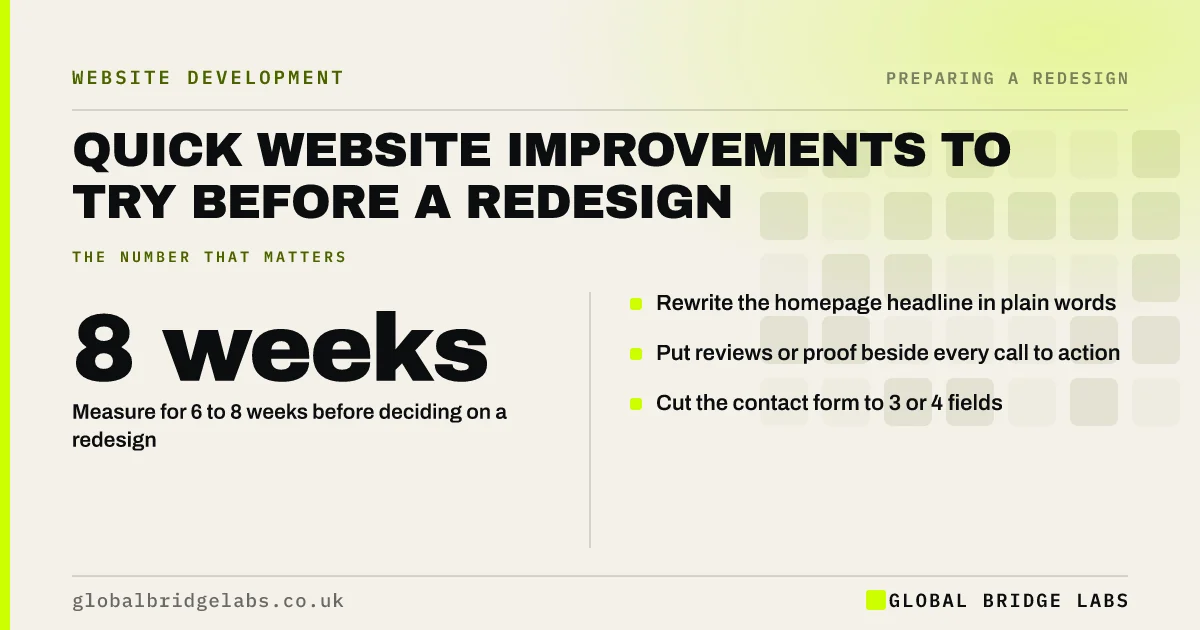
Before paying for a redesign, try the fixes that take days: a plain homepage headline, proof beside every call to action, a shorter form, tappable phone and WhatsApp links, compressed images and enquiry tracking. Measure for 6 to 8 weeks. If enquiries rise, the redesign can wait; if not, you have evidence for it.
- Rewrite the homepage headline in plain words.
- Put reviews or proof beside every call to action.
- Cut the contact form to 3 or 4 fields.
- Measure for 6 to 8 weeks before deciding on a redesign.
Want the quick wins listed for your site? Send us the URL on WhatsApp.
Chat on WhatsApp →Which website improvements are quickest?
The quickest website improvements change words, proof, forms, contact routes, images and tracking, because none of them needs a new design or platform. On most small business sites they can be done in a few days and typically cost £500 to £3,000 in the UK market if a supplier does them.
What are the top ten quick wins?
In order of typical impact on enquiries.
- 1. Homepage headline: what you do, for whom, where.
- 2. One clear call to action on every page.
- 3. Reviews or proof beside each call to action.
- 4. Contact form cut to 3 or 4 fields.
- 5. Tappable phone number and WhatsApp link on mobile.
- 6. Pricing guidance on service pages.
- 7. Compressed images and removed sliders.
- 8. Current photos of your team and work.
- 9. Outdated content removed or updated.
- 10. Enquiry tracking for forms, calls and WhatsApp.
Want us to prioritise these for your site? Ask us on WhatsApp.
Chat on WhatsApp →How do you know which to do first?
Start where most visitors land. Check your top landing pages in GA4 and Search Console, and apply the fixes there first. A better homepage and top three service pages usually cover most of the traffic that leads to enquiries.
How do you measure whether they worked?
Record a baseline before the changes, then compare qualified enquiries and enquiry rate for 6 to 8 weeks afterwards against the same weeks last year. Make changes in a batch with a clear date so the comparison is clean.
When are quick wins not enough?
When the fixes cannot be made because of the platform, such as locked forms or templates that cannot show a clear headline on mobile, or when they are made and enquiries do not move. Either way, you now have evidence for a redesign or rebuild.
What are the risks of quick fixes?
Few, if done carefully. Avoid changing URLs, removing ranking content or installing more plugins for each fix. Test forms and tracking after every change.
Who should make the changes?
Whoever can do them fastest and safely. Headline, proof and content changes can often be made by the owner in the site editor. Form changes, tracking, image optimisation and removing scripts are usually quicker and safer with a developer, especially on a live site that takes enquiries.
Batch the changes into one short piece of work with a clear date. That keeps the cost down, makes the before-and-after comparison clean, and avoids a trickle of small edits that nobody can measure.
- Owner: headline, proof, content and photos.
- Developer: forms, tracking, speed and scripts.
- Batch changes into one dated piece of work.
- Measure the batch as a whole.
What does this look like in practice?
A pattern in UK trades: a firm about to spend on a redesign tries a new headline, reviews beside the form, a four-field form and a WhatsApp button first. Enquiries rise over the following two months, and the redesign is moved to next year with a clearer brief.
Quick wins checklist
Complete in one or two weeks.
- Record a baseline.
- Rewrite the homepage headline.
- Add proof beside every call to action.
- Shorten the form and add WhatsApp.
- Compress images and remove sliders.
- Compare enquiries after 6 to 8 weeks.
Next step
If you want to try quick wins before a redesign, we will list the ten for your site in a 30-minute call, in order of impact.
Message us on WhatsApp for your quick wins list, or book a 30-minute consultation.
Chat on WhatsApp →Sources and further reading
- About key events · Google Analytics Help
- How to use click to chat · WhatsApp Help Center
- Structuring forms · GOV.UK Service Manual
Frequently asked questions
How can I improve my website without redesigning it?
Rewrite the homepage headline in plain words, add proof beside calls to action, shorten the contact form, add tappable phone and WhatsApp links, show pricing guidance, compress images, update content and set up enquiry tracking. Start with the pages most visitors land on.
What is the quickest way to get more enquiries from my website?
Usually a clearer homepage headline, proof beside the call to action and a shorter contact form with phone and WhatsApp alternatives. These changes address the most common reasons visitors hesitate and can be done in days. Make sure every enquiry route is tracked.
How long should I wait to see results from website changes?
Measure for 6 to 8 weeks, comparing with the same weeks last year to account for seasonality. Low-traffic sites may need longer to see a clear pattern. Record the date of each change so the comparison is clean. Keep other changes to a minimum meanwhile.
When should I redesign instead of making small fixes?
When the platform prevents the fixes, or when the fixes are made and enquiries still do not improve after a fair test. At that point the evidence supports a redesign or rebuild, and you have a clearer brief for it.
Written by

Global Bridge Labs (GBL) is a UK–Sri Lanka partner for social media, websites and BPO. Everything here comes from client delivery, not theory.