On this page
- 01Key takeaways
- 02Why do website changes get prioritised badly?
- 03How do you score website changes?
- 04What always goes first?
- 05Where do good ideas come from?
- 06What are the limits of scoring?
- 07What does this look like in practice?
- 08Prioritisation checklist
- 09Next step
- 10Sources and further reading
- 11Frequently asked questions
Key takeaways
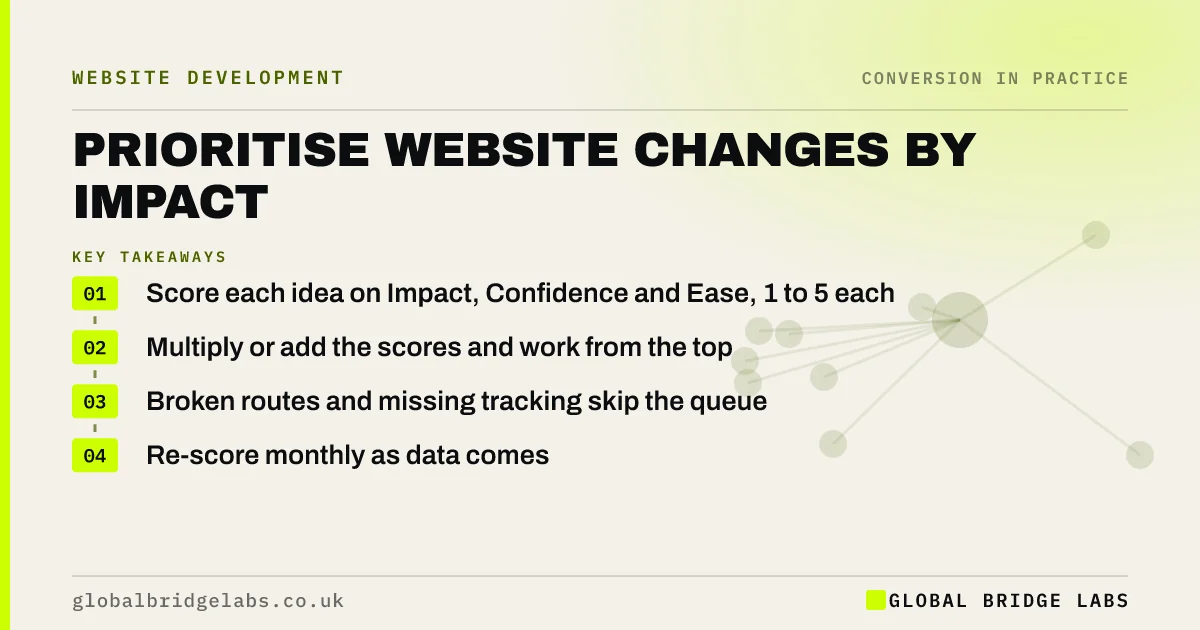
Prioritising website changes by impact means ranking every idea by how many enquiries it could affect, how confident you are it will help, and how easy it is to do. It stops the loudest opinion or latest trend deciding what gets built. Broken routes and missing tracking always go first; after that, the score decides.
- Score each idea on Impact, Confidence and Ease, 1 to 5 each.
- Multiply or add the scores and work from the top.
- Broken routes and missing tracking skip the queue.
- Re-score monthly as data comes in.
Want your website to-do list ranked? Send it to us on WhatsApp.
Chat on WhatsApp →Why do website changes get prioritised badly?
Most small business websites are changed by whoever asks loudest: a director who dislikes the colour, a salesperson who wants a new page, an agency recommending a feature. None of those requests are wrong, but without a method, visible cosmetic changes crowd out the unglamorous fixes that actually raise enquiries.
How do you score website changes?
A simple method is ICE scoring: Impact, Confidence and Ease, each scored 1 to 5.
- Impact: how many visitors or enquiries does this affect? A top landing page scores higher than a rarely visited page.
- Confidence: how sure are you it will help? Evidence from data, surveys or sales calls scores higher than a hunch.
- Ease: how quickly and cheaply can it be done? A copy change scores higher than a new feature.
- Total: multiply the three (or add them) and rank.
Want a ready-made scoring sheet? Ask us on WhatsApp.
Chat on WhatsApp →What always goes first?
Some changes skip the scoring because the cost of waiting is obvious: broken forms, failing checkouts, missing tracking, incorrect prices or phone numbers, security problems and anything with legal risk. Fix these immediately, then score everything else.
Where do good ideas come from?
The best-scoring ideas usually come from evidence: a conversion audit, the funnel's biggest drop, on-site survey answers, recordings, sales team objections and lost-deal reasons. Collect ideas in one list with their source, so confidence scores reflect real evidence.
What are the limits of scoring?
Scores are estimates and can be gamed. Keep them honest by writing down the evidence behind each confidence score and reviewing results after each change. Occasionally a low-scoring strategic change, such as a new service page for a planned market, is right anyway. Make those exceptions consciously.
What does this look like in practice?
A UK training provider had a website list of 34 items, from a new colour scheme to a course finder. ICE scoring put five items at the top: fixing an untracked booking form, adding dates and prices to the top three course pages, and shortening the enquiry form. All five were done in a month. The colour scheme scored last and was never missed.
Prioritisation checklist
- Collect all website ideas in one list with their source.
- Fix broken routes, tracking and legal issues immediately.
- Score the rest on Impact, Confidence and Ease.
- Work from the top; change one area at a time.
- Record results and re-score monthly.
- Make strategic exceptions consciously.
Next step
A ranked list turns website arguments into decisions. We can score your current list with you and show which changes are likely to move enquiries.
Message us on WhatsApp for a prioritised website plan, or book a 30-minute consultation.
Chat on WhatsApp →Sources and further reading
- About key events · Google Analytics Help
- User research · GOV.UK Service Manual
- About Microsoft Clarity (heatmaps and session recordings) · Microsoft
Frequently asked questions
How do I prioritise website improvements?
Fix broken routes, tracking and legal issues first. Then score every other idea on Impact, Confidence and Ease from 1 to 5, rank them, and work from the top. Re-score monthly as results come in. Write down the evidence behind each confidence score so the ranking stays honest.
What is ICE scoring?
ICE scoring ranks ideas by Impact (how much it could help), Confidence (how sure you are) and Ease (how simple it is). Multiplying or adding the three gives a score that helps teams agree priorities without relying on opinion. Score each factor from 1 to 5.
What website changes have the biggest impact?
Usually fixes on the busiest landing pages: clearer headlines, proof beside calls to action, price guidance, shorter forms and working, tracked enquiry routes. Cosmetic changes rarely move enquiries as much. Fix broken routes and tracking first, because they cost enquiries every day and need no further evidence to justify.
How do I stop website decisions being based on opinion?
Collect ideas with their evidence, score them openly, and agree that the score decides unless a conscious strategic exception is made. Reviewing the results of each change builds trust in the method. Name one decision owner who has the final say when scores are close.
Written by

Global Bridge Labs (GBL) is a UK–Sri Lanka partner for social media, websites and BPO. Everything here comes from client delivery, not theory.