On this page
- 01Key takeaways
- 02Why do trades businesses stall?
- 03What has to be hired?
- 04What can be supplied without an office?
- 05How do you standardise quoting?
- 06What does office capacity cost?
- 07When do you need an office manager?
- 08What does this look like in practice?
- 09Trades scaling checklist
- 10Next step
- 11Sources and further reading
- 12Frequently asked questions
Key takeaways
To scale a trades business, remove the owner as the bottleneck for calls, quotes and invoices. Skilled people on site are the product and must be hired. Everything around them can be supplied without building an office: a managed team answers and books, prepares quotes from a price guide, and invoices on completion.
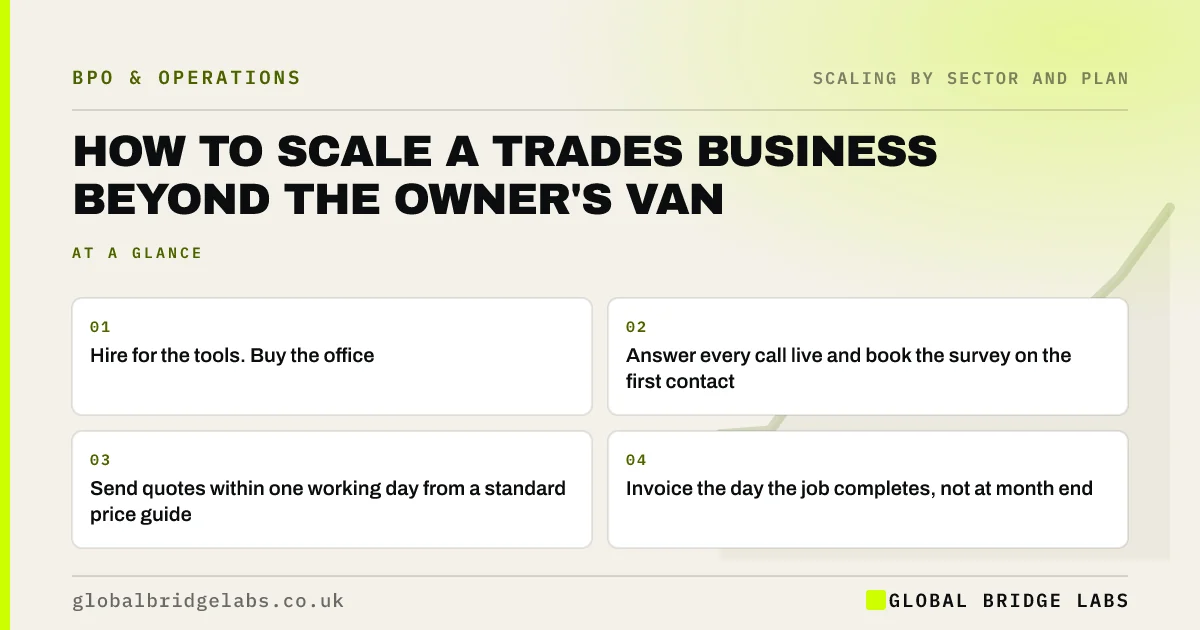
- Hire for the tools. Buy the office.
- Answer every call live and book the survey on the first contact.
- Send quotes within one working day from a standard price guide.
- Invoice the day the job completes, not at month end.
Still doing quotes at the kitchen table? Message us on WhatsApp with your weekly enquiry numbers.
Chat on WhatsApp →Why do trades businesses stall?
Trades businesses stall at the size the owner can personally run. The owner takes the calls, prices the jobs, manages the diary and sends the invoices, usually after a day on site. Adding engineers adds more of all four. Without office capacity, more vans simply mean more missed calls and slower quotes.
What has to be hired?
The people who do the work have to be hired or subcontracted: qualified engineers, fitters and site supervisors. They need to be local, on site and trusted with your reputation. Contractors in construction also have duties under the Construction Industry Scheme (CIS), including verifying subcontractors and filing monthly returns.
What can be supplied without an office?
The office functions can be supplied remotely. A managed team can answer calls and messages in your business name, book surveys and jobs into the diary, prepare quotes from your price guide for approval, send invoices, chase payments and keep job records up to date.
- Call and message answering.
- Diary and job scheduling.
- Quote preparation and follow-up.
- Invoicing and payment chasing.
- Certificates, job sheets and records.
How do you standardise quoting?
Standardise quoting by writing a price guide for your common jobs: labour hours, materials and standard extras. Most domestic and small commercial work falls into repeatable types. With a guide, someone else can prepare the quote and the owner only approves it, which takes minutes instead of an evening.
Want to discuss your requirements for calls, quotes and invoicing? Send us your trade and area on WhatsApp.
Chat on WhatsApp →What does office capacity cost?
As indicative market ranges, managed offshore admin and call teams cost £9–£18 per hour and onshore providers £20–£35 per hour. A full-time UK office administrator at £30,000 costs about £34,500 a year at the loaded rate. Many trades firms start with part-time cover for calls and invoicing.
When do you need an office manager?
You need an in-house office or operations manager when you have enough engineers that scheduling, parts and customer issues need someone making decisions all day, often at around eight to ten on the tools. That person then directs the remote team. Hire them for judgement, not for typing.
What does this look like in practice?
A pattern we see in UK plumbing, electrical and building firms with four to eight engineers: calls go to the owner's mobile, and a third are missed while on site. Quotes follow days later. A managed team answering live and booking surveys, with quotes drafted from a price guide, turns enquiries into booked work the same day.
Across our client work, enquiry rates have risen 2.4 times.
Trades scaling checklist
Get these in place before adding another van.
- Count calls received, answered and missed for two weeks.
- Measure days from survey to quote.
- Write a price guide for your ten commonest jobs.
- Move calls and booking to live answering.
- Invoice on completion with payment links.
- Set a chasing routine for overdue invoices.
- Decide when an in-house coordinator is justified.
Next step
Tell us your trade, how many engineers you run and how enquiries reach you. We will outline what office capacity you need to add the next van.
Message us on WhatsApp for a trades capacity review, or book a 30-minute consultation.
Chat on WhatsApp →Sources and further reading
- What you must do as a Construction Industry Scheme (CIS) contractor · GOV.UK
- Rates and thresholds for employers 2026 to 2027 · HM Revenue & Customs
- Business population estimates for the UK and regions 2025 · Department for Business and Trade
Frequently asked questions
How do I grow my trades business?
Grow a trades business by making sure every enquiry is answered and quoted quickly, then adding skilled people on site. Take calls, scheduling, quoting and invoicing off the owner using a price guide and office support, so the owner can win work, supervise quality and recruit engineers.
When should a tradesperson get office help?
Get office help when calls are being missed on site, quotes are taking more than a day or two, invoices are going out late or paperwork is filling evenings. For many firms that is at two or three engineers. Part-time or outsourced cover is usually enough to start.
Should a trades business hire an administrator or outsource?
Outsource if the workload is under a full role, varies through the week or needs cover across long hours. Hire if you need someone on site making decisions all day about scheduling, parts and customers. Many firms use both: a coordinator in-house and a remote team for volume.
How do I stop missing calls when I am on a job?
Divert calls to a live answering team that can take details, answer common questions and book surveys into your diary. Customers with urgent work often ring the next firm if nobody answers. A voicemail message rarely keeps them.
Written by

Global Bridge Labs (GBL) is a UK–Sri Lanka partner for social media, websites and BPO. Everything here comes from client delivery, not theory.