On this page
- 01Short answer
- 02What are UTM parameters?
- 03Which parameters do you need?
- 04What naming convention should you use?
- 05Where do you use them?
- 06What are the limits of UTM tracking?
- 07What does a working UTM set look like?
- 08How do you keep UTMs tidy over time?
- 09Next step
- 10Sources and further reading
- 11Frequently asked questions
Short answer
UTM parameters are tags added to a link so analytics can tell you where a visitor came from. Set a naming convention, use it for every link you publish, and keep a shared sheet so nobody invents their own. Twenty minutes of setup makes every future month of reporting possible.
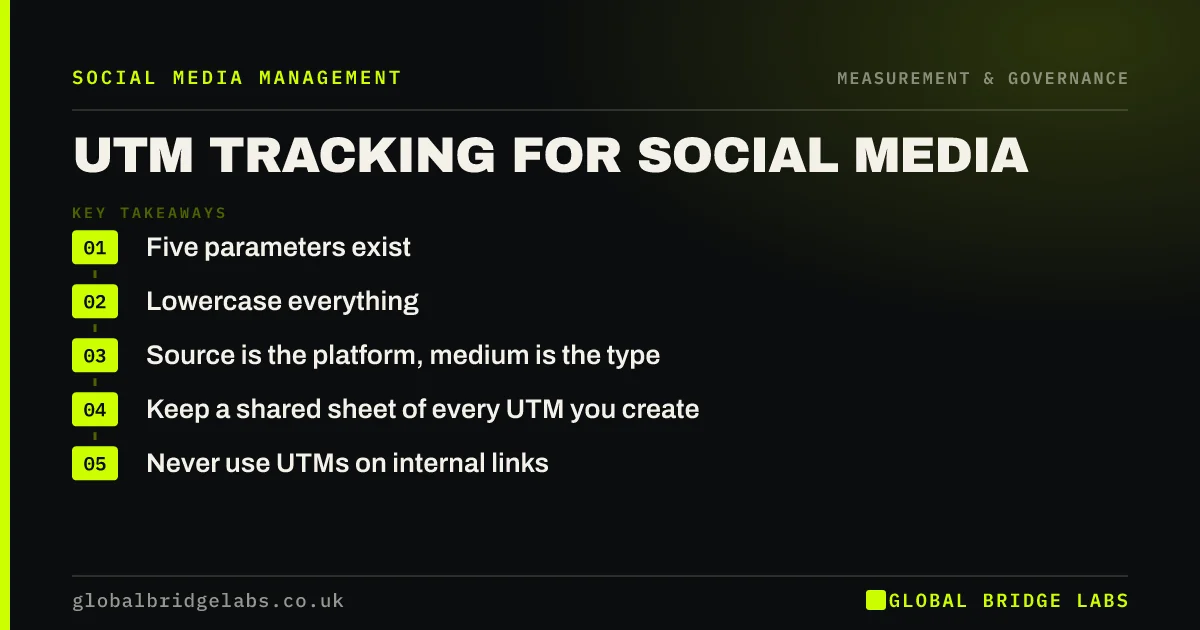
- Five parameters exist. You need three: source, medium, campaign.
- Lowercase everything. Analytics treats Facebook and facebook as different sources.
- Source is the platform, medium is the type, campaign is the thing being promoted.
- Keep a shared sheet of every UTM you create. Inconsistency ruins the data.
- Never use UTMs on internal links. They restart the session and break attribution.
Want your UTM convention set up and documented? Message us on WhatsApp.
Chat on WhatsApp →What are UTM parameters?
UTM (Urchin Tracking Module) parameters are text added to the end of a URL that analytics platforms read to categorise incoming traffic.
Without them, a click from an Instagram bio and a click from a LinkedIn post can both appear as generic social or even as direct traffic, which makes it impossible to say which channel produced anything.
Which parameters do you need?
Three, consistently. Two more exist and are rarely worth the complexity for a small business.
- utm_source: the platform. instagram, linkedin, facebook, tiktok.
- utm_medium: the type of link. organic_social, paid_social, bio_link, email.
- utm_campaign: what is being promoted. autumn_offer, kitchen_case_study.
- utm_content: optional, to distinguish two versions of the same link.
- utm_term: for paid search keywords. Not needed for social.
What naming convention should you use?
Lowercase, underscores rather than spaces, and a fixed vocabulary agreed in advance. Analytics is case sensitive, so LinkedIn and linkedin become two separate sources and your data splits silently.
Write the allowed values down. Source is the platform name, medium is one of four or five agreed types, and campaign is either a month or a named promotion. Anyone adding a new campaign value adds it to the sheet.
We set up tracking as standard for UK clients. Message us on WhatsApp to see what it covers.
Chat on WhatsApp →Where do you use them?
On every external link you publish: bio links, link stickers in stories, links in posts, ad destinations, links in creator briefs and links in email.
Do not use them on links between pages of your own website. Doing so starts a new session in analytics and overwrites the original source, which means you lose the attribution you were trying to capture.
What are the limits of UTM tracking?
It only sees clicks. Enquiries that start as direct messages, phone calls prompted by a post, or searches for your brand name after seeing content are all invisible to it.
That is why UTMs are one of three attribution methods rather than the answer on their own. Pair them with a source field on your enquiry form and a CRM note for message conversations.
What does a working UTM set look like?
Concrete examples, since the convention only becomes obvious once you see it applied consistently.
An Instagram bio link uses source instagram, medium bio_link, campaign always_on. A link sticker in a story promoting a specific service uses source instagram, medium organic_social, campaign bathroom_offer. A paid Facebook campaign uses source facebook, medium paid_social, campaign autumn_leads. A link in a monthly email uses source newsletter, medium email, campaign november.
Four values for source, four for medium, and a growing but controlled list for campaign. That is the whole system, and it stays readable after two years precisely because nobody was allowed to invent a fifth medium.
- Bio links: medium bio_link, campaign always_on.
- Organic posts and stories: medium organic_social, campaign names the thing promoted.
- Paid: medium paid_social, campaign matches the campaign name in the ad account.
- Keep mediums to a fixed list of four or five. Never improvise one.
How do you keep UTMs tidy over time?
The failure mode is drift. Six months in, someone has used Instagram with a capital I, someone else has used ig, and a third person has invented a medium called social. Analytics treats all of them as separate, and your channel totals quietly stop being true.
Three controls prevent it. Keep the shared sheet as the only place UTMs are created, with a column for who created each one and when. Restrict the medium list to a fixed set that only one person can extend. And audit the source and medium values in analytics once a quarter, which takes ten minutes and catches drift while it is still cheap to fix.
When you do find a stray value, do not retrospectively rename it. Note it in the sheet, map it to the correct value in your reporting, and correct the link if it is still live.
- One shared sheet is the only place new UTMs are created.
- Fixed medium list, extendable by one named person.
- Quarterly audit of source and medium values in analytics.
- Map stray values in reporting rather than renaming history.
Next step
UTM setup is a twenty-minute job that determines whether next quarter's reporting is possible. It is the cheapest measurement work available.
Message us on WhatsApp and we will set up your UTM convention and tracking sheet.
Chat on WhatsApp →Sources and further reading
- URL builders: collect campaign data with custom URLs · Google Analytics Help
- Meta Business Help Centre · Meta
Frequently asked questions
What are UTM parameters used for?
They tag a link so analytics can attribute the visit to a specific platform, link type and campaign. Without them, clicks from different social channels frequently collapse into generic social or direct traffic, making per-channel performance impossible to measure.
Which UTM parameters should a small business use?
Three: source for the platform, medium for the link type, and campaign for what is being promoted. Keep values lowercase with underscores, and record every value used in a shared sheet so nobody invents variants.
Should I use UTMs on internal links?
No. UTMs on links between your own pages start a new analytics session and overwrite the original traffic source, which destroys the attribution you were trying to capture. Use them only on links published outside your site.
Do UTMs track direct message enquiries?
No. They only capture clicks, so enquiries starting as direct messages, phone calls or brand-name searches are invisible. Pair UTMs with a source field on your enquiry form and a CRM note for message conversations.
Written by

Global Bridge Labs (GBL) is a UK–Sri Lanka partner for social media, websites and BPO. Everything here comes from client delivery, not theory.