On this page
- 01Key takeaways
- 02What is marketing attribution?
- 03Why is attribution hard for small businesses?
- 04What does GA4 attribution do?
- 05How do you fill the gaps analytics misses?
- 06How should you use attribution to make decisions?
- 07When is attribution not worth the effort?
- 08What does this look like in practice?
- 09Simple attribution checklist
- 10Next step
- 11Sources and further reading
- 12Frequently asked questions
Key takeaways
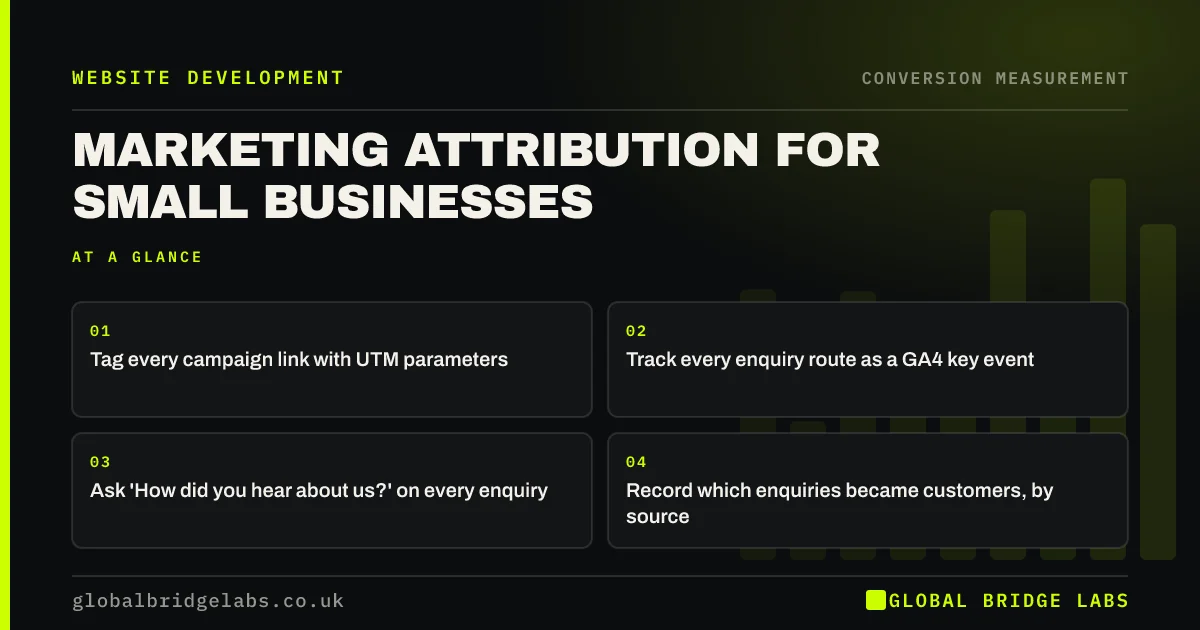
Marketing attribution is working out which channels deserve credit for an enquiry or sale. Small businesses do not need complex models. Combine three things: UTM-tagged links and GA4 key events, a 'How did you hear about us?' question, and a record of which enquiries became customers. Together they are accurate enough to guide spending.
- Tag every campaign link with UTM parameters.
- Track every enquiry route as a GA4 key event.
- Ask 'How did you hear about us?' on every enquiry.
- Record which enquiries became customers, by source.
Want simple attribution set up for your business? Message us on WhatsApp.
Chat on WhatsApp →What is marketing attribution?
Marketing attribution is the process of assigning credit for a conversion to the marketing touchpoints that led to it. A buyer might see a social post, search your name a week later and then enquire. Attribution decides how much credit each step gets, which shapes where you spend next.
Why is attribution hard for small businesses?
Real buyer journeys cross devices, channels and conversations that analytics cannot see: a recommendation over dinner, a van on the street, a WhatsApp forward. Cookie consent rules mean some visits are not recorded. So no tool gives a perfect answer. The goal is a consistent, good-enough picture, not certainty.
What does GA4 attribution do?
Google Analytics 4 uses data-driven attribution by default for key events, spreading credit across the touchpoints it can see, and also lets you view last-click results. For most small businesses, the default is fine. What matters more is that every link is tagged, every enquiry route is a key event, and you review the same report each month.
How do you fill the gaps analytics misses?
Ask. A 'How did you hear about us?' field on every form and question on every call captures word of mouth, offline and dark social sources. Compare the answers with GA4. Where they disagree, such as analytics saying 'direct' and buyers saying 'Instagram', the buyer's answer often explains the gap.
- Add a 'How did you hear about us?' dropdown with an 'Other' box.
- Ask the same question on calls and log it.
- Use call tracking numbers on print and vans.
- Record the source against each customer, not just each enquiry.
Want your enquiry form set up to capture source properly? Ask us on WhatsApp.
Chat on WhatsApp →How should you use attribution to make decisions?
Use attribution to spot big differences, not small ones. If one channel produces half your customers at a fraction of the cost, act on it. If two channels differ by a few percent, the difference may be noise. Look at trends over quarters and combine analytics, self-reported source and customer outcomes before cutting any channel.
When is attribution not worth the effort?
If you spend very little on marketing and most work comes from one source, detailed attribution adds little. Basic tracking and a source question are enough. Invest more in attribution when spend grows across several channels and decisions about where to put money become significant.
What does this look like in practice?
A UK wedding venue was about to stop Instagram because GA4 showed few enquiries from it. The venue's enquiry form, updated to ask 'How did you hear about us?', showed Instagram was the most common answer. Couples saw the venue on Instagram and later searched its name. The venue kept Instagram and treated branded search as partly its result.
Simple attribution checklist
- Tag every campaign link with UTMs.
- Track every enquiry route as a GA4 key event.
- Add 'How did you hear about us?' to forms and calls.
- Record source against every customer.
- Compare analytics with self-reported sources quarterly.
- Act on big differences, not small ones.
Next step
Good-enough attribution stops you cutting channels that work and funding ones that do not. We can set up the tracking and the source question so the picture is clear within a quarter.
Message us on WhatsApp for simple attribution setup, or book a 30-minute consultation.
Chat on WhatsApp →Sources and further reading
- Get started with attribution · Google Analytics Help
- URL builders: collect campaign data with custom URLs · Google Analytics Help
- About key events · Google Analytics Help
Frequently asked questions
What is marketing attribution?
Marketing attribution is working out which marketing channels and touchpoints deserve credit for an enquiry or sale. It helps decide where to spend by showing which channels actually lead to customers. No tool is perfect, so combine analytics with asking customers how they found you and recording which enquiries became customers.
What attribution model should a small business use?
GA4's default data-driven attribution is fine for most small businesses. More important is consistent tagging, tracking every enquiry route and asking customers how they heard about you. Together these give a reliable enough picture. Review the same report each month so trends are comparable over time.
How do I track where my leads come from?
Use UTM tags on campaign links, set up GA4 key events for forms, calls and WhatsApp, and ask 'How did you hear about us?' on every enquiry. Record the source against each customer in a CRM or spreadsheet. Compare the two every quarter.
Why does GA4 show so much direct traffic?
Direct traffic includes visitors who typed your address, used bookmarks, or came from apps, messages and untagged links. Some social and word-of-mouth visits appear as direct. Tag links and ask enquirers how they found you to fill the gap. Brand searches often hide social reach.
Written by

Global Bridge Labs (GBL) is a UK–Sri Lanka partner for social media, websites and BPO. Everything here comes from client delivery, not theory.