On this page
- 01Key takeaways
- 02What is white label outsourcing?
- 03Why do agencies struggle to scale by hiring?
- 04Which agency work can be white-labelled?
- 05What does white label capacity cost?
- 06What must the contracts cover?
- 07When does white labelling go wrong?
- 08What does this look like in practice?
- 09White label checklist
- 10Next step
- 11Sources and further reading
- 12Frequently asked questions
Key takeaways
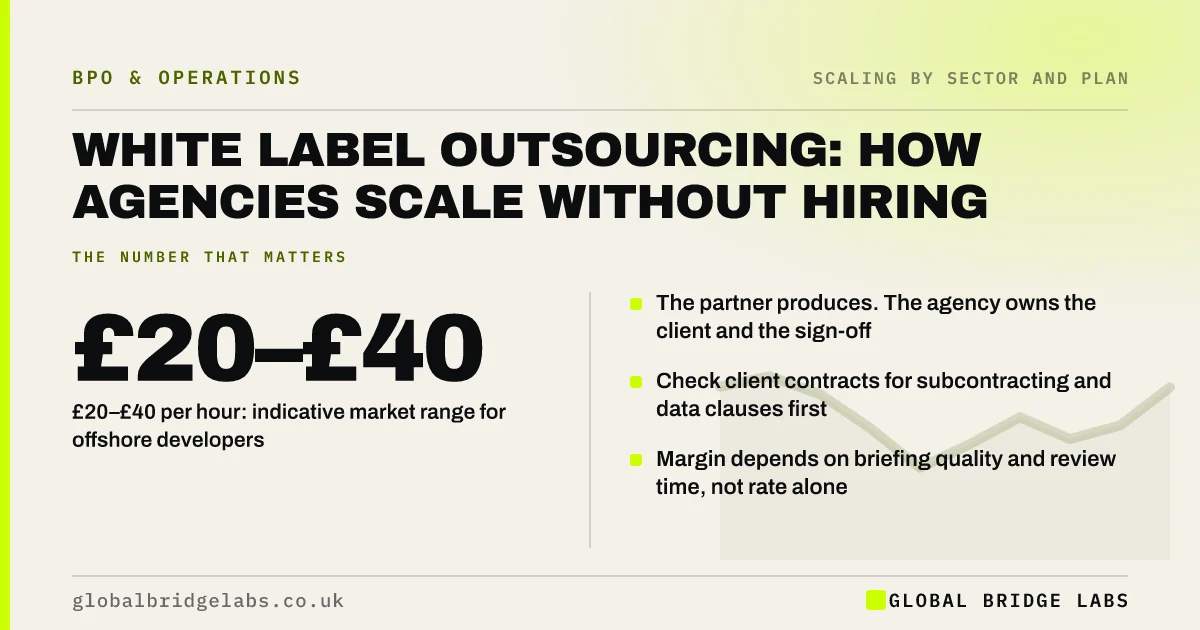
White label outsourcing for agencies means a partner produces work that the agency delivers to clients under its own name. It lets a small agency take on more or larger projects without hiring for every peak. The agency keeps strategy, client contact and quality sign-off. The partner supplies design, build, content or support capacity.
- The partner produces. The agency owns the client and the sign-off.
- £20–£40 per hour: indicative market range for offshore developers.
- Check client contracts for subcontracting and data clauses first.
- Margin depends on briefing quality and review time, not rate alone.
Agency turning work away or working weekends? Message us on WhatsApp with your pipeline.
Chat on WhatsApp →What is white label outsourcing?
White label outsourcing is an arrangement in which one company produces goods or services that another company sells under its own brand. For agencies, a production partner builds websites, designs assets, writes content or runs support, and the agency presents the result to its client as its own work.
Why do agencies struggle to scale by hiring?
Agencies struggle to scale by hiring because workload is uneven. A big project needs three developers for two months and one afterwards. Hiring for the peak leaves people idle in the trough. Refusing the project caps growth. A flexible production partner absorbs the peaks without the permanent cost.
Which agency work can be white-labelled?
Production work with a clear brief can be white-labelled. Strategy, client relationships and creative direction should stay with the agency, because they are what the client is buying. The partner works to the agency's specifications, brand standards and deadlines.
- Website builds, maintenance and updates.
- Design production and resizing.
- Content writing, editing and scheduling.
- Testing and quality assurance.
- Reporting, admin and client support desks.
What does white label capacity cost?
As indicative market ranges, offshore developers cost £20–£40 per hour, design £25–£40 per hour and managed back-office support £9–£18 per hour. The agency's margin is the difference between its client rate and the partner cost, less the time its own people spend briefing and reviewing. That review time is the figure agencies most often underestimate.
Want to discuss your requirements for white label production? Send us your service lines on WhatsApp.
Chat on WhatsApp →What must the contracts cover?
Contracts must cover four things: confidentiality, ownership of the work, non-solicitation of clients and data protection. Check your client contracts for clauses restricting subcontracting. Under UK GDPR, a processor needs the controller's written authorisation before engaging another processor, so client consent may be required where personal data is involved.
- Confidentiality and non-disclosure.
- Intellectual property assigned to the agency or its client.
- No direct approach to the agency's clients.
- Processor and sub-processor terms for personal data.
When does white labelling go wrong?
White labelling goes wrong when briefs are vague, when the agency has nobody able to review technical work, or when the partner is asked to deal with clients directly without context. It also fails if the agency competes on price alone and leaves no margin for quality checks.
What does this look like in practice?
A pattern we see in UK agencies with five to fifteen staff: designers are selling projects and developers are writing proposals, because production fills every other hour. Moving builds and maintenance to a white label partner, with one in-house lead reviewing, lets the agency accept the larger projects it used to decline.
White label checklist
Agree these before the first project.
- A written brief template and definition of done.
- One in-house reviewer for each service line.
- Client contracts checked for subcontracting terms.
- Confidentiality, IP and non-solicitation agreed.
- Data protection terms and client authorisation.
- A pilot project with a friendly client.
- Margin calculated including review time.
Next step
Tell us which services you sell and where capacity runs out. We will outline how a white label arrangement could work and what you would need to keep in-house.
Message us on WhatsApp to talk through white label delivery, or book a 30-minute consultation.
Chat on WhatsApp →Sources and further reading
- Contracts and liabilities between controllers and processors · Information Commissioner's Office
- Controllers and processors · Information Commissioner's Office
- How copyright protects your work · GOV.UK
Frequently asked questions
What does white label mean for an agency?
For an agency, white label means a partner company does part of the production work, such as building websites or creating content, and the agency delivers it to the client under the agency's own brand. The client relationship, strategy and final approval remain with the agency.
Is white label outsourcing legal?
Yes, provided contracts allow it. Check that your client agreements do not prohibit subcontracting, that intellectual property is properly assigned, and that data protection rules are followed. Where personal data is involved, a processor needs the controller's authorisation to use a sub-processor.
Should an agency tell clients it uses white label partners?
Check the contract first: some require consent to subcontract. Many agencies describe having an extended delivery team without naming suppliers. Never misrepresent who will handle personal data, and be truthful if asked directly. Clients mainly care about quality, deadlines and accountability.
How do agencies keep quality with white label work?
Agencies keep quality by writing clear briefs, agreeing a definition of done, having an in-house specialist review every deliverable, and starting with a pilot project. Building review time into the price protects margin and ensures nothing reaches a client unchecked.
Written by

Global Bridge Labs (GBL) is a UK–Sri Lanka partner for social media, websites and BPO. Everything here comes from client delivery, not theory.