On this page
- 01Short answer
- 02What is the actual difference?
- 03When is boosting the right choice?
- 04What do you lose by only boosting?
- 05How do you move from boosting to proper campaigns?
- 06What does this look like in practice?
- 07What should you set up before your first campaign?
- 08How do you read the results either way?
- 09Next step
- 10Sources and further reading
- 11Frequently asked questions
Short answer
Boosting is a simplified advert with fewer controls. It is genuinely useful for amplifying a post that has already performed and for building local awareness cheaply. For anything measured on enquiries or sales, use Ads Manager, where you can choose a conversion objective, control placements and see what actually happened.
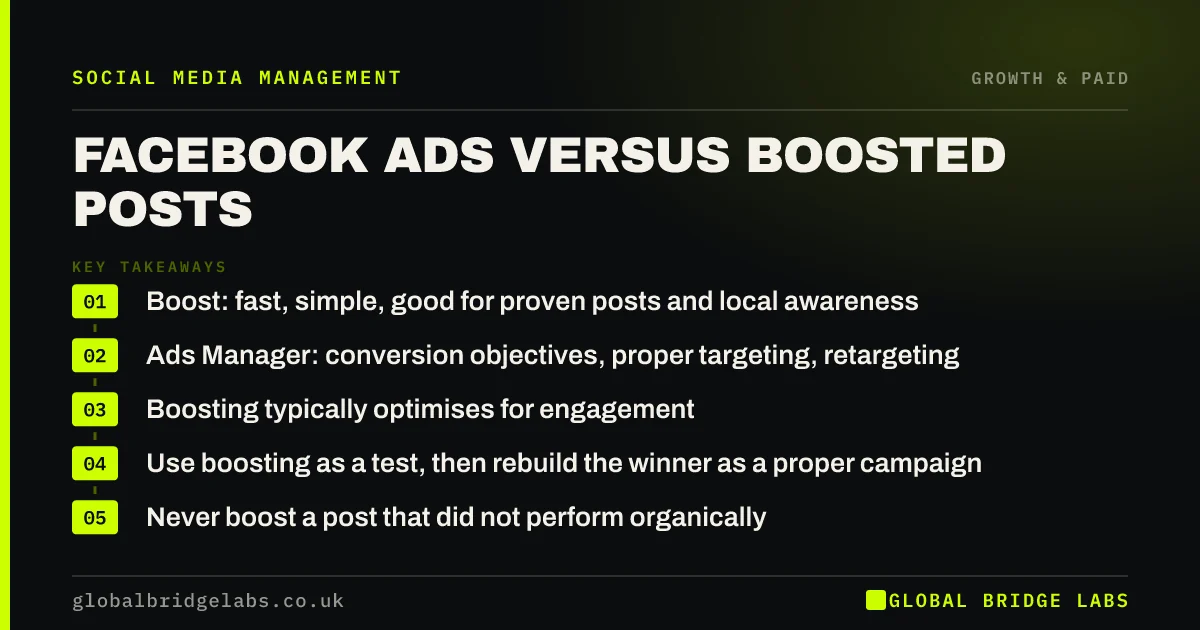
- Boost: fast, simple, good for proven posts and local awareness.
- Ads Manager: conversion objectives, proper targeting, retargeting, real reporting.
- Boosting typically optimises for engagement, which buys reactions rather than enquiries.
- Use boosting as a test, then rebuild the winner as a proper campaign.
- Never boost a post that did not perform organically. You are amplifying a known failure.
Not sure which your budget needs? Message us on WhatsApp with what you are trying to achieve.
Chat on WhatsApp →What is the actual difference?
Both run through the same advertising system. The difference is how much control you have and what the system is told to optimise for.
A boost offers a small number of objectives, limited audience controls and simplified placements. Ads Manager exposes the full objective list, detailed audience definition, placement control, budget scheduling and proper reporting. Same engine, different steering.
When is boosting the right choice?
Three situations where boosting is the correct decision rather than a compromise.
- Amplifying a post that already earned engagement organically, to a local audience.
- Local awareness for an event, opening or seasonal service with a short window.
- Testing whether a message resonates before building a full campaign around it.
What do you lose by only boosting?
Four things that matter commercially: conversion optimisation, retargeting, placement control and attribution.
The first is the most costly. If the system is optimising for engagement, it finds people who react to posts, and those people are not necessarily people who enquire. Businesses that only boost frequently report high engagement and no leads, which is exactly what they paid for without realising it.
- No conversion objective, so you buy reactions rather than enquiries.
- No retargeting of website visitors or previous engagers.
- No placement control, so budget goes to placements that may not suit your creative.
- Weaker reporting, making it hard to know what worked.
We set up and run Meta campaigns for UK clients. Message us on WhatsApp for what that would cover.
Chat on WhatsApp →How do you move from boosting to proper campaigns?
Keep boosting what works organically as a small ongoing line, and build one proper campaign alongside it with a conversion or messaging objective.
Set up the pixel or conversions API on your website first, even if volume is low, because it takes time to accumulate data and you cannot retroactively build an audience of past visitors. This is the single most common missing foundation we find when auditing small business advertising accounts.
What does this look like in practice?
A pattern in small retail accounts: a year of budget committed entirely to boosted posts, strong engagement figures, and no way to attribute a single sale.
Keeping a small boosting line for proven posts and moving the rest into a conversion campaign with retargeting usually reduces total engagement. Attributable revenue appears for the first time, and within a quarter the business can state a cost per purchase, which changes every subsequent budget decision.
What should you set up before your first campaign?
Four foundations, none of which can be added retrospectively without losing data.
A business account that owns the page and the ad account, so nothing depends on a personal profile. The pixel or conversions API installed and verified on your site. At least one custom audience definition, usually website visitors and people who engaged with your content. And a conversion event that matches what you actually want, whether that is a form submission, a message or a purchase.
This takes an afternoon. Skipping it is the most common reason small businesses spend for a year and then discover they cannot retarget anyone, because the audiences they needed were never accumulating in the background.
- Business account owns the page and ad account.
- Pixel or conversions API installed and verified.
- Custom audiences defined early so they accumulate.
- A conversion event that matches the outcome you want.
How do you read the results either way?
Judge on cost per outcome, and be explicit about which outcome you asked for, because the most frequent misreading is comparing an engagement campaign against a conversion campaign as though the numbers mean the same thing.
A boost optimised for engagement will show a low cost per result and produce no enquiries; a conversion campaign will show a much higher cost per result and produce enquiries. Both look worse than the other on the wrong metric, and businesses regularly abandon the campaign that was actually working.
Set the comparison up front: for each campaign, record the objective, the audience, the creative source and the cost per enquiry. Four columns, checked monthly, prevents almost every wrong conclusion available here.
- Always record the objective beside the result.
- Never compare cost per engagement with cost per enquiry.
- Track objective, audience, creative source and cost per enquiry.
- Review monthly, decide quarterly.
Next step
If your paid social produces engagement but no attributable enquiries, the objective is almost certainly the problem rather than the creative.
Message us on WhatsApp for a review of your Meta advertising setup and objectives.
Chat on WhatsApp →Sources and further reading
- Meta Business Help Centre · Meta
- Recognising ads: brand-owned and paid social media · ASA / CAP
Frequently asked questions
Is boosting a post the same as running a Facebook ad?
Both use the same advertising system, but boosting exposes far fewer controls. You get limited objectives, simplified targeting and weaker reporting. Ads Manager gives you conversion objectives, retargeting, placement control and attribution, which matter once you are measuring enquiries.
Is boosting posts a waste of money?
Not always. Boosting a post that already performed organically, to a tight local audience, is a legitimate and efficient use of budget. It becomes waste when it is your only method and you are expecting enquiries from an engagement objective.
Which posts should I boost?
Only ones that already earned engagement without payment. Organic performance is a free test of whether the message works. Boosting a post that failed organically amplifies a known failure to a larger audience at your expense.
Do I need the Meta pixel on my website?
Yes, install it early even if your conversion volume is low, because audiences of past visitors take time to accumulate and cannot be built retroactively. It is the most common missing foundation in small business advertising accounts we audit.
Written by

Global Bridge Labs (GBL) is a UK–Sri Lanka partner for social media, websites and BPO. Everything here comes from client delivery, not theory.