On this page
- 01Key takeaways
- 02What is CPM?
- 03How do you calculate it?
- 04What does CPM look like across channels?
- 05Why is the cheapest CPM not always the best buy?
- 06How do you adjust CPM for waste?
- 07Where do the audience numbers come from?
- 08What should you use alongside CPM?
- 09When is CPM the wrong measure?
- 10What does this look like in practice?
- 11Next step
- 12Sources and further reading
- 13Frequently asked questions
Key takeaways
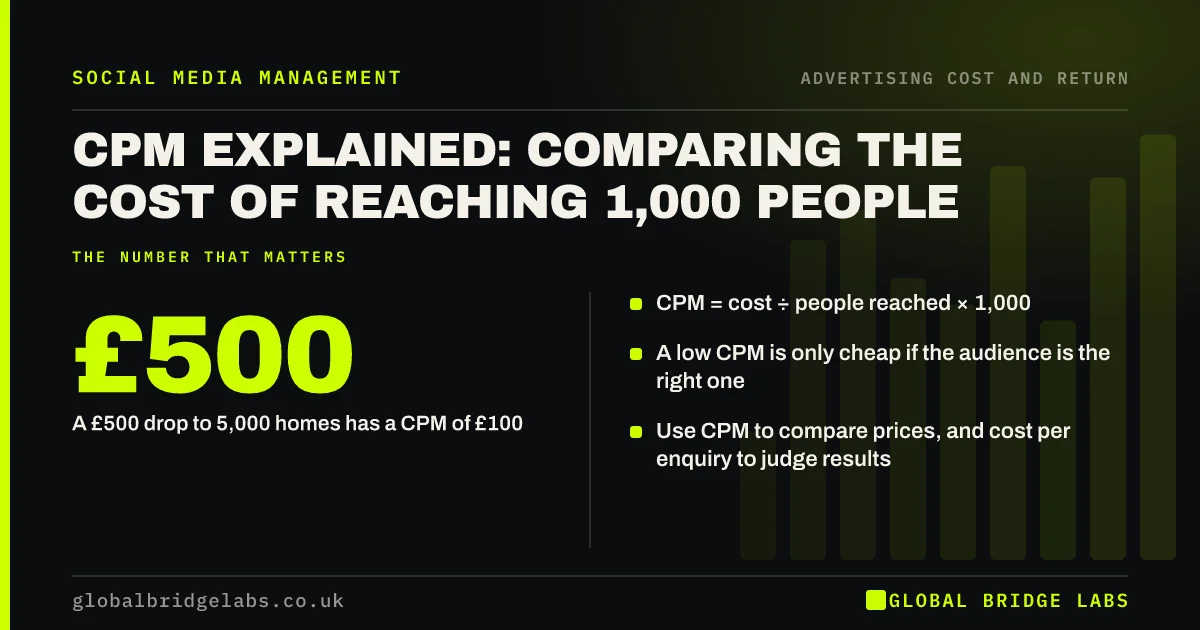
CPM, or cost per mille, is the cost of reaching 1,000 people with an advert. It is the one figure that lets you put a leaflet, a radio spot and a social advert side by side. It measures how expensive an audience is, not whether the advert worked.
- CPM = cost ÷ people reached × 1,000.
- A £500 drop to 5,000 homes has a CPM of £100.
- A low CPM is only cheap if the audience is the right one.
- Use CPM to compare prices, and cost per enquiry to judge results.
Want two quotes turned into comparable CPMs? Message us on WhatsApp.
Chat on WhatsApp →What is CPM?
CPM stands for cost per mille, mille being Latin for thousand. It is the price of 1,000 impressions, an impression being one occasion on which an advert is shown, delivered or heard. Media owners and social platforms both quote it, which makes it the common currency of advertising.
How do you calculate it?
Divide the total cost by the number of people reached, then multiply by 1,000. Include production in the cost if you want the true figure.
- 1. Take the total cost, for example £500.
- 2. Take the audience, for example 5,000 households.
- 3. Divide: £500 ÷ 5,000 = £0.10.
- 4. Multiply by 1,000: a CPM of £100.
What does CPM look like across channels?
CPM varies enormously by medium, which is the first thing the calculation teaches. Using the indicative costs in this series as illustrations: a leaflet at 6p to 15p per home has a CPM of £60 to £150, and a mailed letter at 60p to £1.20 has a CPM of £600 to £1,200. Broadcast and paid social are usually far lower, often in single or low double figures.
Why is the cheapest CPM not always the best buy?
A low CPM buys a large audience, and most of it may be wrong for you. Regional radio reaches people forty miles away for pennies each. A letter to a past customer costs a pound and goes to exactly the right person. Attention differs too: a leaflet handled at the door is not the same as a post scrolled past.
How do you adjust CPM for waste?
Work out an effective CPM by counting only the people who could buy. If a station reaches 100,000 listeners but only 10,000 live in your service area, divide the cost by 10,000 instead. The figure rises tenfold and becomes honest.
- Remove people outside your area.
- Remove people who could never use the service.
- Recalculate on the remainder.
Where do the audience numbers come from?
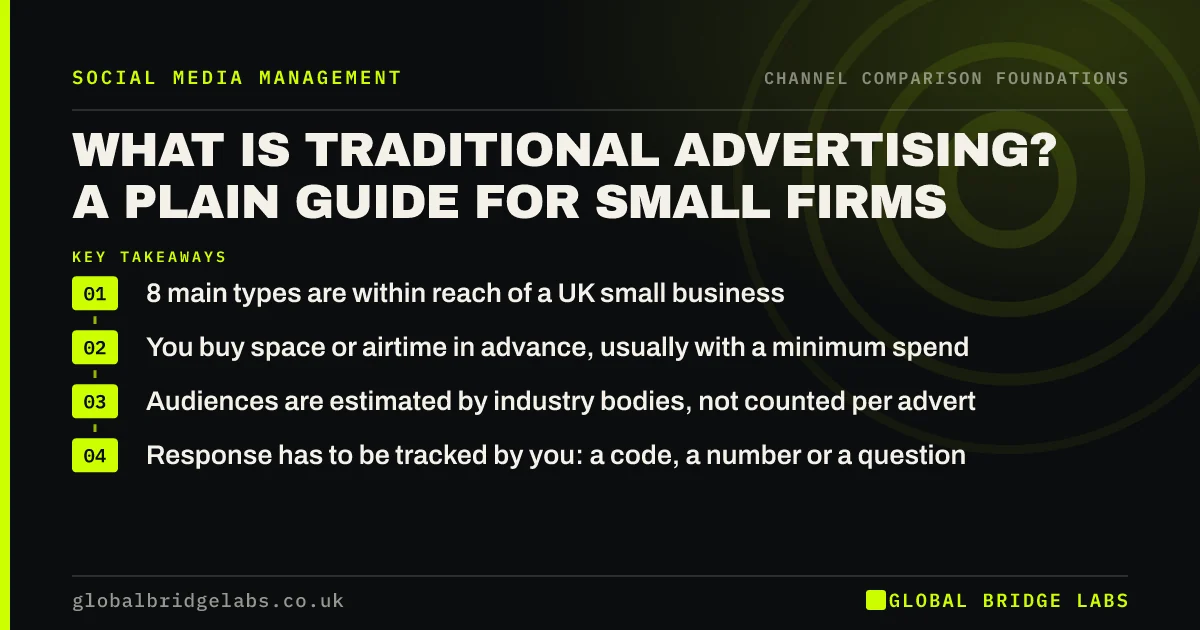
Social platforms count impressions for each advert. Traditional media use industry estimates: RAJAR for radio listening, BARB for television and JICMAIL for mail. Print titles quote circulation, ideally audited. Ask which figure you are being given and for which area, because estimates and counts are not the same thing.
What should you use alongside CPM?
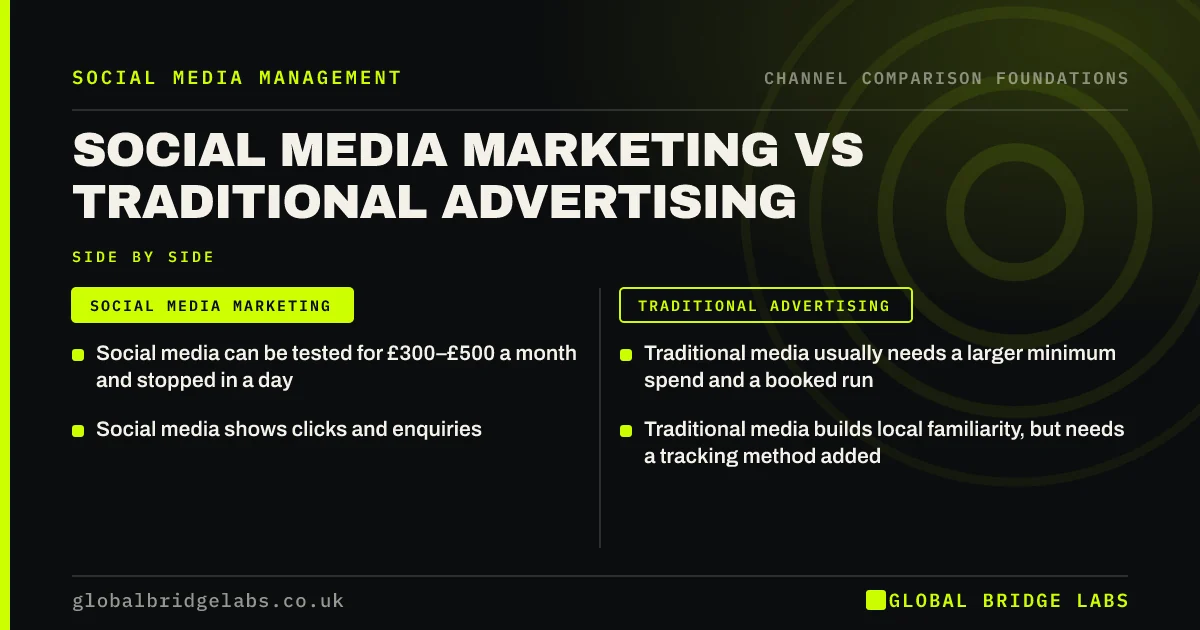
Use cost per enquiry and cost per customer alongside it. CPM tells you what the audience cost. The others tell you what it produced. Paid social can be tested from £300–£500 a month, which is usually enough to get a first cost per enquiry to compare with a traditional quote.
- Cost per lead by channel: comparing social media and offline
- How to compare advertising ROI across online and offline
Want a first cost per enquiry from a small social test? Message us on WhatsApp and we will discuss your requirements.
Chat on WhatsApp →When is CPM the wrong measure?
CPM is the wrong measure for channels that are not about reach: a trade show, a sponsorship or a phone call. It also misleads for very small, valuable audiences, where a high CPM is exactly what you should expect to pay.
What does this look like in practice?
A pattern we see when owners compare media for the first time: the option with the biggest audience figure looks like the bargain. Once the audience is cut down to people inside the service area, the small local option with the high headline CPM frequently turns out cheaper per real prospect.
Next step
Take your last two advertising invoices, find the audience each claimed and work out both CPMs. Then cut each audience to people you could actually serve.
Message us on WhatsApp with the figures and we will check the sums, or book a 30-minute consultation.
Chat on WhatsApp →Sources and further reading
Frequently asked questions
What does CPM mean in advertising?
CPM means cost per mille, the price of 1,000 impressions of an advert. An impression is one showing, delivery or hearing. It is used across print, broadcast, outdoor and online advertising so that different media can be compared on audience cost.
What is a good CPM?
There is no universal good figure, because it depends on how well the audience matches your market. A high CPM for exactly the right people can be better value than a low CPM for a broad audience. Compare within the same medium first.
How do I calculate CPM for a leaflet drop?
Divide the total cost of print and delivery by the number of households, then multiply by 1,000. A £500 drop to 5,000 homes gives £0.10 per home and a CPM of £100. Include design if you paid for it.
Is CPM or cost per lead more important?
Cost per lead matters more for deciding whether to continue, because it measures results. CPM is useful earlier, when comparing quotes before you have any results. Use CPM to shortlist and cost per lead to judge.
Written by

Global Bridge Labs (GBL) is a UK–Sri Lanka partner for social media, websites and BPO. Everything here comes from client delivery, not theory.