On this page
- 01Key takeaways
- 02Why is the quoted price rarely the full price?
- 03What does production add?
- 04What do minimums and contracts add?
- 05What does waste cost?
- 06What does your own time cost?
- 07What does a fully costed example look like?
- 08Does social media have hidden costs too?
- 09Are these costs a reason to avoid traditional media?
- 10What does this look like in practice?
- 11Checklist: questions to ask before booking
- 12Next step
- 13Sources and further reading
- 14Frequently asked questions
Key takeaways
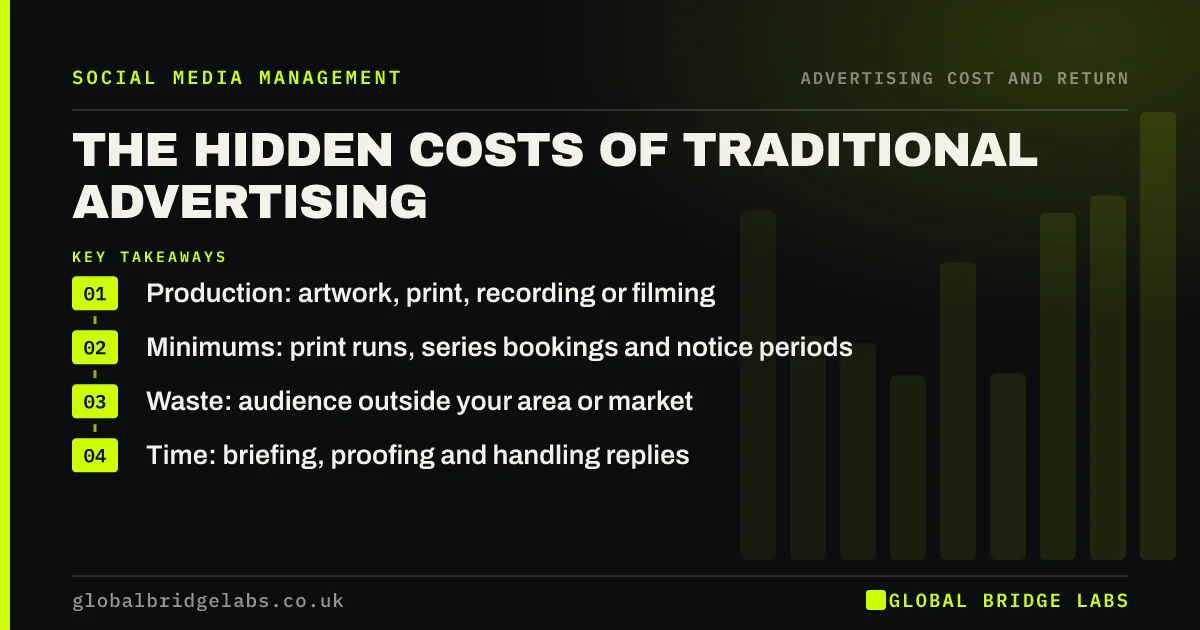
The hidden costs of traditional advertising are the charges and losses that sit outside the rate card: making the advert, minimum quantities, contract terms and paying to reach people who will never buy. Together they can add half as much again to the quoted price.
- Production: artwork, print, recording or filming.
- Minimums: print runs, series bookings and notice periods.
- Waste: audience outside your area or market.
- Time: briefing, proofing and handling replies.
Got a quote that looks too simple? Message us on WhatsApp and we will help you find the full cost.
Chat on WhatsApp →Why is the quoted price rarely the full price?
The quoted price is for space or airtime. Everything needed to fill it is extra. Media sellers are not hiding this, but they quote what they sell. Unless you ask for a total, you will compare a media price in one channel with an all-in price in another.
What does production add?
Production is the largest extra. As indicative figures, a professionally produced radio advert costs £300 to £1,000, and a television advert from around £2,000. Print needs artwork to the publisher's specification. Leaflets need design and printing, and billboards need large-format printing and posting.
- Design and copywriting.
- Photography or stock images.
- Voice-over, music licence and studio time.
- Printing and delivery to the media owner.
What do minimums and contracts add?
Minimums raise the real entry price. Printers price leaflets by the thousand, so small runs cost more each. Series discounts tie you to several issues. Some directories and sponsorships renew automatically unless you cancel in writing by a set date. Read the term, the notice period and the renewal clause before signing.
What does waste cost?
Waste is the share of the audience you paid for who could never buy. If a newspaper covers a county and you serve one town, most of the price is waste. It never appears on the invoice. Work it out by estimating the fraction of the audience inside your market.
What does your own time cost?
Your time is the cost most often left out. Briefing a designer, checking proofs, chasing a booking and answering unsuitable calls can take a working day per campaign. At the April 2026 National Living Wage that is about £16.27 an hour with employer costs, and an owner's hour is worth much more.
What does a fully costed example look like?
Take an illustrative local radio test. Airtime for three weeks at £800 a week is £2,400. Production adds £500. Eight hours of an owner's time at £40 an hour adds £320. The real cost is £3,220, a third more than the airtime quote.
- Airtime: £2,400.
- Production: £500.
- Owner's time: £320.
- Total: £3,220.
Want a quote rebuilt as a full cost? Message us on WhatsApp and we will discuss your requirements.
Chat on WhatsApp →Does social media have hidden costs too?
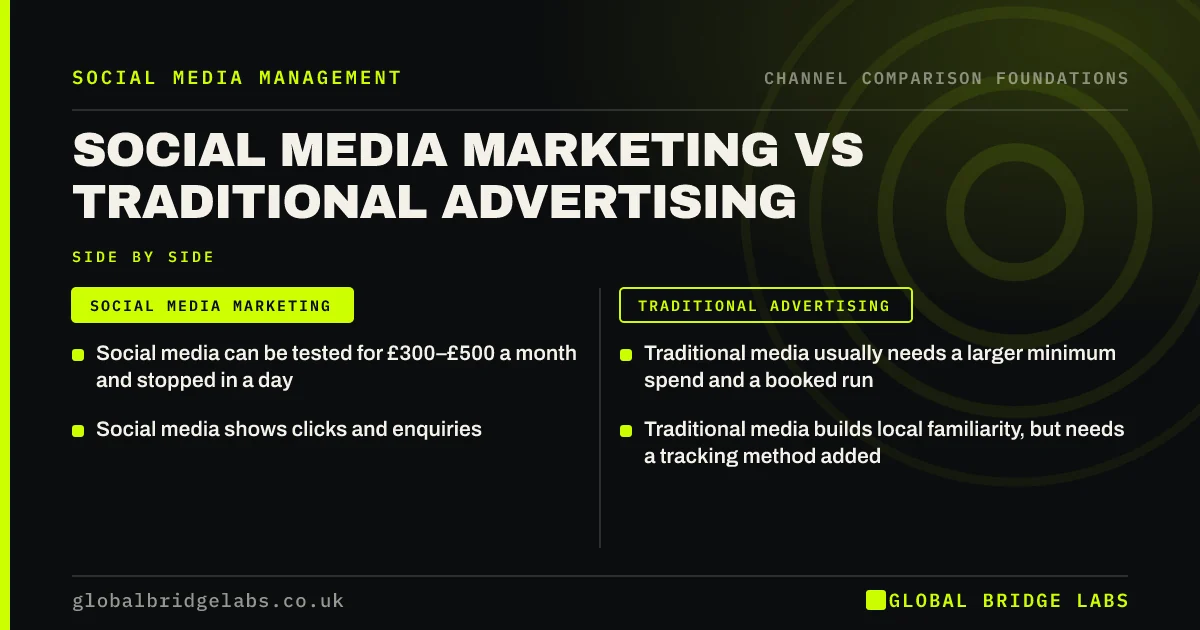
Yes. Social media hides its costs in time, content and tools instead of production and minimums. The difference is flexibility: paid social can be tested from £300–£500 a month and stopped at once, so a mistake costs weeks, not a year's contract.
Are these costs a reason to avoid traditional media?
No. They are a reason to price it honestly. A leaflet campaign can still be the best buy in a tight local area once every cost is counted. The risk lies in comparing a partial price with a full one and choosing on that basis.
What does this look like in practice?
A pattern we see with first-time bookings: the space is bought, then the artwork deadline arrives and a rushed design is paid for at a premium. The advert runs looking unlike anything else the firm produces. Asking for the full specification and deadlines before agreeing avoids both problems.
Checklist: questions to ask before booking
- What is the total, including production and VAT?
- What is the minimum booking and the notice period?
- Does it renew automatically?
- What are the artwork specifications and deadlines?
- How much of the audience is in my area?
Next step
Take your last traditional advertising invoice and add production, printing and your own hours to it. Use that figure in every comparison from now on.
Message us on WhatsApp for help building the full cost, or book a 30-minute consultation.
Chat on WhatsApp →Sources and further reading
- National Minimum Wage and National Living Wage rates · GOV.UK
- Rates and thresholds for employers 2026 to 2027 · HM Revenue & Customs
- Marketing and advertising: the law · GOV.UK
- Radio Joint Audience Research: UK radio listening figures · RAJAR
Frequently asked questions
What are the hidden costs of traditional advertising?
The main ones are producing the advert, minimum print runs or series bookings, automatic renewals, your own time, and the share of the audience outside your market. They can add a third or more to the quoted media price.
How much does it cost to produce a radio advert?
As an indicative range, a professionally produced local radio advert costs about £300 to £1,000, covering script, voice-over, music and studio time. Some stations include basic production in a campaign price, so ask what is covered.
Do advertising contracts renew automatically?
Some do, particularly directory listings, sponsorships and series bookings. Check the term, the notice period and the renewal clause before signing, put the cancellation date in your diary and send notice in writing if you do not want to continue.
Is traditional advertising more expensive than it looks?
Usually, because the quote covers space or airtime only. Add design, production, printing, your time and the cost of reaching people outside your area. Only the full figure is a fair comparison with an all-in social media cost.
Written by

Global Bridge Labs (GBL) is a UK–Sri Lanka partner for social media, websites and BPO. Everything here comes from client delivery, not theory.