On this page
- 01Key takeaways
- 02What is talking-head video?
- 03When does putting a person on camera help?
- 04What should you say in 45 seconds?
- 05How do you film it properly with a phone?
- 06What if you do not want to be on camera?
- 07What are the risks?
- 08What does this look like in practice?
- 09Talking-head video checklist
- 10Next step
- 11Sources and further reading
- 12Frequently asked questions
Key takeaways
Talking-head video for business is a person speaking directly to the camera. It builds trust quickly for services where the buyer is choosing a person as much as a product. The owner does not have to be the face. Someone credible and comfortable, appearing regularly, is what matters.
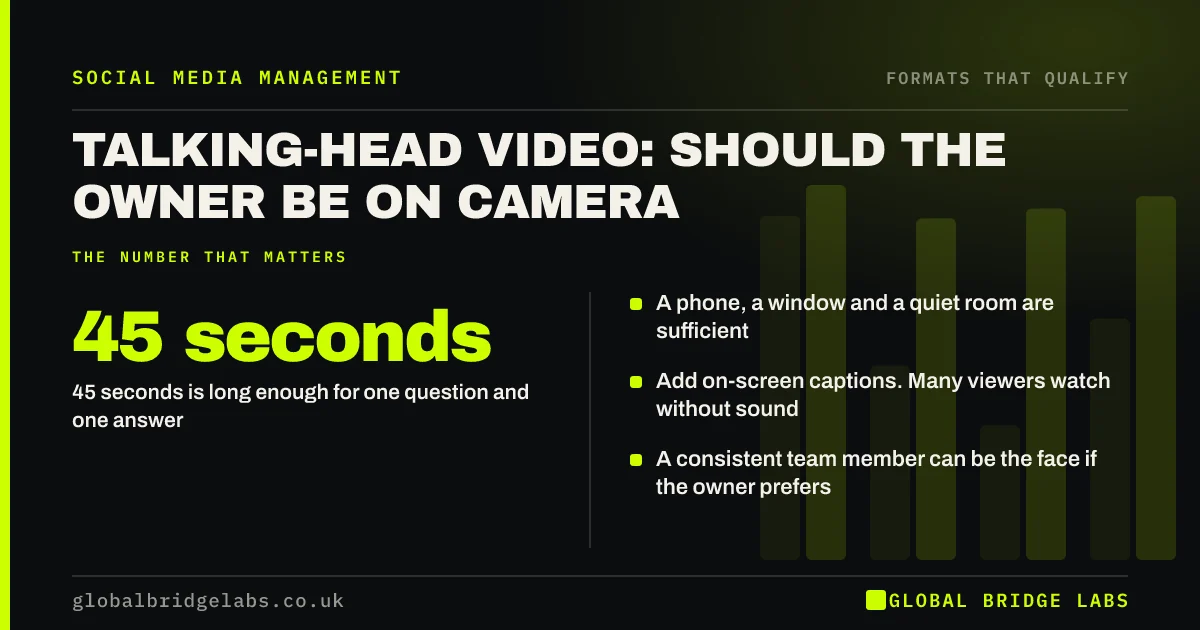
- 45 seconds is long enough for one question and one answer.
- A phone, a window and a quiet room are sufficient.
- Add on-screen captions. Many viewers watch without sound.
- A consistent team member can be the face if the owner prefers.
Want scripts for your first five videos? Message us on WhatsApp.
Chat on WhatsApp →What is talking-head video?
Talking-head video is footage of one person, framed from the chest up, speaking to the viewer. It is the simplest video a business can make and one of the most personal. A buyer hears how you explain things and judges whether they would like to deal with you.
When does putting a person on camera help?
It helps most when the purchase involves trust in an individual: professional advice, work inside someone's home, health, care and consultancy. It helps less for standard products, where the item itself should be the star. If customers say 'I felt I knew you already', it is working.
What should you say in 45 seconds?
Answer one customer question. Open with the question, give the direct answer, add one reason or example, and close with a next step. Write three bullet points, not a full script, so you sound like yourself. One take with a small stumble is better than a stiff reading.
- 0 to 3 seconds: the question, on screen and spoken.
- 3 to 15 seconds: the direct answer.
- 15 to 35 seconds: the reason or an example.
- 35 to 45 seconds: one next step.
- Turn customer questions into FAQ posts on social media
- Social media hooks that stop the right people scrolling
Send us a customer question on WhatsApp and we will outline the 45 seconds. Let us discuss your requirements.
Chat on WhatsApp →How do you film it properly with a phone?
Face a window, hold the phone at eye level on a stand, and record in a quiet room. Film upright for short-form feeds. Look at the lens, not the screen. Add captions afterwards. Sound matters more than picture, so a small clip-on microphone is the one purchase worth making.
- Light from a window in front of you.
- Phone at eye level on a stand.
- A quiet room, or a clip-on microphone.
- Captions added before posting.
What if you do not want to be on camera?
Then do not be. Choose a team member who is comfortable and knowledgeable, use a voiceover across footage of the work, or film hands and process without a face. The trust comes from a consistent, real human presence. It does not have to be yours.
What are the risks?
The risks are dependence on one person, who may leave or tire of it, and saying something inaccurate without a second pair of eyes. Share the role between two people where you can, and have someone review each video before it goes out, especially in regulated sectors.
What does this look like in practice?
A pattern we see with UK owner-managed firms: the owner films five answers in one 40-minute session each month, after weeks of putting it off, and finds the fifth far easier than the first. Batching removes most of the reluctance.
Talking-head video checklist
Before you post.
- One question, one answer.
- The question is on screen in the first seconds.
- Under about 45 seconds.
- Sound is clear.
- Captions are added.
- It ends with one next step.
Next step
Write down five questions customers asked this month and film all five in one sitting. Post one a week.
Message us on WhatsApp for the 45-second outline sheet, or book a 30-minute consultation.
Chat on WhatsApp →Sources and further reading
- Measure key moments for audience retention · YouTube Help
- TikTok for Business · TikTok
- WCAG 2 overview · W3C Web Accessibility Initiative
Frequently asked questions
Should a business owner show their face on social media?
It helps where buyers are choosing a person to trust, such as advice, care or work in their home. It is not essential. A consistent, credible team member, or a voiceover across footage of the work, can do the same job.
How long should a talking-head video be?
About 30 to 60 seconds for short-form feeds, which is enough for one question and one answer. Longer explanations suit YouTube or a carousel. If it needs more than a minute, split it into two videos. Check the retention graph to see where viewers leave.
What equipment do I need?
A phone, a stand and a window. A clip-on microphone is the most worthwhile extra, because poor sound loses viewers faster than poor picture. Add captions in the app before posting. A plain background and a steady frame matter more than an expensive camera or lighting kit.
How do I get comfortable on camera?
Film in batches, use bullet points instead of a script, and talk as you would to a customer in front of you. Most people find the fifth video far easier than the first. Do not aim for a perfect take.
Written by

Global Bridge Labs (GBL) is a UK–Sri Lanka partner for social media, websites and BPO. Everything here comes from client delivery, not theory.