On this page
- 01Key takeaways
- 02What is employee advocacy?
- 03Why does it help consistency?
- 04How do you set it up simply?
- 05What policy do you need?
- 06What should you avoid?
- 07What does this look like in practice?
- 08What makes a good advocacy post?
- 09How do you measure advocacy?
- 10Next step
- 11Sources and further reading
- 12Frequently asked questions
Key takeaways
Employee advocacy means staff sharing and creating content about the business on their own social profiles. For small businesses it extends reach to people who trust your staff and adds consistency beyond one company page. Keep it voluntary, easy and light: two or three willing people, one ready-to-share post a week and a short policy.
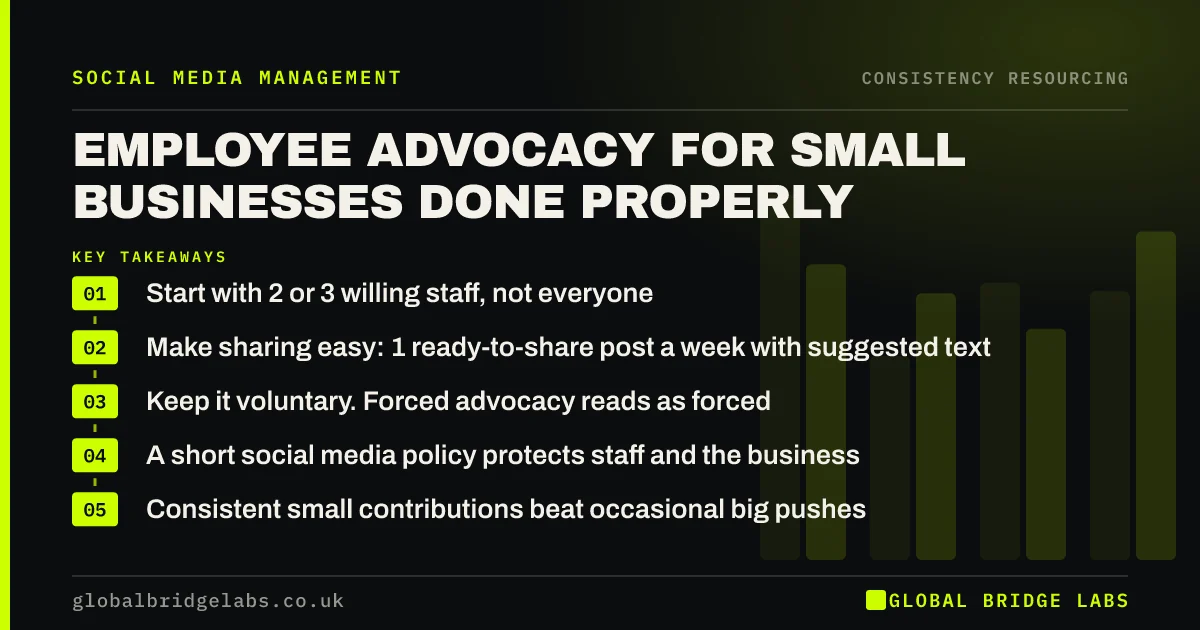
- Start with 2 or 3 willing staff, not everyone.
- Make sharing easy: 1 ready-to-share post a week with suggested text.
- Keep it voluntary. Forced advocacy reads as forced.
- A short social media policy protects staff and the business.
- Consistent small contributions beat occasional big pushes.
Want an employee advocacy plan for your team? Message us on WhatsApp.
Chat on WhatsApp →What is employee advocacy?
Employee advocacy is the practice of employees promoting their organisation through their own social media, by sharing company posts, writing about their work or commenting on industry topics. Their networks often trust them more than company pages, and personal posts often reach more people on LinkedIn than page posts.
Why does it help consistency?
Because it spreads the effort. When several people contribute occasionally, the business stays visible even when the main account slows. It also multiplies repeated exposure: buyers see your business through several trusted people rather than one page.
How do you set it up simply?
- Ask who wants to take part. Two or three volunteers is enough to start.
- Share one ready-to-post item a week with suggested text they can edit.
- Encourage staff to post about their own work, in their own words.
- Celebrate contributions internally, without targets.
- Review quarterly what worked.
Want a weekly advocacy post pack for your team? Message us on WhatsApp.
Chat on WhatsApp →What policy do you need?
A short social media policy that explains what staff can and cannot share, how to handle confidential information and client names, and what to do if they receive a complaint or negative comment. Acas and other UK employment advice bodies recommend clear, reasonable policies that respect staff privacy.
What should you avoid?
- Making advocacy compulsory or linked to performance reviews.
- Asking staff to post identical text. It looks coordinated and reads as advertising.
- Sharing client details without permission.
- Promotional posts that should be labelled as ads under ASA rules.
- Overloading staff with daily requests.
What does this look like in practice?
A UK surveying firm asked for volunteers and three surveyors agreed to post occasionally on LinkedIn about interesting jobs. The firm sent them one suggested post a week, which they rewrote in their own words. Over six months, their posts regularly reached more people than the company page, and two new instructions came from contacts of the surveyors.
What makes a good advocacy post?
- It is about the person's own work, in their own words.
- It includes a specific detail: a job, a problem solved, a lesson.
- It mentions the business naturally, not as an advert.
- It respects client confidentiality.
- It invites conversation rather than pushing a sale.
How do you measure advocacy?
Keep it light. Track how many staff posted, reach and engagement on their posts where they are happy to share it, enquiries or candidates that mention a staff member's post, and changes in company page followers. Review quarterly and thank contributors.
Next step
Ask your team who would like to take part, write a one-page policy and send the first weekly post next Monday.
Message us on WhatsApp and we will help you launch employee advocacy.
Chat on WhatsApp →Sources and further reading
- LinkedIn Pages best practices · LinkedIn
- Recognising ads: social media and influencer marketing · ASA / CAP
- LinkedIn relevance: optimising the member experience · LinkedIn Help
Frequently asked questions
What is employee advocacy on social media?
Employees sharing or creating content about their organisation on their own social profiles. It extends reach to their networks and builds trust, because people often trust individuals more than company pages.
Should employee advocacy be compulsory?
No. Voluntary participation produces more authentic posts and avoids employment relations problems. Start with willing volunteers and make it easy and rewarding.
Do employees need a social media policy?
Yes. A short policy explaining what can be shared, how to handle confidential information and complaints, and how personal and business posting differ protects both staff and the business.
Does employee advocacy work for small businesses?
Yes, often better than for large companies, because staff in small businesses have direct, visible roles in the work. Two or three people posting occasionally can meaningfully extend reach.
Do employees need to disclose they work for the business?
Where staff post about their employer's products or services, it should be clear they work there. In most cases their profile shows this, but promotional posts should make the connection obvious to avoid misleading followers, in line with ASA guidance on recognising ads.
Written by

Global Bridge Labs (GBL) is a UK–Sri Lanka partner for social media, websites and BPO. Everything here comes from client delivery, not theory.