On this page
- 01Key takeaways
- 02Do you have to make video?
- 03Which channels work on text and photography?
- 04What makes non-video content work?
- 05What are the workarounds that do not work?
- 06How would you add video later?
- 07What does this look like in practice?
- 08What should a photo-led business photograph?
- 09Next step
- 10Sources and further reading
- 11Frequently asked questions
Key takeaways
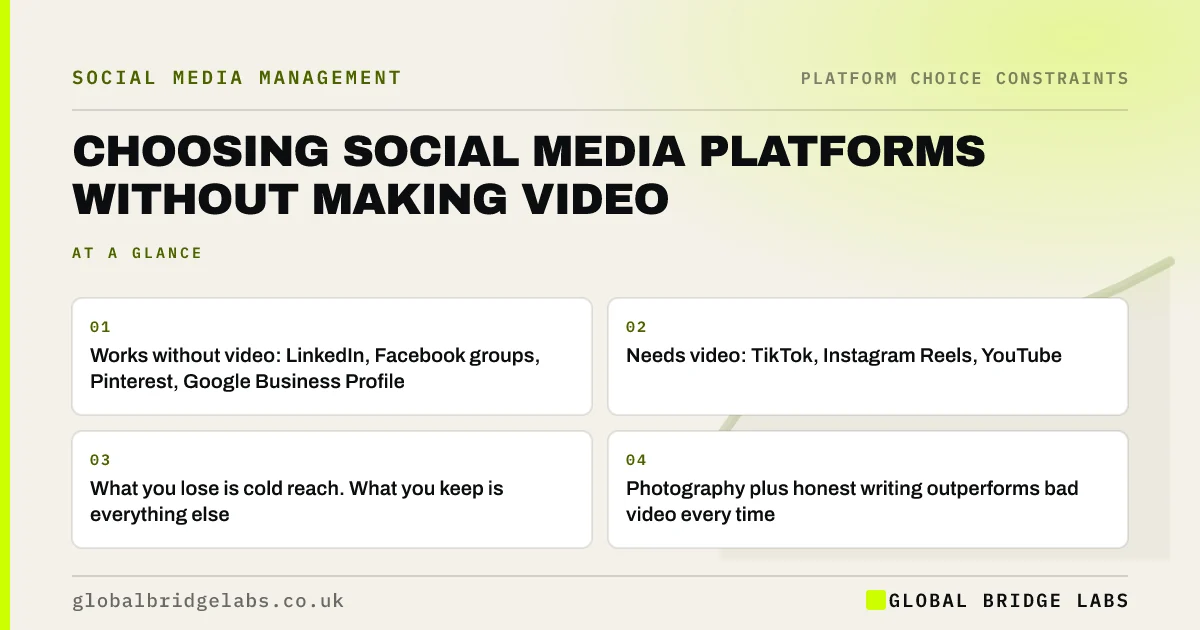
LinkedIn, Facebook groups, Pinterest and a Google Business Profile all work without any video at all. What you give up is cold reach: video is the only format that reliably reaches people who have never heard of you.
- Works without video: LinkedIn, Facebook groups, Pinterest, Google Business Profile.
- Needs video: TikTok, Instagram Reels, YouTube. No workaround exists.
- What you lose is cold reach. What you keep is everything else.
- Photography plus honest writing outperforms bad video every time.
- If you add video later, start with one talking-head clip a fortnight.
Do not want to be on camera? We will build a plan without it. Ask on WhatsApp.
Chat on WhatsApp →Do you have to make video?
No. Several channels work well without it, and a business that dislikes video will make bad video, which is worse than no video. The honest advice is to choose channels that match what you will actually produce.
What you give up is cold reach. Short-form video is the only format that reliably shows a small business to strangers, so a no-video strategy will grow more slowly and depend more on search, recommendation and existing networks.
Which channels work on text and photography?
Four, and between them they cover most UK small business needs.
- LinkedIn: text-first by design. Video is optional and often unnecessary.
- Facebook groups: conversation, not content. Video adds almost nothing there.
- Pinterest: still images, and vertical photography works perfectly.
- Google Business Profile: photographs, hours, reviews and questions.
- Instagram grid and carousels: workable, though reach is now video-led.
What makes non-video content work?
Specificity, which is the thing video is actually good at conveying and which text can do better if you let it. A post describing exactly what a job involved, what it cost and what went wrong carries more weight than a polished clip saying nothing.
Photography matters more when there is no video. One well-lit photograph of real work beats five poor ones, and a phone in daylight is entirely sufficient. What fails is stock imagery, which readers identify instantly and discount.
We will build a photo and text content system for you. Message us on WhatsApp.
Chat on WhatsApp →What are the workarounds that do not work?
Three that businesses try when they want video reach without making video. Animated text slides, which perform poorly and look automated. Stock footage with captions, which is identified immediately. And synthetic presenters, which currently read as inauthentic to most UK audiences and undermine the trust you were trying to build.
Slideshow-style posts made from still photographs are the one partial exception, because the images are genuinely yours. They perform below real video and above the alternatives.
How would you add video later?
Slowly, and without appearing on camera if that is the barrier. Most useful business video has no presenter at all: hands working, a process running, a before and after, with text on screen.
If you do want to appear, start with one clip a fortnight answering a question a customer actually asked. Two minutes, phone on a shelf, no script. The first ten are uncomfortable and the eleventh is fine, which is roughly five months at that cadence.
What does this look like in practice?
A UK chartered surveyor was told repeatedly that the practice needed video and found the prospect genuinely unpleasant. Two attempts produced stilted content that was worse than the written posts it replaced.
Committing to text and photography on a professional network, with detailed posts about real valuation problems and what they cost clients, produced consistent enquiries over the following year. No video was ever made. The channel worked because the content was specific, which was always the actual requirement.
What should a photo-led business photograph?
The work, in progress and finished, and the people doing it. Those two subjects cover almost everything a UK service business needs and both are available as a by-product of trading.
Shoot in daylight, get closer than feels natural, and take the photograph before you tidy up as well as after. Process shots consistently outperform finished shots for trust, because anyone can photograph a finished kitchen and only the person who built it can photograph the second fix.
Keep them. A folder of a hundred job photographs is a year of content, and the businesses that struggle for things to post are almost always the ones who did not take the picture at the time.
One practical rule: photograph something every day you are working, even when you have no plan for it. The cost is thirty seconds and it removes the blank page problem permanently.
Next step
Pick one channel that works without video and commit to it rather than producing video you dislike. Bad video damages credibility more than no video does, and specificity in writing is available to anyone who knows their trade.
Message us on WhatsApp and we will plan a channel that needs no video at all.
Chat on WhatsApp →Sources and further reading
- LinkedIn Pages best practices · LinkedIn
- Pinterest Business help: get started · Pinterest
Frequently asked questions
Can a business succeed on social media without video?
Yes. LinkedIn, Facebook groups, Pinterest and a Google Business Profile all work perfectly well on text and photography alone. What you give up is cold reach, since short-form video is the only format that reliably shows a small business to strangers.
Which social platforms need video?
TikTok, Instagram Reels and YouTube, and there is no genuine workaround. Animated text slides, stock footage and synthetic presenters all perform poorly and are recognised by audiences quickly, which costs more trust than the additional reach is worth.
What makes non-video social content work?
Specificity. A post describing exactly what a job involved, what it cost and what went wrong carries more weight than a polished clip saying nothing. One well-lit real photograph beats five poor ones or any stock image.
How do you start making video if you dislike being on camera?
Most useful business video has no presenter: hands working, a process running, before and after, with text on screen. If you do want to appear, one two-minute clip a fortnight answering a real customer question is enough.
Written by
Global Bridge Labs (GBL) is a UK–Sri Lanka partner for social media, websites and BPO. Everything here comes from client delivery, not theory.