On this page
- 01Short answer
- 02Why does short-form video matter for small businesses?
- 03What kit do you actually need?
- 04Which three formats work for business video?
- 05How do you write the first two seconds?
- 06What wastes a shoot day?
- 07How do you know if video is working?
- 08What does this look like in practice?
- 09How do you keep video production sustainable?
- 10Next step
- 11Sources and further reading
- 12Frequently asked questions
Short answer
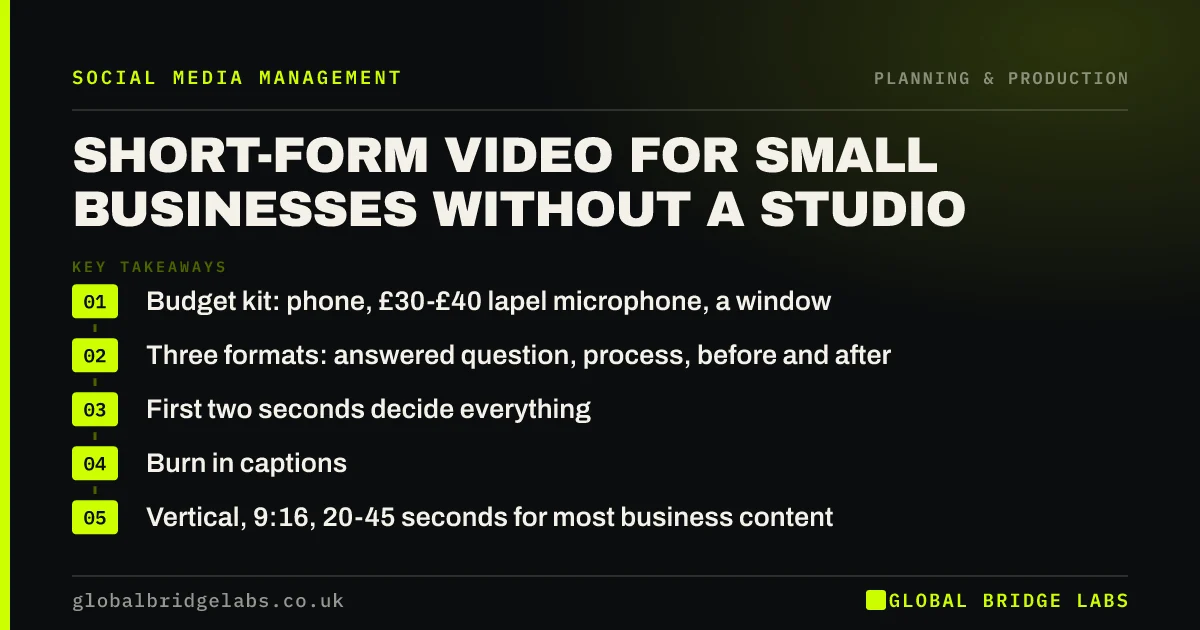
You need a recent phone, natural light, a clip-on microphone under £40 and a written shot list. Three formats carry almost all small business short-form video: the answered question, the process clip and the before and after. Sound quality matters more than picture quality, and captions are not optional.
- Budget kit: phone, £30-£40 lapel microphone, a window. Under £60 total.
- Three formats: answered question, process, before and after.
- First two seconds decide everything. Lead with the outcome or the problem.
- Burn in captions. A large share of social video is watched with sound off.
- Vertical, 9:16, 20-45 seconds for most business content.
Want a shot list for your first video batch? Message us on WhatsApp.
Chat on WhatsApp →Why does short-form video matter for small businesses?
Because every major platform currently distributes short video to people who do not already follow you, which is the only cheap way for a small account to reach new buyers.
There is a second, less discussed benefit. Video does trust work that text cannot. A 30-second clip of the person who will turn up at your house removes more hesitation from a domestic buying decision than any amount of written copy.
What kit do you actually need?
Less than you think, and in this order of importance.
- Audio: a clip-on lapel microphone, £30-£40. This is the single biggest quality gain available.
- Light: a window, filmed facing it. Free, and better than most cheap LED panels.
- Stability: a small tripod or a flat surface. Handheld reads as unplanned.
- Camera: the phone you already own. Any phone from the last four years is sufficient.
- Editing: the native platform editor or a free mobile editor. Do not start with desktop software.
Which three formats work for business video?
The answered question: a real question from a customer, answered straight to camera in 30 seconds. Highest trust value, lowest production cost, and infinitely repeatable because customers keep asking.
The process clip: 20 seconds of work happening, with a caption explaining what is being done and why it matters. Works with no speaking, which suits teams who dislike being on camera.
The before and after: the format with the highest completion rate in trades, hospitality and anything visual. Show the after first, then the before, then the after again.
How do you write the first two seconds?
Open with the outcome, the problem or the number. Never with a greeting, your name, or the phrase in this video.
Compare: Hi everyone, today I want to talk about boiler servicing, against, This is what a £90 service should include, and what most people are not getting. The second one gives a reason to stay before the viewer has decided to scroll.
Send us three video ideas on WhatsApp and we will write the opening lines for you.
Chat on WhatsApp →What wastes a shoot day?
Filming without a shot list, which turns a two-hour session into an afternoon. Chasing perfect delivery, when the third take is almost always good enough and the eighth is worse. And filming horizontally out of habit, which forces a crop that ruins the framing.
One more, specific to small businesses: filming content that requires ongoing editing skill to maintain. If the format needs two hours of editing per clip, it will be abandoned by the third month regardless of how well it performs.
How do you know if video is working?
Watch two numbers: the percentage still watching at three seconds, and average watch time as a share of length. The first tests your opening, the second tests whether the content delivered on it.
If three-second retention is low, rewrite openings. If retention is fine but watch time drops midway, the clip is too long for its content. Cut it rather than adding to it. Views and likes are downstream of both and tell you much less.
What does this look like in practice?
A pattern in camera-shy teams: video resisted for a year on the basis that nobody wants to be filmed. The way in is process clips only, with no speaking and captions over twenty seconds of work.
Those clips routinely outperform the photo content they replace, and within a couple of months some of the team are usually comfortable answering questions to camera, because they have seen how their work is received. Starting with the format that requires the least exposure is how most camera-shy teams end up on camera.
How do you keep video production sustainable?
Fix the format so that only the subject changes. The reason video programmes stop after two months is that each one is designed from scratch, which turns a thirty-minute job into a half day.
Pick three templates and reuse them: the same opening structure, the same caption style, the same length, the same ending. Once the format is fixed, the work is answering a different question rather than making a different video, and the production time falls by more than half.
Keep everything. Unused footage, second takes and detail shots become filler and background for later clips, and the businesses that sustain video longest are the ones with a library rather than the ones with the best camera.
- Three fixed templates, changing only the subject.
- Same opening, caption style, length and ending.
- Keep unused footage. It becomes later filler.
- Design the format once, then stop designing.
Next step
Video is the highest-leverage format currently available to a small UK business, and the barrier is process rather than budget.
Message us on WhatsApp for a short-form video plan and shot list for your business.
Chat on WhatsApp →Sources and further reading
- TikTok for Business · TikTok
- Create a YouTube channel · YouTube Help
Frequently asked questions
What equipment do I need for social media video?
A phone from the last four years, a £30-£40 clip-on microphone, a window for light and a small tripod. Audio is the biggest quality gain per pound spent. Viewers tolerate imperfect picture far more readily than they tolerate poor sound.
How long should a business video be?
Twenty to forty-five seconds for most business content. Long enough to answer one question properly, short enough to be watched to the end. Completion rate matters more to distribution than length, so cut anything that does not earn its seconds.
Do I need to be on camera for my business?
No. Process clips with captions and no speaking perform well, especially in trades, manufacturing and hospitality. Start there if the team is reluctant. Many people become comfortable on camera once they have seen the response to their work.
Should I add captions to social videos?
Always. A large share of social video is watched with sound off, and burned-in captions also improve completion for viewers who do have sound on. Use the platform's caption tool but check it, because it mishandles trade terms and UK place names.
Written by

Global Bridge Labs (GBL) is a UK–Sri Lanka partner for social media, websites and BPO. Everything here comes from client delivery, not theory.