On this page
- 01Short answer
- 02Why do approval processes kill social media?
- 03What actually needs approval?
- 04How do you keep approval fast?
- 05What about regulated industries?
- 06Who should hold publishing access?
- 07What does this look like in practice?
- 08What do you do when something wrong gets published?
- 09Next step
- 10Sources and further reading
- 11Frequently asked questions
Short answer
Approve categories, not posts. Agree in advance which content types are pre-approved, which need one named approver, and which need legal or director sign-off. Most small business content should need no approval at all, and the approval that remains should have a 24-hour default-yes rule.
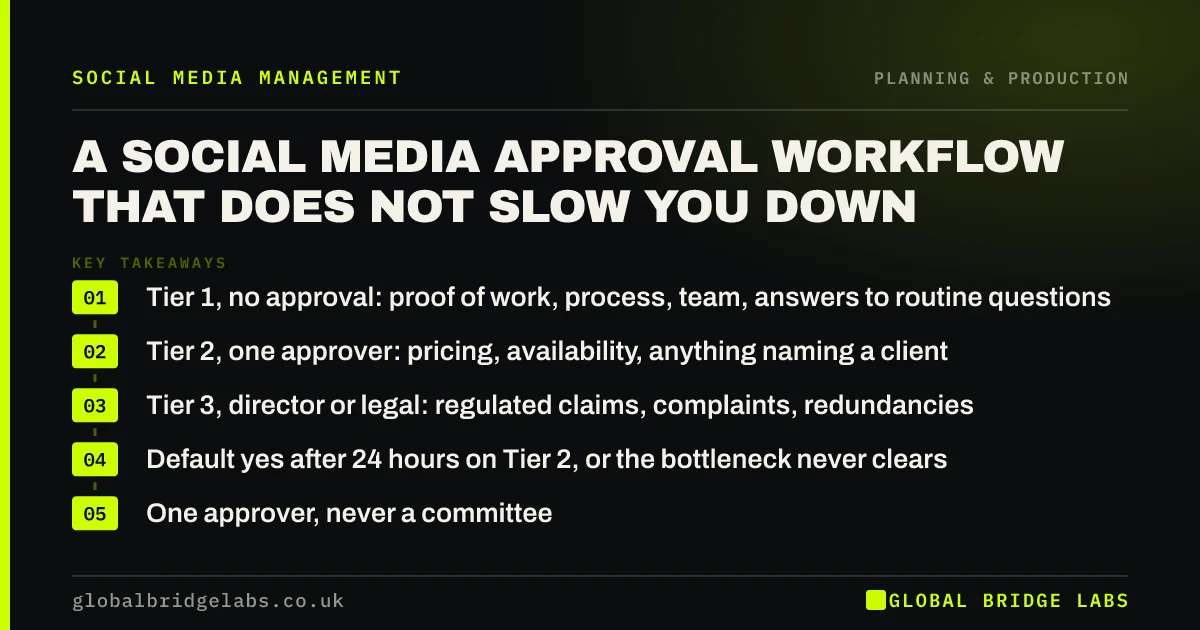
- Tier 1, no approval: proof of work, process, team, answers to routine questions.
- Tier 2, one approver: pricing, availability, anything naming a client.
- Tier 3, director or legal: regulated claims, complaints, redundancies, anything topical.
- Default yes after 24 hours on Tier 2, or the bottleneck never clears.
- One approver, never a committee. Two approvers doubles the delay and halves the accountability.
Want this mapped to your business and risk tolerance? Message us on WhatsApp.
Chat on WhatsApp →Why do approval processes kill social media?
Because social media is time-sensitive and approval is not. A post that needed to go out on Tuesday and is approved on Friday has usually lost most of its value, and the team learns to stop proposing anything time-sensitive.
The deeper cost is what gets self-censored. When approval is slow and unpredictable, people propose only safe content, which is exactly the content that performs worst.
What actually needs approval?
Far less than most businesses assume. The honest test is whether a mistake in this post would cost money, breach a regulation, or damage a client relationship. If not, it does not need a second pair of eyes.
- Needs approval: prices, claims about results, anything naming a customer, anything about a live incident.
- Does not need approval: photos of completed work, process explanations, team content, answers to questions you answer daily.
- Always needs director sign-off: staffing changes, responses to complaints that have escalated, anything referencing a competitor.
How do you keep approval fast?
Three rules. One named approver with a named deputy, so absence does not stop publishing. A 24-hour window with default yes, so silence does not become a veto. And approval on the batch rather than post by post, reviewed once a month at the planning session.
Batch approval is the change that usually matters most. Reviewing twenty posts in twenty minutes once a month is a fundamentally different task from reviewing one post twenty times.
Send us your current approval chain on WhatsApp and we will tell you where the delay actually is.
Chat on WhatsApp →What about regulated industries?
Financial services, healthcare and legal services carry genuine constraints, and the approach there is to pre-approve language rather than to approve posts.
Build a library of approved phrasings for the things you say repeatedly, get that signed off once, and let the team assemble content from it. A financial adviser with fifteen pre-approved ways of describing their service can publish daily without a compliance review each time.
Who should hold publishing access?
As few people as possible, with the business owning every account. The most common and most damaging governance failure in small businesses is discovering that a former employee or a previous agency holds the only administrator access to a page.
Use a business account structure where the company is the owner, grant individual access rather than sharing passwords, and run an access review every six months and on every departure.
What does this look like in practice?
A pattern wherever approval has three people in it: roughly half of what was planned gets published, the average delay runs into days, and nothing topical ever survives.
Cutting to one approver, pre-approving whole content categories and moving to monthly batch approval reliably fixes it. The publishing rate rises sharply and the approver usually spends less time on it than before, because twenty minutes once a month replaces a stream of individual requests.
What do you do when something wrong gets published?
Decide the procedure now, because the instinct in the moment is to delete quietly, which is usually the worst option available.
The rule we recommend: a typo or wrong detail is corrected within the hour with a note saying what changed. A factual error that people have already engaged with is corrected publicly in the same place rather than removed. Something genuinely damaging is taken down, escalated to the decision-maker immediately, and explained rather than left as a visible gap.
Then record what happened and which control would have caught it. Most published errors in small businesses trace back to one person publishing at speed without the single check the approval tier was designed to provide.
- Typo or wrong detail: correct within the hour and note the change.
- Factual error with engagement: correct in public, do not delete.
- Genuinely damaging: remove, escalate immediately, explain.
- Log the cause and the control that would have caught it.
Next step
If your team is producing content that never gets published, the constraint is the workflow, not the content.
Message us on WhatsApp and we will redesign your social media approval workflow in 30 minutes.
Chat on WhatsApp →Sources and further reading
- Recognising ads: brand-owned and paid social media · ASA / CAP
- Lawful basis for processing personal data · Information Commissioner's Office
Frequently asked questions
Who should approve social media posts in a small business?
One named person, with a named deputy for absence. Committees double the delay and dilute accountability. Most content should be pre-approved by category so that only pricing, client-naming and regulated claims reach the approver at all.
How do you stop approval delaying publishing?
Approve batches monthly rather than posts individually, and set a 24-hour default-yes rule so silence cannot become a veto. Those two changes alone typically take publishing rates from around half of planned posts to above ninety percent.
What should never be published without sign-off?
Prices, claims about results, anything naming a client, responses to escalated complaints, staffing changes, and anything referencing a live incident or a competitor. Everything else, including proof of work and process content, can safely be pre-approved by category.
Who should own our social media accounts?
The business, through a business account structure, with individual access granted per person rather than shared passwords. Review access every six months and on every departure. Losing administrator access to a former employee or agency is a common and expensive failure.
Written by

Global Bridge Labs (GBL) is a UK–Sri Lanka partner for social media, websites and BPO. Everything here comes from client delivery, not theory.