On this page
- 01Key takeaways
- 02Why are some roles so hard to fill?
- 03What does an unfilled role cost?
- 04When should you stop recruiting and outsource?
- 05Which roles suit outsourcing and which do not?
- 06How does the cost compare with the hire you cannot find?
- 07How do you make an outsourced role work like a hire?
- 08When should you keep recruiting?
- 09How do you make the in-house part of the role easier to fill?
- 10What does this look like in practice?
- 11Recruitment gap checklist
- 12Next step
- 13Sources and further reading
- 14Frequently asked questions
Key takeaways
If you are struggling to recruit staff in the UK for admin, reception or support roles, check how long the vacancy has been open and what the gap costs each week. If a repeatable role has been unfilled for more than two months, or hires keep leaving, an outsourced team can cover the work within weeks while you decide whether to keep recruiting.
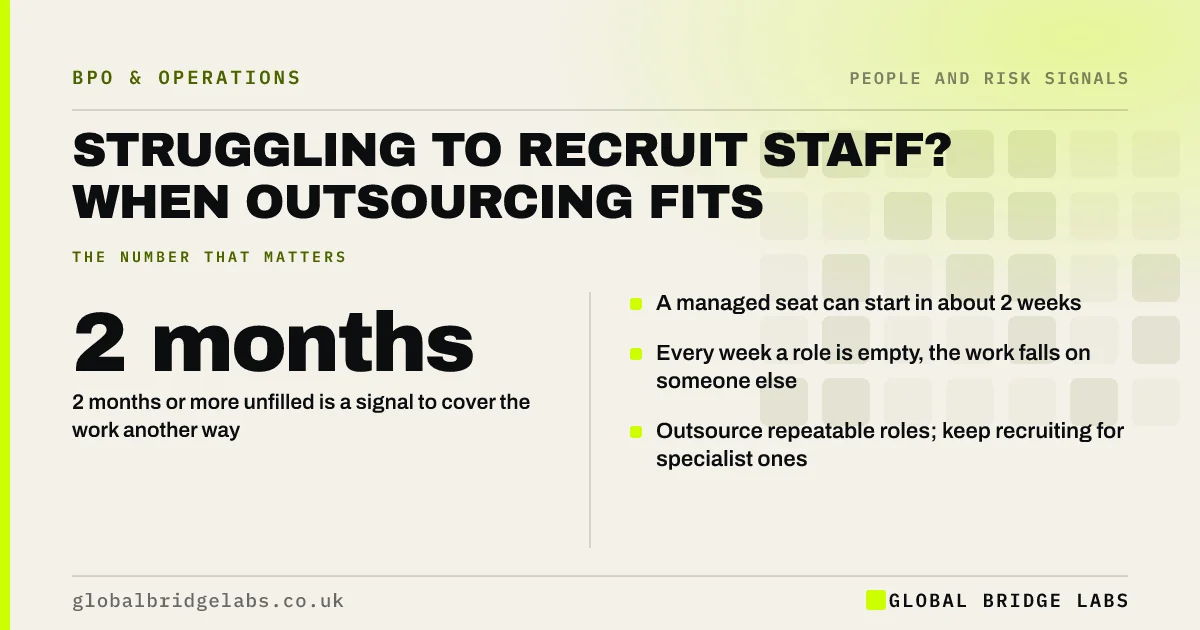
- 2 months or more unfilled is a signal to cover the work another way.
- A managed seat can start in about 2 weeks.
- Every week a role is empty, the work falls on someone else.
- Outsource repeatable roles; keep recruiting for specialist ones.
Role still unfilled? Message us on WhatsApp with the job description.
Chat on WhatsApp →Why are some roles so hard to fill?
Admin, reception and customer service roles in small businesses compete with larger employers offering hybrid work, progression and higher pay. Local labour markets vary, and roles needing early starts, evenings or specific software skills attract fewer applicants. The ONS publishes regular data on UK vacancies, and hard-to-fill roles persist even when overall vacancies fall.
What does an unfilled role cost?
An unfilled role costs the work that does not get done or gets done by someone more expensive. Usually the owner or a senior employee covers it, at their hourly value, while their own work slips. Add recruitment costs, repeated adverts, interview time and the risk of a rushed hire who leaves within months.
- Owner or senior time covering the role.
- Missed calls, slow replies and late invoices.
- Advertising, agency fees and interview time.
- Overtime for the rest of the team.
Want to put a weekly cost on your vacancy? Send us the details on WhatsApp.
Chat on WhatsApp →When should you stop recruiting and outsource?
Consider outsourcing when a repeatable role has been open for more than two months, when two or more hires have left within a year, or when the work needs cover beyond one person anyway. Outsourcing does not have to be permanent: many businesses cover the gap while they keep recruiting, then decide.
Which roles suit outsourcing and which do not?
Roles built around repeatable, remote-friendly processes suit outsourcing: phones, email, booking, data entry, order processing and invoicing. Roles that need someone physically present, such as front-desk reception, or specialist judgement, such as a qualified bookkeeper signing off accounts, usually need a hire.
How does the cost compare with the hire you cannot find?
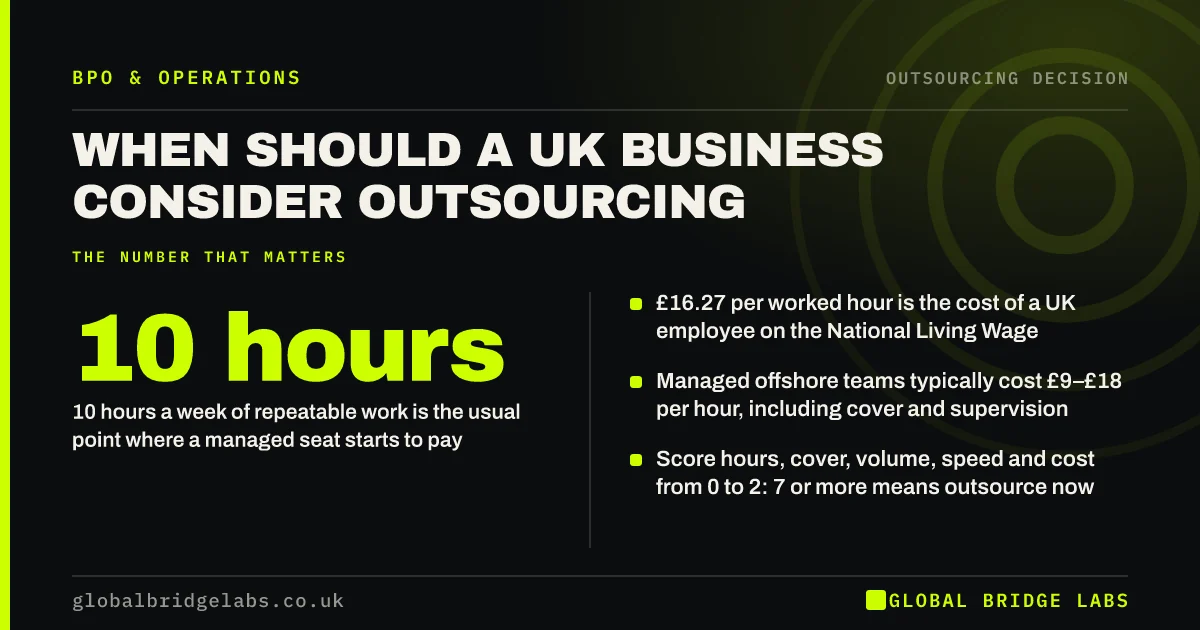
A full-time employee on the National Living Wage of £12.71 costs about £28,309 a year with employer National Insurance and pension, about £16.27 per worked hour before recruitment and overheads. Managed offshore teams cost an indicative £9–£18 per hour including cover. Often the outsourced option costs no more than the hire you were trying to make.
How do you make an outsourced role work like a hire?
Treat the onboarding like a new starter's. Write down the tasks, give access to the systems, introduce the team lead to your staff, and review work closely for the first few weeks. Ask for the same named people each day where possible, so your team and customers get to know them.
When should you keep recruiting?
Keep recruiting when the role is central to your culture or customer relationships, when it needs someone on site, or when you are building a future team leader. In those cases, use outsourcing only to cover the gap and to document the role, so the eventual hire has a written process to learn from.
How do you make the in-house part of the role easier to fill?
Make it smaller, clearer and more attractive. Once the repeatable, interrupt-heavy tasks are outsourced, the remaining role often becomes a coordinator or customer-facing position with more variety and fewer evenings. That is easier to advertise, can sometimes be part-time or flexible, and attracts candidates who would not apply for an overloaded all-rounder job.
- Rewrite the advert around the smaller, clearer role.
- Offer part-time or flexible hours where the work allows.
- Mention the support and cover behind the role.
- Show progression, even in a small team.
What does this look like in practice?
A pattern we see in UK clinics and trades firms outside big cities: the same receptionist or office administrator advert runs three times in six months with few suitable applicants. An outsourced team covering phones and booking fills the gap within a fortnight, and the business keeps a smaller in-person role that is easier to recruit for.
Recruitment gap checklist
Use this when a role will not fill.
- Note how long the role has been open.
- Estimate the weekly cost of the gap.
- Split the role into on-site and remote tasks.
- Cost an outsourced seat for the remote tasks.
- Cover the gap while recruiting if needed.
- Document the role so any future hire can learn it.
Next step
Send us the job description that will not fill. We will tell you honestly whether an outsourced team could cover it and what it would cost.
Message us on WhatsApp with the role, or book a 30-minute consultation.
Chat on WhatsApp →Sources and further reading
- Vacancies and jobs in the UK (latest bulletin) · Office for National Statistics
- National Minimum Wage and National Living Wage rates · GOV.UK
- Rates and thresholds for employers 2026 to 2027 · HM Revenue & Customs
- Workplace pensions: what you, your employer and the government pay · GOV.UK
Frequently asked questions
What can I do if I cannot find staff?
Split the role into on-site and remote tasks, cover the remote, repeatable tasks with an outsourced team, and keep recruiting for anything that needs presence or specialist judgement. Improving pay, flexibility and the job advert helps, but outsourcing gets the work done in the meantime.
Is outsourcing a good alternative to hiring?
For repeatable, remote-friendly work, often yes. It starts in about two weeks, includes cover and can scale monthly. For roles central to culture, relationships or on-site service, hiring is usually better. Many businesses combine an in-house lead with outsourced volume.
How long should I try to recruit before outsourcing?
If a repeatable role has been open for more than two months, or hires keep leaving, outsourcing the work is worth testing. You can keep recruiting in parallel and decide later whether to keep the outsourced cover.
Written by

Global Bridge Labs (GBL) is a UK–Sri Lanka partner for social media, websites and BPO. Everything here comes from client delivery, not theory.