On this page
- 01Key takeaways
- 02What is the cost of not outsourcing?
- 03How do you calculate the cost of waiting?
- 04What does owner time really cost?
- 05How much do slow replies cost?
- 06What are the people costs of waiting?
- 07Which costs of waiting are easiest to miss?
- 08When is waiting the right call?
- 09What does this look like in practice?
- 10Cost of waiting checklist
- 11Next step
- 12Sources and further reading
- 13Frequently asked questions
Key takeaways
The cost of not outsourcing is the monthly total of owner and skilled-staff hours spent on repeatable work, enquiries lost to slow replies, overtime, and the recruitment cost when overloaded staff leave. For many UK SMEs it is larger than the price of a managed seat, but it never appears on an invoice.
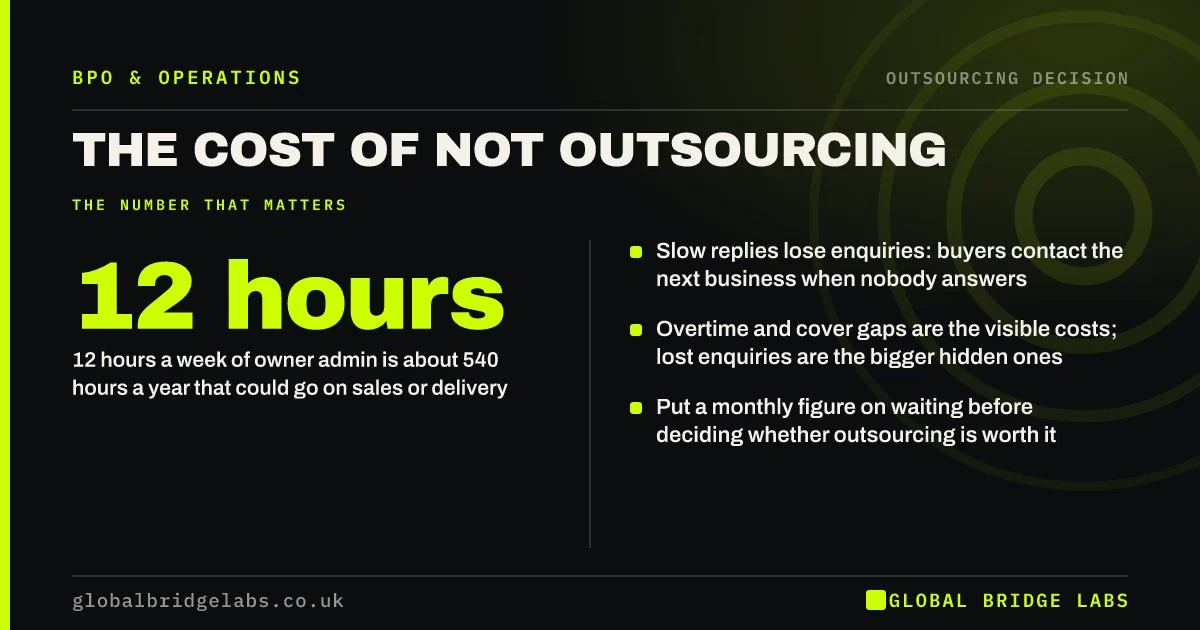
- 12 hours a week of owner admin is about 540 hours a year that could go on sales or delivery.
- Slow replies lose enquiries: buyers contact the next business when nobody answers.
- Overtime and cover gaps are the visible costs; lost enquiries are the bigger hidden ones.
- Put a monthly figure on waiting before deciding whether outsourcing is worth it.
Want to put a number on what waiting is costing you? Message us on WhatsApp.
Chat on WhatsApp →What is the cost of not outsourcing?
The cost of not outsourcing is the value lost each month by keeping repeatable work with people whose time is worth more elsewhere, or by leaving it undone. It includes time, missed revenue and staff costs. Because none of it arrives as a bill, it is usually underestimated until someone adds it up.
How do you calculate the cost of waiting?
Add four numbers for one month. Each can be estimated from a two-week log and your enquiry records. The total is the cost of doing nothing, and it is the number any outsourcing quote should be compared with.
- Owner and senior hours on repeatable work x the value of their time.
- Enquiries unanswered or answered late x conversion rate x average sale.
- Overtime and temporary cover paid.
- Errors, write-offs and late payments caused by admin delays.
Send us your four numbers on WhatsApp and we will compare them with a managed team.
Chat on WhatsApp →What does owner time really cost?
Owner time is the most expensive time in a small business, because it is the only time that wins big contracts, sets prices and fixes problems. An owner who spends 12 hours a week on admin gives up about 540 hours a year after holidays. Even valued at £50 an hour, that is £27,000 of capacity.
The real loss is what does not happen: the quotes not followed up, the partnership not pursued, the price rise not implemented.
How much do slow replies cost?
Slow replies cost the enquiries that go elsewhere. If a business gets 40 enquiries a month, loses 5 to slow replies, converts 25% and averages £2,000 a job, the monthly cost is £2,500. That single line is often larger than the monthly price of a part-time managed seat.
Customers notice speed. The Institute of Customer Service's UK Customer Satisfaction Index was 78.3 out of 100 in July 2026, and prompt, first-time resolution is consistently what separates high scorers from the rest.
What are the people costs of waiting?
Overloaded teams leave. Replacing an admin or support employee means advertising, interviewing, notice periods and training, and the work falls back on whoever is left. Overtime becomes routine and costs more per hour than the original role. These costs rise the longer the overload lasts.
Which costs of waiting are easiest to miss?
The easiest costs to miss are the ones spread thinly across many people and days. Nobody notices ten minutes of admin per job, a quote that went out a day late, or an invoice sent at the end of the month instead of the end of the job. Added up over a year, these small delays are often the largest line.
- Late invoicing, which delays cash and increases overdue balances.
- Quotes sent days after the visit, when the buyer has moved on.
- Skilled staff doing admin at their own hourly cost.
- Customer churn from slow service that nobody records as a complaint.
- Management time spent covering gaps instead of planning.
When is waiting the right call?
Waiting is right when the cost of doing nothing is small, when the process is about to change, or when a cheaper fix exists. If an online booking tool or a shared inbox would remove half the work, do that first. Waiting is a decision too, as long as it is made with the number in front of you.
What does this look like in practice?
A pattern we see in UK clinics: missed calls during clinic hours, an overloaded receptionist, and a practice owner doing admin after appointments. Adding up missed bookings, overtime and owner hours typically produces a monthly figure several times the cost of an outsourced booking seat.
Cost of waiting checklist
Fill these in for last month.
- Owner and senior hours on repeatable work.
- Enquiries answered late or not at all.
- Overtime and temporary cover paid.
- Errors, write-offs and late invoices.
- Staff who left or are at risk of leaving.
- The monthly total, compared with a managed seat.
Next step
Send us your monthly cost of waiting and the process behind it. We will tell you whether outsourcing would cost less, and by how much, in 30 minutes.
Message us on WhatsApp with your numbers, or book a 30-minute consultation.
Chat on WhatsApp →Sources and further reading
- UK Customer Satisfaction Index · Institute of Customer Service
- National Minimum Wage and National Living Wage rates · GOV.UK
- Overtime: your rights · GOV.UK
Frequently asked questions
What is the opportunity cost of doing admin yourself?
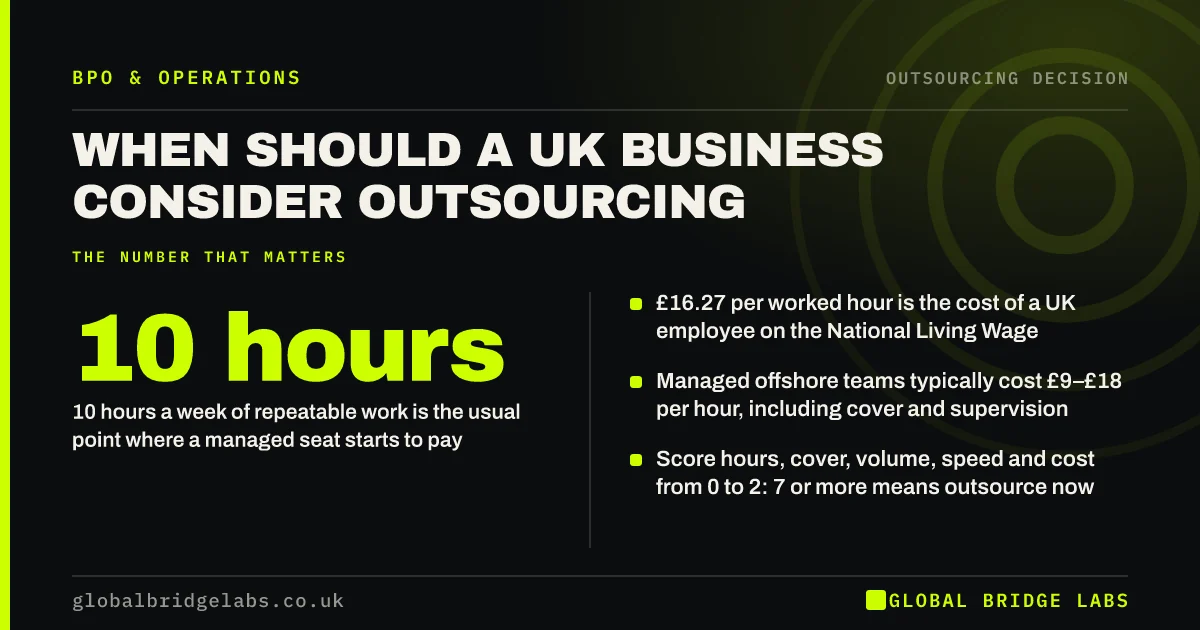
It is the value of what you would do with those hours instead: selling, pricing, managing or delivering. An owner spending 12 hours a week on admin gives up about 540 hours a year. Valued at even £50 an hour, that is £27,000 of capacity each year.
How do I work out if waiting to outsource is costing me money?
Add up one month of owner and senior hours on repeatable work, enquiries lost to slow replies, overtime and cover, and admin errors. Compare that total with the monthly price of a managed seat. If waiting costs more, delay is the expensive option.
Is it cheaper to do everything in-house?
It looks cheaper because in-house costs are spread across salaries and owner time. Counted properly, repeatable work done by senior people is often the most expensive way to do it. Keep core, judgement-heavy work in-house and test outsourcing on the repeatable rest.
Written by

Global Bridge Labs (GBL) is a UK–Sri Lanka partner for social media, websites and BPO. Everything here comes from client delivery, not theory.