On this page
- 01Short answer
- 02What does website ownership mean?
- 03Why do businesses lose control of their websites?
- 04Who owns the domain name?
- 05Who owns the design, code and content?
- 06Which accounts should be in your name?
- 07When is shared control reasonable?
- 08What does this look like in practice?
- 09Ownership checklist
- 10Next step
- 11Sources and further reading
- 12Frequently asked questions
Short answer
Your business should own its domain, hosting account, website files, content, analytics and Search Console, but that does not happen automatically. In the UK, copyright in commissioned design and code stays with the creator unless it is assigned in writing, and domains belong to whoever is named as registrant. Check each one now, not when you want to leave a supplier.
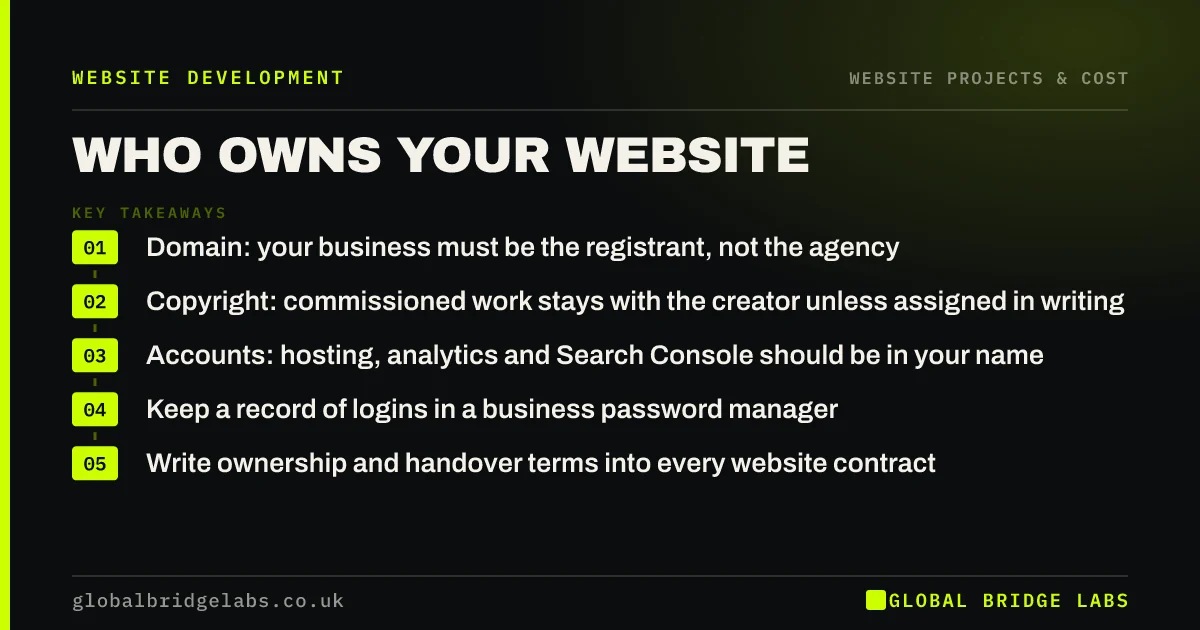
- Domain: your business must be the registrant, not the agency.
- Copyright: commissioned work stays with the creator unless assigned in writing.
- Accounts: hosting, analytics and Search Console should be in your name.
- Keep a record of logins in a business password manager.
- Write ownership and handover terms into every website contract.
Not sure who controls your domain and accounts? Message us on WhatsApp and we will help you check.
Chat on WhatsApp →What does website ownership mean?
Website ownership means holding the legal rights and practical control over all the parts that make up a website: the domain name, the hosting account, the design and code, the content and images, and the accounts that manage and measure it.
These are separate things. You can own the domain but not the code, or the content but not the hosting. Each needs checking individually.
Why do businesses lose control of their websites?
Usually by accident. A web designer registers the domain for convenience, hosts the site on their own account, and sets up analytics in their own Google account. Everything works until the relationship ends, a freelancer becomes unavailable, or the business wants to switch supplier.
At that point the business may find it cannot move the site, change the domain settings or access years of analytics data without the supplier's cooperation.
- Domain registered in the supplier's name.
- Hosting on the supplier's account.
- Analytics and Search Console owned by the supplier.
- No written assignment of copyright.
- Proprietary platforms that cannot be exported.
Who owns the domain name?
The domain belongs to whoever is named as the registrant. For .uk domains, the registry is Nominet, and you can check the registrant through the registrar's control panel or a WHOIS lookup, although personal details may be hidden.
Make sure the registrant is your business, the contact email is one you control, and you have your own login to the registrar account. Turn on auto-renewal so the domain cannot lapse.
Who owns the design, code and content?
Under UK copyright law, the creator of a work owns the copyright unless they are an employee creating it in the course of employment, or they have assigned it in writing. Paying for a website does not, on its own, transfer copyright in the design, code or text a supplier created.
The solution is a written assignment in the contract, transferring copyright in bespoke design, code and content to your business on payment. Third-party elements, such as themes, plugins, fonts and stock images, are licensed rather than owned, so make sure licences are in the business's name.
Want your website contract checked for ownership terms? Send it to us on WhatsApp.
Chat on WhatsApp →Which accounts should be in your name?
Hold ownership-level access to every account, and give suppliers their own lower-level access that you can remove.
- Domain registrar.
- Hosting or platform account.
- Website admin (your own administrator login).
- Google Analytics 4 property.
- Google Search Console property.
- Google Business Profile.
- Tag manager, booking system, email marketing and payment accounts.
When is shared control reasonable?
Shared control is reasonable when a supplier manages hosting as part of a maintenance plan, provided you have admin access, regular backups and a contractual right to a full export. Some platforms are proprietary by design, and the trade-off for convenience is reduced portability.
Decide knowingly. Convenience is fine if you can leave on reasonable terms. Being locked in is not.
What does this look like in practice?
A pattern when businesses change website supplier: the domain is registered to a former freelancer who can no longer be reached, and the renewal date is approaching.
Recovering a domain in that position can take weeks and may need the registry's dispute process. Checking the registrant today, and moving it into the business's name while relationships are good, avoids the problem entirely.
Ownership checklist
Check each of these this month.
- Confirm the domain registrant is your business.
- Get your own registrar login and turn on auto-renewal.
- Confirm hosting is in the business's name.
- Hold admin access to the website.
- Own the GA4 and Search Console properties.
- Get written assignment of copyright for bespoke work.
- Store all logins in a business password manager.
Next step
If you are not sure who controls your domain, hosting or analytics, we will check each one with you in 30 minutes and tell you what to move into your name.
Message us on WhatsApp for a website ownership check, or book a 30-minute consultation.
Chat on WhatsApp →Sources and further reading
- How copyright protects your work · GOV.UK
- Google Search Console · Google
- About key events · Google Analytics Help
Frequently asked questions
Who owns my website if a designer built it?
In the UK, the designer owns copyright in the design, code and content they created unless it is assigned to you in writing, even if you paid for it. Separately, the domain belongs to whoever is the registrant. Check both, and put ownership terms in every website contract.
How do I check who owns my domain name?
Log in to your domain registrar account, or ask whoever set it up for access, and check the registrant details. A WHOIS lookup may also help, although personal details are often hidden. The registrant should be your business, with a contact email you control and auto-renewal switched on.
How do I get my website back from an old developer?
Ask in writing for transfer of the domain, hosting access, site files, database and all accounts, citing any contract terms. If the domain is in their name, request a registrant transfer. If they will not cooperate, take legal advice and, for .uk domains, consider Nominet's dispute process.
Do I own the content on my website?
You own content you or your employees wrote. Content written by a supplier belongs to them unless copyright is assigned to you in writing. Images, fonts and themes are usually licensed, not owned, so check the licences are in your business's name and cover your use.
Written by

Global Bridge Labs (GBL) is a UK–Sri Lanka partner for social media, websites and BPO. Everything here comes from client delivery, not theory.