On this page
- 01Key takeaways
- 02How do you know you have too many channels?
- 03What does overspread actually cost?
- 04Which channel should go first?
- 05What should you do with the freed hours?
- 06How fast should you cut?
- 07What does this look like in practice?
- 08How do you tell the team?
- 09Next step
- 10Sources and further reading
- 11Frequently asked questions
Key takeaways
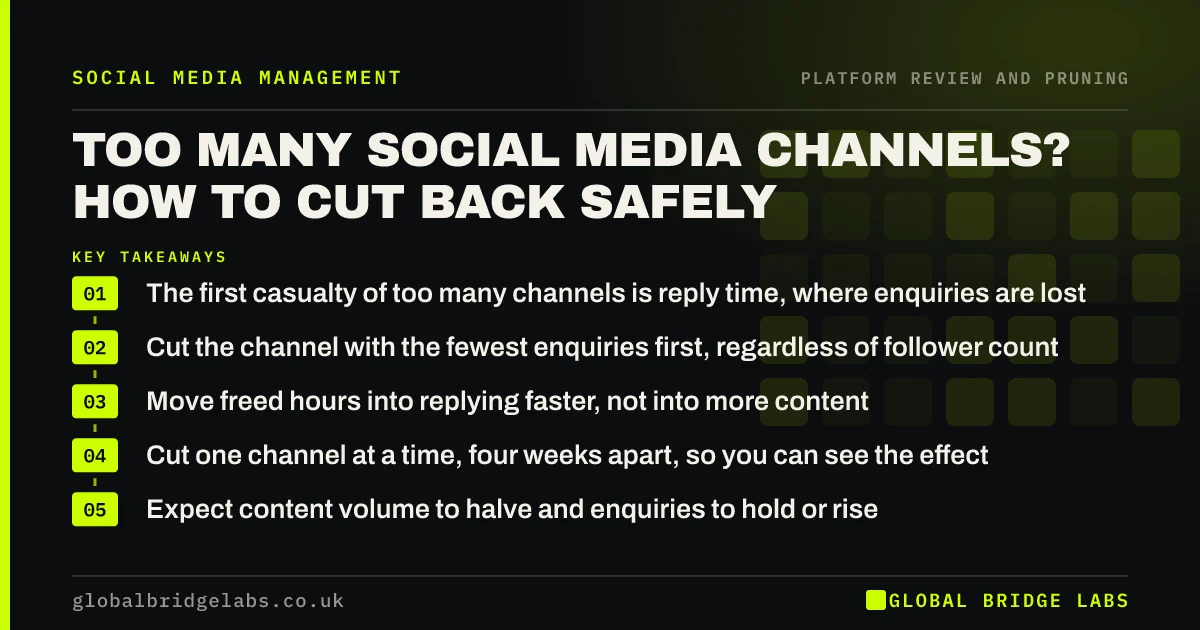
Overspread costs you reply speed first, content quality second and consistency third. Cut in that order of evidence: close the channel with the fewest enquiries, then the one with the highest hours-to-outcome ratio, and move the hours into replies.
- The first casualty of too many channels is reply time, where enquiries are lost.
- Cut the channel with the fewest enquiries first, regardless of follower count.
- Move freed hours into replying faster, not into more content.
- Cut one channel at a time, four weeks apart, so you can see the effect.
- Expect content volume to halve and enquiries to hold or rise.
Spread too thin? We will decide what to cut with you on WhatsApp.
Chat on WhatsApp →How do you know you have too many channels?
Five symptoms, and most overspread businesses have at least three. Identical posts appearing everywhere. Messages taking more than a day to answer. One channel with a gap of over a month. Nobody able to say which channel produces enquiries. And the person responsible avoiding the subject.
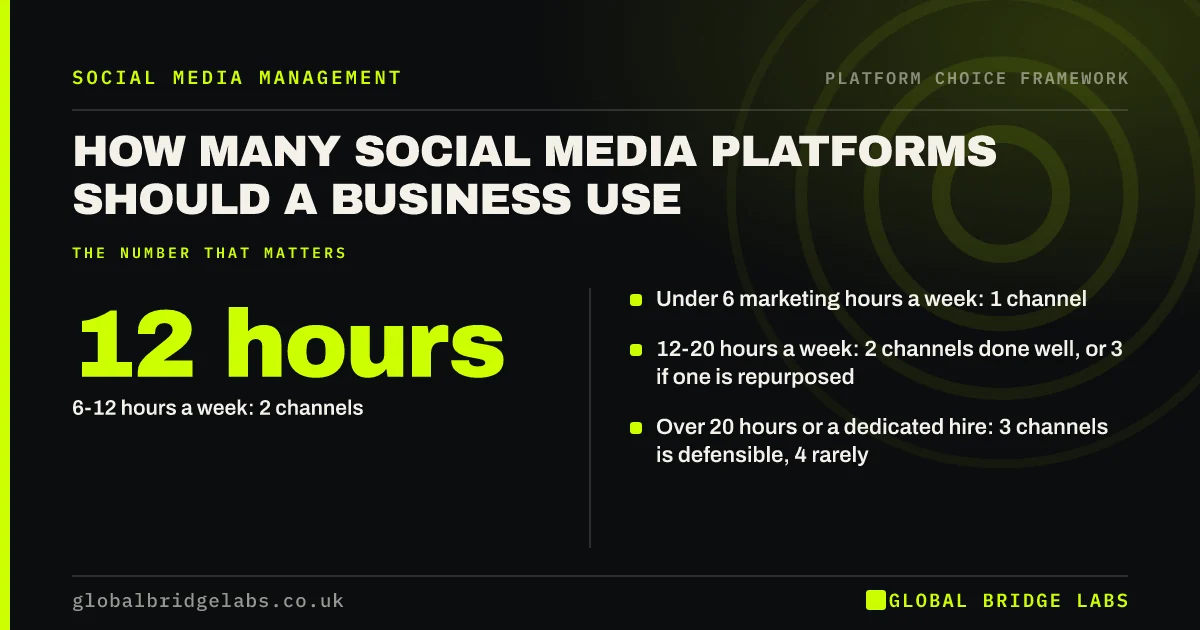
The threshold is not a number of channels, it is the relationship between channels and hours. Two channels with four hours a week is overspread; three channels with twenty hours is not.
What does overspread actually cost?
More than the obvious dilution of content. The costs arrive in a predictable order.
- Reply time first. Most social enquiries arrive as messages, so this is direct revenue.
- Native adaptation second. Cross-posting performs worse and looks automated.
- Consistency third. One channel goes quiet, then another.
- Measurement fourth. Nobody has time to review, so nothing is ever cut.
- Morale last, and hardest to recover: the owner quietly disengages from all of it.
Which channel should go first?
The one with the fewest enquiries over the last six months, regardless of follower count, engagement rate or how much effort went into building it. Those three numbers are exactly the ones that make cutting feel wrong, which is why the decision has to be made on enquiries alone.
If two channels produce similarly few enquiries, cut the one that consumes more hours. You are buying back capacity, so take the expensive one.
We will rank your channels by enquiries per hour. Ask on WhatsApp.
Chat on WhatsApp →What should you do with the freed hours?
Put them into replying faster, not into producing more content. This is counterintuitive and it is where most of the gain comes from.
A business that cuts from four channels to two and reduces reply time from two days to four hours usually sees enquiries rise even though content volume halved. The bottleneck was never reach. It was that people asking a question got an answer too late to matter.
How fast should you cut?
One channel at a time, four weeks apart, so you can see what happens. Cutting three channels in one week gives you no information about which one mattered, and if enquiries fall you will not know why.
Four weeks is enough to see the effect on reply time and enquiry volume without dragging the process out. Most businesses need two cuts, which is eight weeks from start to a settled position.
What does this look like in practice?
A UK independent nursery group ran five channels with one administrator who also answered the phone. Messages took two to three days to answer, which for a parent comparing nurseries is effectively no answer at all.
Cutting to two channels over eight weeks brought reply time under four hours. Content output fell by more than half. Enquiries and show-arounds both increased, because the parents who messaged on a Tuesday evening got an answer on Wednesday morning rather than on Friday.
How do you tell the team?
Frame it as protecting the channels that work rather than as a retreat, because whoever built the channel you are closing will hear the second version whatever you intend.
Be specific about the evidence and specific about where the hours are going. We are closing this because it produced two enquiries in six months, and those four hours are going into answering messages within four hours instead, is a sentence people can accept.
Then measure and share the result. If reply times improve and enquiries hold, the person who lost their channel sees what the decision bought, which makes the next one considerably easier.
It also helps to say plainly that the channel is being closed, not paused. A pause that nobody revisits leaves a dormant profile and leaves the person who ran it wondering whether it is coming back.
Next step
Count the enquiries from each channel over the last six months and cut the lowest one this week. Then spend the next four weeks putting those hours into answering messages faster, and measure what happens before cutting anything else.
Message us on WhatsApp and we will plan the cuts in the right order.
Chat on WhatsApp →Sources and further reading
- UK Customer Satisfaction Index · Institute of Customer Service
- Meta Business Help Centre · Meta
Frequently asked questions
How do you know if you have too many social media channels?
Identical posts appearing everywhere, messages taking over a day to answer, a channel with a month-long gap, nobody able to say which channel produces enquiries, and the person responsible avoiding the subject. Three of those is enough.
Which social media channel should you cut first?
The one producing the fewest enquiries over the last six months, regardless of follower count, engagement rate or how much effort went into building it. If two are equally unproductive, cut the one consuming more hours, because capacity is what you are buying.
What should you do with the time freed by cutting a channel?
Put it into replying faster rather than into producing more content. Businesses that halve their channel count and cut reply time from two days to four hours usually see enquiries rise, even though total content volume has fallen by half.
How quickly should you cut back on channels?
One at a time, four weeks apart, so that you can see the effect of each cut before making the next. Removing three channels in one week leaves you unable to tell which one mattered if enquiries subsequently change.
Written by

Global Bridge Labs (GBL) is a UK–Sri Lanka partner for social media, websites and BPO. Everything here comes from client delivery, not theory.