On this page
- 01Short answer
- 02How should you decide between platforms?
- 03What does each channel cost you in hours?
- 04Which platform is best for UK B2B?
- 05Which platform is best for local UK consumer businesses?
- 06When should you close a channel?
- 07What about emerging platforms?
- 08What does this look like in practice?
- 09Next step
- 10Sources and further reading
- 11Frequently asked questions
Short answer
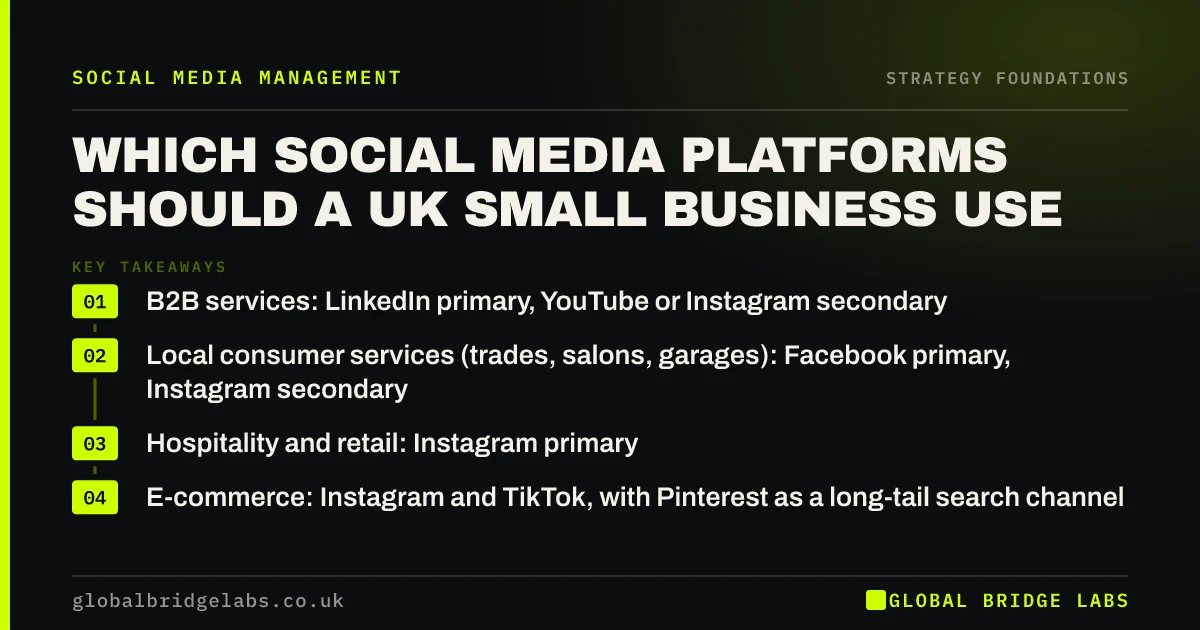
Choose two channels. For UK B2B service firms that is usually LinkedIn plus one visual channel. For local consumer businesses it is usually Facebook plus Instagram, with a Google Business Profile doing more work than either. Close everything else properly rather than leaving it dormant.
- B2B services: LinkedIn primary, YouTube or Instagram secondary.
- Local consumer services (trades, salons, garages): Facebook primary, Instagram secondary, Google Business Profile always.
- Hospitality and retail: Instagram primary, TikTok secondary if you can commit to video.
- E-commerce: Instagram and TikTok, with Pinterest as a long-tail search channel.
- Recruitment-led: LinkedIn for clients, TikTok or Instagram for candidates.
Not sure which two? Tell us what you sell and to whom on WhatsApp and we will pick them with you.
Chat on WhatsApp →How should you decide between platforms?
Three questions, in this order. Where does your buyer already spend attention during a working day? Which format can you produce every week without heroics? And which channel can you still win, given who is already there?
Most channel decisions go wrong because they answer the third question first, chasing whichever platform is currently being discussed. Ofcom's Online Nation research shows UK usage is broad across platforms but sharply segmented by age and purpose, so a general popularity ranking tells you almost nothing about your specific buyer.
What does each channel cost you in hours?
Budget the true weekly cost before committing, because the hidden cost of a channel is community management rather than publishing.
- LinkedIn: 2-3 hours a week. Text-first, low production cost, high research cost.
- Facebook: 2-3 hours a week, plus group and comment moderation for local businesses.
- Instagram: 4-6 hours a week. Visual production is the cost, not the captions.
- TikTok or Reels: 5-8 hours a week to do properly. Video is a production commitment, not a format choice.
- YouTube: 6-10 hours a week for long form. Treat as a project, not a channel, unless you already film.
- Pinterest: 1-2 hours a week once a library exists. Behaves like search, not social.
Which platform is best for UK B2B?
LinkedIn, for almost every UK B2B service business, because it is the only major platform where your buyer's job title is the reason they are there.
The qualifier is that LinkedIn rewards individuals more reliably than company pages. For a small firm, the practical strategy is a modest company page for credibility, plus consistent posting from two or three named people. Buyers check the page; they follow the people.
Which platform is best for local UK consumer businesses?
Facebook still wins for local reach in most of the UK, particularly through local community groups and recommendation threads, where a genuine customer tagging you is worth more than any post you publish.
Instagram works alongside it as the credibility check, because it is where someone looks after they get your name. And the channel most local businesses under-invest in is not social at all: a maintained Google Business Profile with recent photos, current hours and answered questions typically produces more enquiries per hour of effort than either.
We will audit which two channels your buyers actually use. Message us on WhatsApp with your sector and service area.
Chat on WhatsApp →When should you close a channel?
Close it when it has had six months of genuine effort and produced no enquiries, or when you cannot maintain it and it now shows a last post from 2024.
A dormant profile is worse than no profile. It ranks for your brand name, it appears in search results, and it tells a prospective customer that the business may not still be trading. If you cannot maintain it, either delete it or leave a pinned post directing people to the channel you do maintain.
What about emerging platforms?
Claim the handle, post nothing, and wait. Handle-squatting costs five minutes and protects your brand. Building a presence on an unproven platform costs hours you need for the two channels that pay.
The exception is when your specific buyers migrate early, which happens in a few sectors such as fashion, gaming and creative services. If you see three of your customers there, it is worth a test. If you see three of your competitors there, that is not the same signal.
What does this look like in practice?
A pattern in B2B sectors such as logistics: five channels maintained, including one for a market the business has exited. Reach looks fine in aggregate and enquiries stay flat.
Cutting to two channels, moving the freed hours into a small number of case-study videos, and letting the rest go dormant behind pinned redirects usually halves total content volume. Enquiries improve anyway, because the content finally matches where the decision is actually made.
Next step
Channel choice is the decision that determines whether the next twelve months of effort compounds or evaporates. It is worth 30 minutes with someone who has made the mistake before.
Message us on WhatsApp and we will help you pick the two channels worth your hours.
Chat on WhatsApp →Sources and further reading
Frequently asked questions
How many social media platforms should a small business be on?
Two, maintained properly, plus a Google Business Profile if you serve a local area. Two channels at three posts a week is six pieces of content, which a small UK team can sustain. Five channels produces fifteen and the quality collapses within a quarter.
Is Facebook still worth it for UK small businesses?
Yes for local consumer services, where community groups and recommendation threads drive real enquiries. It is weaker for reaching under-25s and for most B2B. Judge it on enquiries from your service area, not on follower growth.
Do I need TikTok for my business?
Only if you can commit to five to eight hours a week of video production and your buyers are there. TikTok rewards volume and consistency more aggressively than other platforms, so a half-hearted presence performs worse than not being there at all.
Should I delete social media accounts I do not use?
Delete them or repurpose them with a pinned redirect. A dormant profile still ranks for your brand name and signals to prospective customers that you may have stopped trading, which costs you more than the account was ever worth.
Written by

Global Bridge Labs (GBL) is a UK–Sri Lanka partner for social media, websites and BPO. Everything here comes from client delivery, not theory.