On this page
- 01Short answer
- 02What is a social media KPI?
- 03Why do most social media reports fail to change anything?
- 04Which KPIs should a small business actually track?
- 05What are realistic social media benchmarks for a UK SME?
- 06When are follower counts worth tracking?
- 07How do you attribute enquiries to social media?
- 08What does this look like in practice?
- 09Next step
- 10Sources and further reading
- 11Frequently asked questions
Short answer
Set one commercial goal, one leading KPI that moves weekly, and one lagging KPI that moves monthly. Three numbers. Anything beyond that dilutes attention and gives teams somewhere to hide when the commercial number does not move.
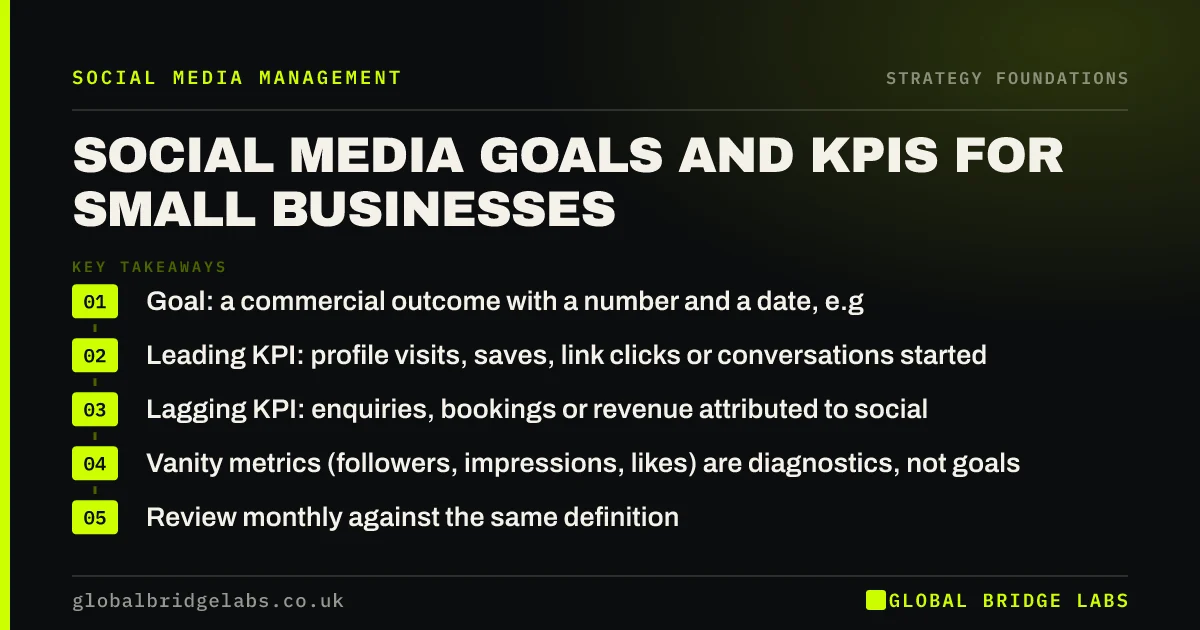
- Goal: a commercial outcome with a number and a date, e.g. 25 qualified enquiries a month from social by December.
- Leading KPI: profile visits, saves, link clicks or conversations started. Tells you the work is landing.
- Lagging KPI: enquiries, bookings or revenue attributed to social. Tells you it mattered.
- Vanity metrics (followers, impressions, likes) are diagnostics, not goals.
- Review monthly against the same definition. Changing the definition mid-quarter destroys the trend.
Want a KPI set you can actually defend at a board meeting? Message us on WhatsApp with your current reporting.
Chat on WhatsApp →What is a social media KPI?
A social media KPI is a single measured number that tells you whether social activity is moving a business outcome you have already agreed matters.
The important word is single. Dashboards that show forty metrics are not measurement, they are decoration, because no team can act on forty numbers in a weekly meeting.
Why do most social media reports fail to change anything?
Because they report activity rather than consequence. A report that says reach rose 40% raises exactly one question, which the report cannot answer: did that produce anything?
The second failure is inconsistent definitions. If engagement rate is calculated against reach one month and against followers the next, the trend line is fiction. Write the formula down once and never change it mid-year.
- Reports that show volume without a comparison period.
- Metrics with no owner and no threshold for action.
- Platform screenshots pasted in without a business read-through.
- No attribution path from social to enquiry, so social gets credited for nothing.
Which KPIs should a small business actually track?
Match the KPI to the goal. These four goal types cover almost every UK SME we work with.
- Goal: more enquiries. Leading KPI: link clicks and messages started. Lagging KPI: enquiries tagged social.
- Goal: more bookings. Leading KPI: profile visits and saves. Lagging KPI: bookings from social-first customers.
- Goal: cheaper hiring. Leading KPI: applications started from a post. Lagging KPI: cost per hire versus agency fee.
- Goal: retention and repeat orders. Leading KPI: story replies and community responses. Lagging KPI: repeat order rate among followers.
What are realistic social media benchmarks for a UK SME?
Treat published industry benchmarks as a sanity check, not a target, because they average across company sizes and budgets that look nothing like yours. Your previous quarter is a far better benchmark than an industry median.
As rough orientation for small UK accounts: organic engagement rates in the low single digits are normal, a click-through rate above 1% on organic social is good, and a reply time under four working hours materially changes how many conversations convert.
The benchmark that matters most is cost per enquiry. If a £400 monthly local budget produces eight qualified enquiries, that is £50 an enquiry. Compare that with what the same enquiry costs you through paid search or a lead-generation directory before deciding whether social is expensive.
Send us a month of your current numbers on WhatsApp and we will tell you what your real cost per enquiry is.
Chat on WhatsApp →When are follower counts worth tracking?
Followers matter in exactly two situations: when you sell to consumers repeatedly and the audience is a distribution asset you own, and when a buyer or partner uses follower count as a credibility proxy before a first meeting.
Outside those two cases, follower growth is a diagnostic. A rising count with flat enquiries usually means your content is attracting the wrong audience, often because a reel travelled outside your service area. That is useful information, but it is not a goal.
How do you attribute enquiries to social media?
Use three overlapping methods, because none of them is complete on its own.
First, UTM tags on every link you publish, so analytics can separate social traffic by channel and campaign. Second, a required How did you hear about us field on your enquiry form, with social named as an option. Third, a note in your CRM when a conversation starts in direct messages, which analytics will never see.
Expect the three to disagree. Self-reported attribution consistently credits social more than analytics does, because much of social media's influence happens before someone types your name into Google.
What does this look like in practice?
A pattern in professional services firms: eleven metrics reported monthly, and still no answer to whether social media should keep its budget. Cutting the report to three lines changes the conversation: conversations started, enquiries tagged social, and cost per enquiry.
Two things tend to follow. The team stops producing content designed to be shared and starts producing content designed to be asked a question about. And the monthly meeting turns from an exercise in interpretation into a short set of decisions.
Next step
If your social reporting is detailed but still does not tell you whether to spend more or less next quarter, we will rebuild it around three numbers in a 30-minute session.
Message us on WhatsApp to rebuild your social media KPIs around commercial outcomes.
Chat on WhatsApp →Sources and further reading
- Online Nation: how the UK uses online services · Ofcom
- URL builders: collect campaign data with custom URLs · Google Analytics Help
Frequently asked questions
What is a good engagement rate for a small business?
For small UK accounts, organic engagement rates in the low single digits are normal, and the figure varies far more by industry and format than by quality. Compare against your own previous quarter rather than an industry median, which averages across budgets unlike yours.
How many KPIs should we track?
Three: one commercial goal, one leading indicator that moves weekly, and one lagging indicator that moves monthly. More than three and weekly meetings turn into interpretation rather than decisions, which is how underperforming channels survive for years.
Is reach a good KPI?
Reach is a diagnostic, not a KPI. It tells you whether distribution is working, which is useful when enquiries drop and you need to know why. On its own it cannot justify a budget, because reach outside your service area has no commercial value.
How often should we review social media KPIs?
Leading indicators weekly, in ten minutes. Lagging indicators monthly, against the same definitions. Make the strategic decision quarterly, because 90 days is roughly the minimum period over which organic social produces a trend you can trust.
Written by

Global Bridge Labs (GBL) is a UK–Sri Lanka partner for social media, websites and BPO. Everything here comes from client delivery, not theory.