On this page
- 01Key takeaways
- 02Should businesses follow social media trends?
- 03What is the five-question trend test?
- 04When do trends help a business?
- 05When do trends hurt?
- 06How do you use trends safely?
- 07What does this look like in practice?
- 08What does a trend really cost?
- 09Which trend formats suit most businesses?
- 10Next step
- 11Sources and further reading
- 12Frequently asked questions
Key takeaways
Businesses should follow social media trends only when a trend fits their buyers, their voice and their offer, and can be done well without displacing the regular schedule. Most trends fail that test. Use a five-question check before joining any trend and keep trend posts to around one in five.
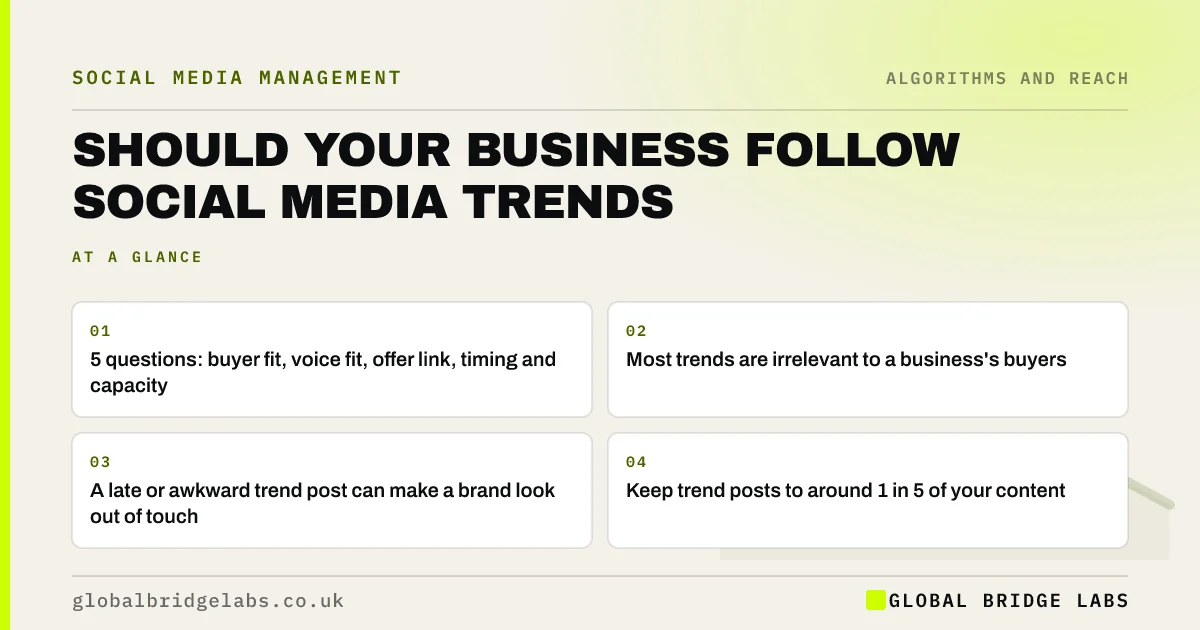
- 5 questions: buyer fit, voice fit, offer link, timing and capacity.
- Most trends are irrelevant to a business's buyers.
- A late or awkward trend post can make a brand look out of touch.
- Keep trend posts to around 1 in 5 of your content.
- Never let trends replace your consistent schedule.
Wondering if a trend suits your business? Send it to us on WhatsApp.
Chat on WhatsApp →Should businesses follow social media trends?
Sometimes, selectively. Trends can bring extra reach and make a brand feel current, but they can also waste time, attract the wrong audience or look forced. The deciding factor is fit: does the trend help you reach and persuade your buyers?
What is the five-question trend test?
- Buyer fit: would your buyers recognise and enjoy this trend?
- Voice fit: can you do it in a way that sounds like your business?
- Offer link: can you connect it clearly to what you do or sell?
- Timing: is it still rising, or has it already peaked?
- Capacity: can you make it well within a day without dropping scheduled posts?
Want the trend test as a one-page checklist? Message us on WhatsApp.
Chat on WhatsApp →When do trends help a business?
Trends help most for consumer brands targeting younger audiences on TikTok and Instagram, where trend participation is part of the culture. They can also help a business show personality, especially when the team appears on camera. And some trends are formats rather than jokes, such as day-in-the-life or before-and-after, which suit many businesses well.
When do trends hurt?
- When the audience reached is outside your market.
- When the trend has peaked and the post looks late.
- When the humour does not suit a professional or regulated service.
- When the trend uses audio or material you do not have the rights to use commercially.
- When trend work replaces the posts your buyers actually need.
How do you use trends safely?
Check the five questions, use the platform's commercial audio library where required, keep the post inside your normal visual and verbal style, and connect it to your offer. Treat it as one post, not a new strategy.
If you advertise or partner with creators, ASA rules on identifying ads apply to trend content as much as any other.
What does this look like in practice?
A UK car valeting business used a popular before-and-after trend format, which suited its work perfectly, and it became one of its recurring series. It ignored the dance and meme trends its staff suggested. The before-and-after series produced steady local enquiries; the business never needed the others.
What does a trend really cost?
A trend-led short video typically takes two to four hours once scripting, filming, retakes and editing are included, and it has to be done within days. At about £16.27 per worked hour for a UK employee on the April 2026 National Living Wage, that is £30 to £65 of staff time per attempt, before any management time. Most attempts reach a few hundred people.
The bigger cost is displacement: the scheduled proof post or customer answer that did not happen because the team was chasing the trend.
Which trend formats suit most businesses?
- Before and after: works for trades, beauty, cleaning, design and fitness.
- Day in the life: shows the team and builds trust.
- Myth versus fact: fits professional and regulated services if claims are accurate.
- Ask me anything: answers real customer questions.
- Process time-lapse: shows how products or jobs are made.
Next step
Apply the five-question test to the next trend you are tempted by. If it passes, make one good post inside your normal style. If not, let it go and stick to your schedule.
Message us on WhatsApp and we will check your next trend idea against the test.
Chat on WhatsApp →Sources and further reading
- How TikTok recommends videos #ForYou · TikTok Newsroom
- Recognising ads: social media and influencer marketing · ASA / CAP
- TikTok for Business · TikTok
Frequently asked questions
Should my business do TikTok trends?
Only if the trend fits your buyers, your voice and your offer, and you can make it well without dropping your regular posts. Consumer brands aimed at younger audiences benefit most. Professional and B2B services usually gain little from most TikTok trends.
Can trending audio be used for business accounts?
Business accounts are often restricted to commercially licensed audio libraries on TikTok and Instagram. Using unlicensed music in business content can lead to posts being muted or removed. Check the platform's commercial music library before using trending sounds.
How quickly should you jump on a trend?
Within a few days of it rising, if it passes your fit test. Late trend posts can look out of touch. But speed should never come at the cost of quality or your regular schedule; missing a trend costs very little.
Are trends good for B2B businesses?
Rarely in the meme sense. B2B businesses often do better with timely industry topics, such as regulatory changes or seasonal challenges, than with entertainment trends. Formats such as behind-the-scenes or explainers can be adapted well.
Can trends hurt a professional services brand?
Yes, if the humour or style does not suit the audience, or if claims in the trend content are inaccurate. Professional and regulated firms usually do better with formats such as myth versus fact or day in the life, which can be adapted in a credible voice.
Written by

Global Bridge Labs (GBL) is a UK–Sri Lanka partner for social media, websites and BPO. Everything here comes from client delivery, not theory.