On this page
- 01Key takeaways
- 02How do you find the right share for your business?
- 03Which businesses give social media the biggest share?
- 04What does the share look like in pounds?
- 05When is the social share too high?
- 06What does this look like in practice?
- 07Marketing share checklist
- 08Next step
- 09Sources and further reading
- 10Frequently asked questions
Key takeaways
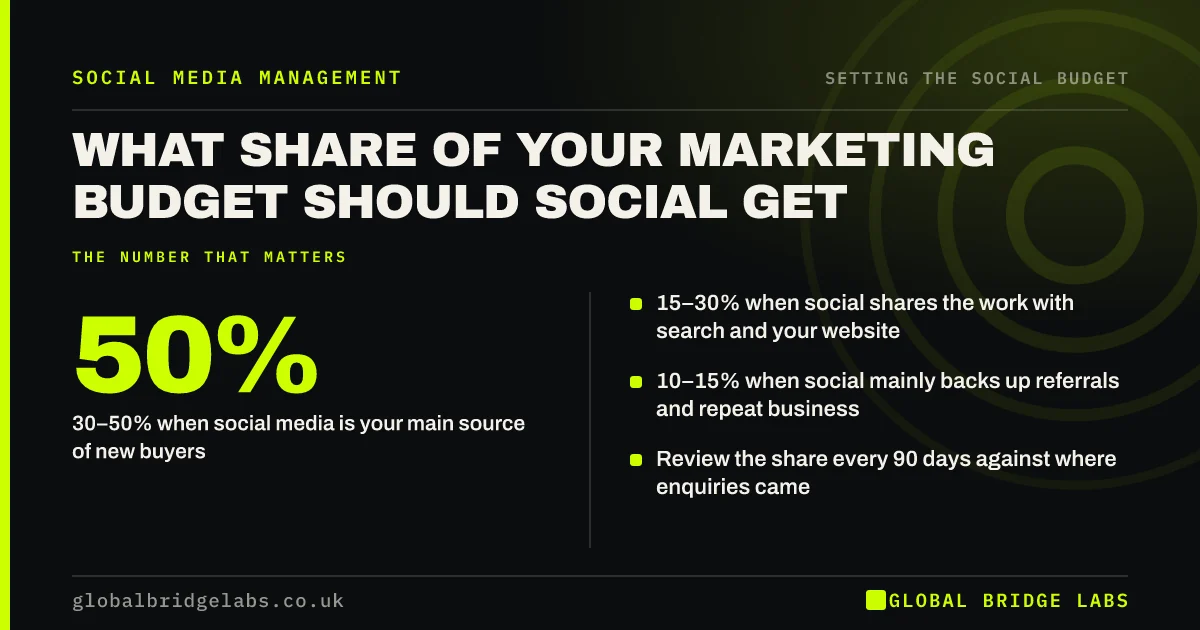
The percentage of marketing budget for social media should follow where your buyers find you. As a GBL rule of thumb, give social 30–50% when it is your main source of new customers, 15–30% when it shares the job with search, and 10–15% when it mainly reassures people sent by referrals.
- 30–50% when social media is your main source of new buyers.
- 15–30% when social shares the work with search and your website.
- 10–15% when social mainly backs up referrals and repeat business.
- Review the share every 90 days against where enquiries came from.
Want your marketing split checked? Message us on WhatsApp.
Chat on WhatsApp →How do you find the right share for your business?
Ask your last 20 customers how they found you and what they checked before buying. If most saw you on Instagram or Facebook first, social earns a large share. If most searched Google and glanced at your profiles, social is a support channel and the website and search deserve more.
Which businesses give social media the biggest share?
Visual, local and impulse businesses give social the most: salons, cafes, florists, gyms, venues and online shops selling under about £100. B2B firms, regulated advisers and emergency trades usually give it less, because buyers search when they have a problem or rely on recommendations from people they know.
What does the share look like in pounds?
On an illustrative £24,000 annual marketing budget, a 15% share is £300 a month and a 40% share is £800 a month. At £300, social is mostly organic posting with small tests. At £800, there is room for regular production plus £300–£500 of ad spend, the usual minimum for a readable test.
Tell us your marketing budget on WhatsApp and we will discuss your requirements.
Chat on WhatsApp →When is the social share too high?
It is too high when social takes most of the budget but brings few enquiries, while your website converts poorly or you rank nowhere in search. Spending more on social then sends people to a weak destination. Fix the website first, because every channel sends traffic through it.
What does this look like in practice?
A pattern we see: a service business puts nearly all its marketing into social media because it is visible and easy to start, while most buyers actually search on Google. Moving part of the budget to the website and search often lifts enquiries without any increase in total spend.
Marketing share checklist
- Ask recent customers where they first found you.
- Set social media's share from that answer, not habit.
- Make sure the website can convert the traffic social sends.
- Keep at least £300–£500 a month for any paid test.
- Move the share each quarter based on enquiries.
Next step
List last quarter's enquiries by source. Compare that split with how your marketing money was spent. The gap between the two is where to move budget first.
Message us on WhatsApp with your split, or book a 30-minute consultation.
Chat on WhatsApp →Sources and further reading
Frequently asked questions
What percentage of a marketing budget goes on social media?
For UK small businesses it commonly ranges from 10% to 50%. Businesses whose buyers discover them on social media give it 30–50%. Those that win work through search and referrals give it 10–15%, using social mainly to reassure people who are already considering them.
Should social media get more budget than my website?
Only if your website already converts well. Social media, search and referrals all send people to the website, so a poor site wastes every channel. If enquiries from the website are low, invest there first and increase social spend afterwards.
How often should I change the split?
Review it every quarter. Look at where enquiries and sales came from, and move a modest share, around 10% of the budget, towards the channel producing customers at the lowest cost. Large swings make it hard to tell what caused any change.
Written by

Global Bridge Labs (GBL) is a UK–Sri Lanka partner for social media, websites and BPO. Everything here comes from client delivery, not theory.