On this page
- 01Key takeaways
- 02How do you turn a percentage into a monthly figure?
- 03Which percentage should you pick?
- 04What does the percentage have to cover?
- 05When does a percentage of revenue mislead you?
- 06What does this look like in practice?
- 07Revenue percentage checklist
- 08Next step
- 09Sources and further reading
- 10Frequently asked questions
Key takeaways
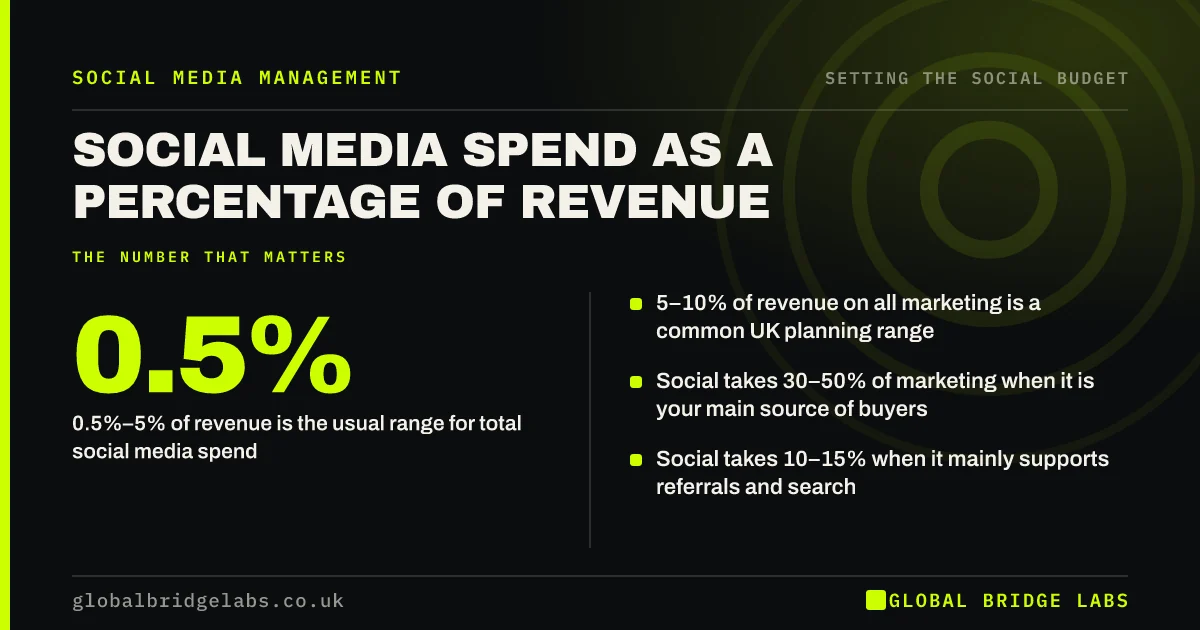
Social media spend as a percentage of revenue usually lands between 0.5% and 5% for a UK small business. That follows from the common planning range of 5–10% of revenue on all marketing, with social media taking 10–50% of it depending on how much new business it brings in.
- 0.5%–5% of revenue is the usual range for total social media spend.
- 5–10% of revenue on all marketing is a common UK planning range.
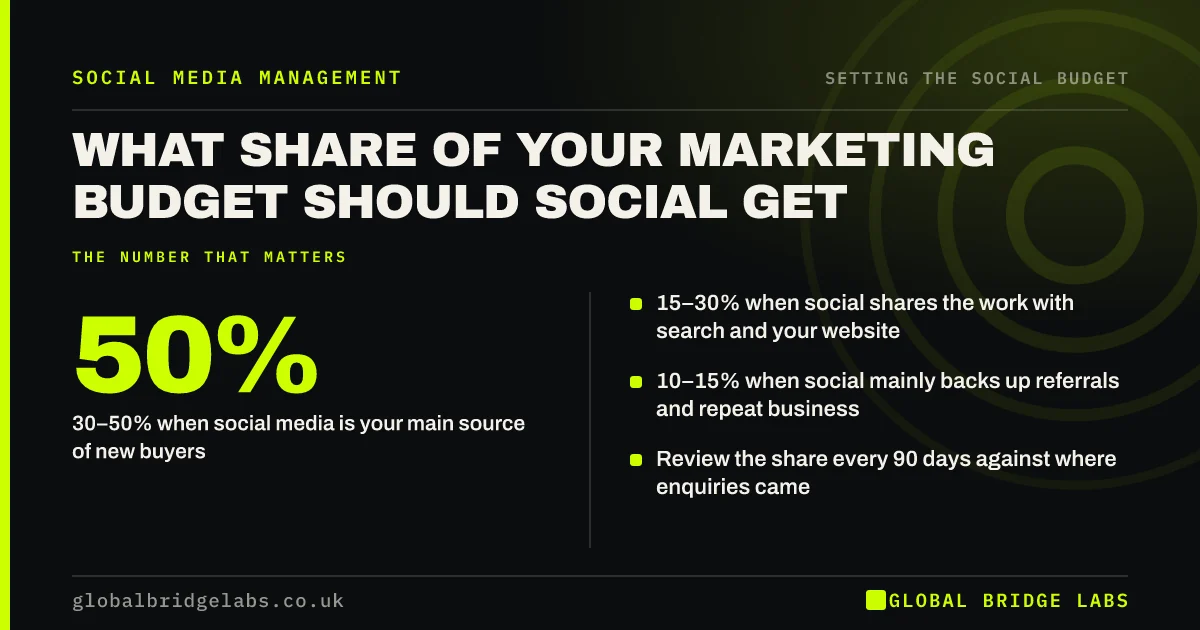
- Social takes 30–50% of marketing when it is your main source of buyers.
- Social takes 10–15% when it mainly supports referrals and search.
Want the percentage worked out against your turnover? Message us on WhatsApp.
Chat on WhatsApp →How do you turn a percentage into a monthly figure?
Multiply annual revenue by your marketing percentage, then by social media's share, then divide by 12. A firm turning over £400,000 with 7% on marketing and 30% of that on social has £8,400 a year, or £700 a month, for time, tools and ads together. The figures are illustrative.
Which percentage should you pick?
Pick the low end if most work arrives by referral and repeat orders, and the high end if you are entering a new area, launching a service or replacing lost revenue. A growing business with thin word of mouth needs more. A busy firm with a waiting list needs less.
What does the percentage have to cover?
It covers every social media cost, not just ads: the hours you or your staff spend, any freelancer or agency fee, tools and paid reach. Owner time counts. Six hours a week at an illustrative £40 an hour is about £1,040 a month, which can exceed the cash budget on its own.
- Production: your hours, staff hours, freelancer or agency fees.
- Tools: scheduling, design and analytics, typically £20–£80 a month.
- Paid reach: ads and boosts, usually £300–£500 a month minimum to learn anything.
Send us your turnover and goal on WhatsApp and we will discuss your requirements.
Chat on WhatsApp →When does a percentage of revenue mislead you?
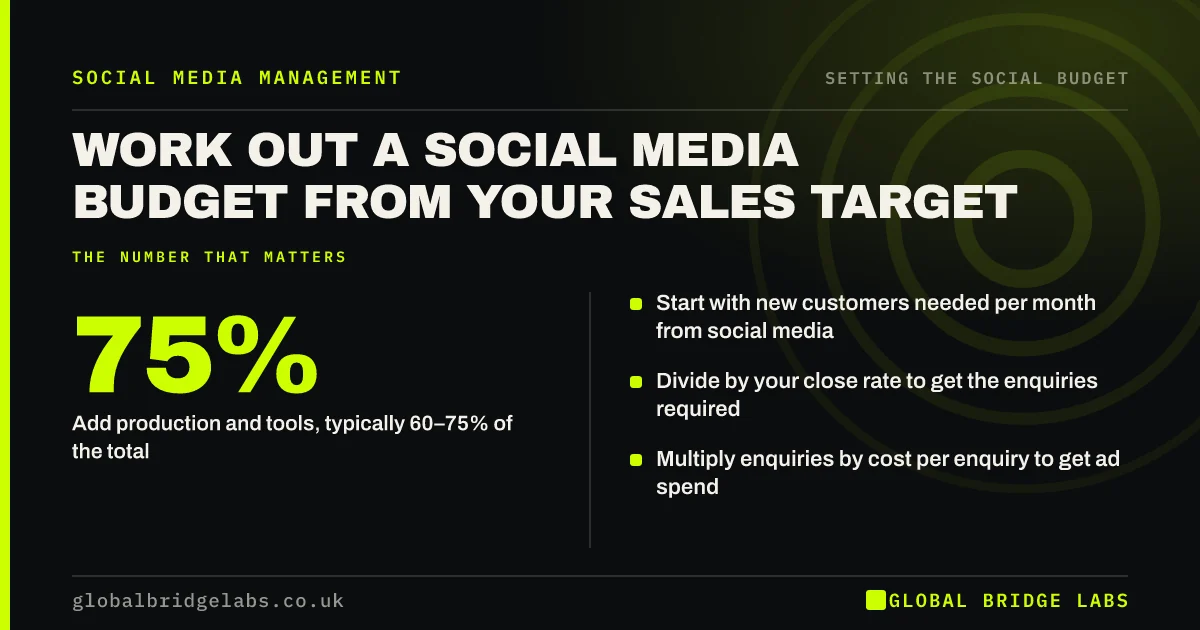
A percentage ties spend to last year's sales, so it shrinks when you most need new customers and grows when you are already busy. New businesses have no revenue to base it on. Use the percentage as a sense check, then set the real figure from the customers you need.
What does this look like in practice?
A pattern we see: an established firm spends almost nothing on social media because the figure was set years ago at a small share of a smaller turnover. Recalculating against current revenue and goals often shows the real gap is unpaid owner hours, not a shortage of ad money.
Revenue percentage checklist
- Use last year's revenue excluding VAT, or a forecast if you are new.
- Choose a marketing percentage between 5% and 10%.
- Give social media a share that matches its role in winning work.
- Count owner and staff hours in the total.
- Re-check the figure each quarter against enquiries.
Next step
Write down last year's revenue, your marketing percentage and social media's share. Divide by 12 and compare the result with what you spent last month, including your own time.
Message us on WhatsApp with the figure, or book a 30-minute consultation.
Chat on WhatsApp →Sources and further reading
- Advertising Association / WARC Expenditure Report · Advertising Association
- Business population estimates for the UK and regions 2025 · Department for Business and Trade
Frequently asked questions
What percentage of revenue should a small business spend on social media?
Most UK small businesses land between 0.5% and 5% of revenue on social media, covering time, tools and ads. That assumes 5–10% of revenue on all marketing, with social taking 10–50% of it depending on whether it supports other channels or is the main source of new customers.
Is 10% of revenue too much for marketing?
Not for a business that is launching, growing fast or entering a new market. It is high for an established firm with steady referrals. The test is whether each extra pound returns more gross profit than it costs within a payback period you can fund, usually a few months.
Should I use turnover or gross profit?
Use turnover excluding VAT for most service businesses. If you resell goods on thin margins, base the budget on gross profit instead, because a percentage of turnover can overstate what you can afford when most of each sale goes straight back to suppliers.
Written by

Global Bridge Labs (GBL) is a UK–Sri Lanka partner for social media, websites and BPO. Everything here comes from client delivery, not theory.