On this page
- 01Key takeaways
- 02How does the sales target method work?
- 03What does a worked example look like?
- 04Where do you get a cost per enquiry if you have none?
- 05What if the answer is unaffordable?
- 06What does this look like in practice?
- 07Sales target checklist
- 08Next step
- 09Sources and further reading
- 10Frequently asked questions
Key takeaways
A social media budget from your sales target starts with the customers you need, not the money you have. Work back through your close rate to the enquiries required, multiply by a realistic cost per enquiry, then add production time and tools. The answer tells you whether the target is affordable.
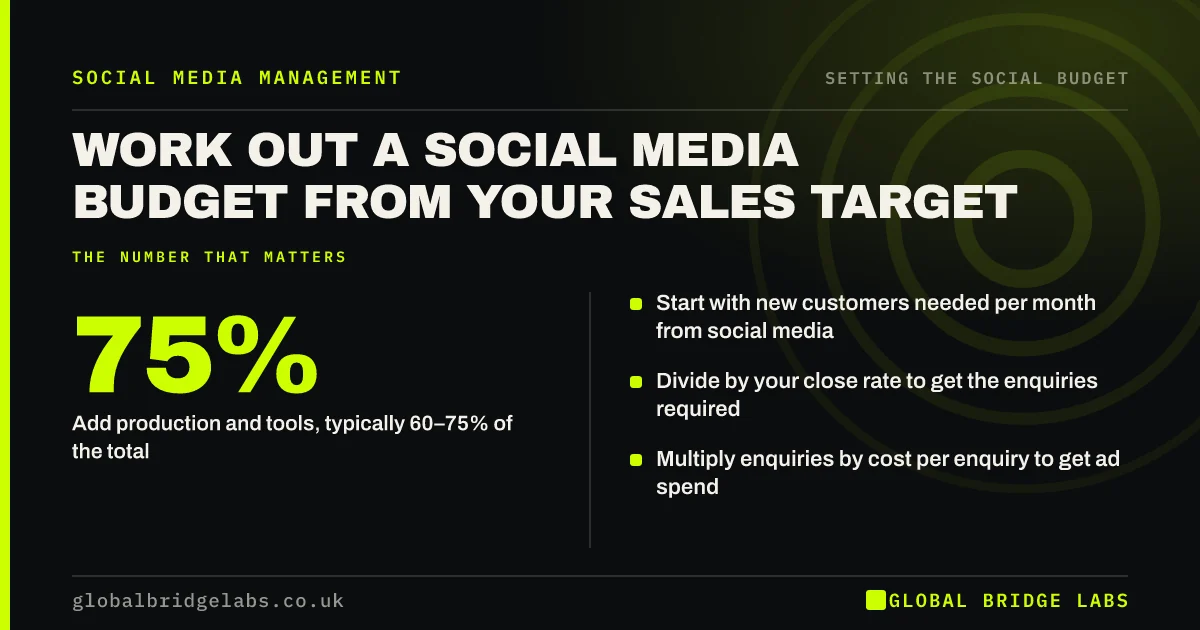
- Start with new customers needed per month from social media.
- Divide by your close rate to get the enquiries required.
- Multiply enquiries by cost per enquiry to get ad spend.
- Add production and tools, typically 60–75% of the total.
Want this worked out for your numbers? Message us on WhatsApp.
Chat on WhatsApp →How does the sales target method work?
Decide how much revenue social media should bring in, divide by your average sale to get customers, then divide customers by the share of enquiries you convert. That gives the enquiries you need. Your cost per enquiry, from past campaigns or a test, turns that number into a monthly ad budget.
What does a worked example look like?
Illustrative figures: a firm wants £6,000 a month from social, with an average job of £1,200. That is five customers. Closing one in four enquiries means 20 enquiries. At £25 per enquiry, ads cost £500 a month. Add production and tools of about £900, and the monthly social budget is £1,400.
- £6,000 target ÷ £1,200 average job = 5 customers.
- 5 customers ÷ 25% close rate = 20 enquiries.
- 20 enquiries × £25 = £500 ad spend.
- £500 ads + £900 production and tools = £1,400 a month.
Send us your average sale and close rate on WhatsApp and we will discuss your requirements.
Chat on WhatsApp →Where do you get a cost per enquiry if you have none?
Run a small, planned test for four to six weeks with one offer, one audience and tracked links, then divide spend by enquiries. Until then, use a cautious estimate and treat the first month as learning. Never borrow another sector's figure: costs per enquiry vary widely by price point and location.
What if the answer is unaffordable?
Then the target, the offer or the channel needs to change. Raise the close rate with faster replies, raise the average sale, lower the cost per enquiry with a better landing page, or take part of the target from referrals and search. Cutting the budget while keeping the target only guarantees a miss.
What does this look like in practice?
A pattern we see: an owner sets a monthly ad budget, then expects a sales figure that the budget could never produce. Running the sum backwards usually shows the gap within minutes, and the discussion moves from spending more to closing more of the enquiries that already arrive.
Sales target checklist
- Write the revenue you want from social media each month.
- Divide by average sale to get customers needed.
- Divide by close rate to get enquiries needed.
- Multiply by a tested cost per enquiry.
- Add production time and tools, then compare with what you can fund.
Next step
Fill in the four numbers: target revenue, average sale, close rate and cost per enquiry. If one is unknown, that is the first thing to measure before setting the budget.
Message us on WhatsApp with your four numbers, or book a 30-minute consultation.
Chat on WhatsApp →Sources and further reading
- URL builders: collect campaign data with custom URLs · Google Analytics Help
- About key events · Google Analytics Help
Frequently asked questions
What is the objective and task method?
The objective and task method sets a marketing budget from what you need to achieve rather than a fixed percentage. You define the sales goal, list the tasks needed to reach it, and cost each one. For social media that means enquiries needed, cost per enquiry, and production time.
How many enquiries do I need from social media?
Divide the number of new customers you want by the share of enquiries you usually convert. If you need five customers a month and close one in four enquiries, you need 20 enquiries. Track your close rate by source, because social enquiries often convert differently from referrals.
What if I do not know my close rate?
Count last quarter's enquiries and the customers who bought from them. Even a rough figure is better than none. If you have no history, assume a cautious rate such as one in five, then replace it with real data after the first two months.
Written by

Global Bridge Labs (GBL) is a UK–Sri Lanka partner for social media, websites and BPO. Everything here comes from client delivery, not theory.