On this page
- 01Key takeaways
- 02How many platforms should a small business use?
- 03What does each extra channel actually cost?
- 04What happens to quality at four channels?
- 05When is three channels defensible?
- 06Is one channel ever enough?
- 07What does this look like in practice?
- 08What about a Google Business Profile?
- 09Next step
- 10Sources and further reading
- 11Frequently asked questions
Key takeaways
Two platforms, maintained properly, plus a Google Business Profile if you serve a local area. The constraint is hours, not ambition: two channels at three posts a week is six pieces of content, which one part-time person can sustain. Four channels produces twelve and quality collapses inside a quarter.
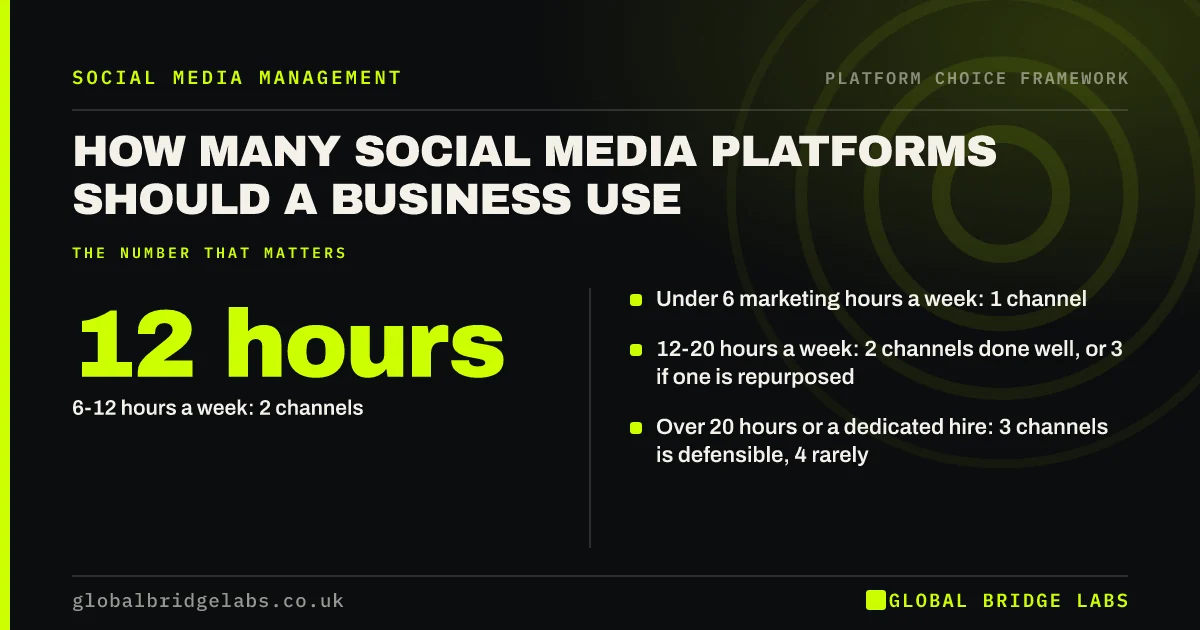
- Under 6 marketing hours a week: 1 channel. Be honest about this.
- 6-12 hours a week: 2 channels. This is where most UK small businesses sit.
- 12-20 hours a week: 2 channels done well, or 3 if one is repurposed.
- Over 20 hours or a dedicated hire: 3 channels is defensible, 4 rarely is.
- Every extra channel costs 3-6 hours a week, not the 1 hour people budget.
Not sure how many hours you really have? We will work it out with you on WhatsApp.
Chat on WhatsApp →How many platforms should a small business use?
Two. One primary channel where you invest the majority of effort and expect enquiries, and one secondary channel that exists as a credibility check and costs a fraction of the time.
This is not a compromise position, it is the number that survives contact with a normal working year. A business that commits to two channels and holds the line for 12 months almost always outperforms one that spread the same hours across five.
What does each extra channel actually cost?
Far more than the publishing time, which is the mistake in every plan that ends with five channels. Publishing is perhaps 20% of the work.
- Publishing and scheduling: 30-60 minutes a week per channel.
- Native format adaptation: 1-2 hours. Cross-posting performs badly and looks it.
- Community management: 1-3 hours. Comments, messages and reviews do not batch.
- Reporting and review: 30 minutes. Skipped first, which is why nobody can say what to cut.
- Cognitive overhead: hardest to measure, and the reason five-channel plans quietly stop.
What happens to quality at four channels?
Three predictable things, in this order. First, native adaptation stops and identical posts appear everywhere, which platforms increasingly discount and readers visibly ignore. Second, replies slow down, and since most social enquiries arrive as messages, this is where the money leaks. Third, one channel goes dark and nobody notices for six weeks.
A dormant profile is worse than no profile, because it still ranks for your brand name and tells a prospective customer you may have stopped trading. The cost of the fourth channel is rarely the fourth channel. It is the damage done to the first two.
When is three channels defensible?
When the third is genuinely free, which happens in exactly two situations. When one channel is a repurposing destination for content you already make, such as vertical video published to two video surfaces from one shoot. And when one channel is a search surface rather than a social one, such as Pinterest or Google Business Profile, where content keeps working for months without daily attention.
The test is whether the third channel adds weekly hours. If it adds more than 90 minutes, it is a third channel and you should count it as one. If it adds 20 minutes because the asset already exists, it is a distribution point.
We will tell you whether your third channel is free or expensive. Message us on WhatsApp.
Chat on WhatsApp →Is one channel ever enough?
Yes, and for many UK businesses under six marketing hours a week it is the right answer. One channel done consistently for a year will beat two channels done sporadically for the same year, because consistency is what both the algorithms and the buyers are reading.
The risk of a single channel is dependency, and it is real. Mitigate it by making sure you can reach your audience some other way: an email list, a customer database, or a Google Business Profile you control the content of. One social channel plus one owned channel is a sound position. One social channel and nothing else is a single point of failure.
What does this look like in practice?
A common pattern in UK hospitality: five profiles, one person, and roughly four hours a week actually available. Content output looks busy, response time on messages sits around two days, and enquiries arrive despite the plan rather than because of it.
Cutting to two, moving the freed time into replying within four working hours, and pinning redirects on the closed profiles typically halves content volume. Enquiries usually improve anyway, because the bottleneck was never reach. It was the two days it took to answer a message asking about availability.
What about a Google Business Profile?
Do not count it as a channel. It costs about an hour a week, most of which is responding to reviews and adding photographs, and for a local business it reaches people at the moment they are looking for what you sell.
That combination makes it the cheapest visibility a UK local business can buy, so it sits outside the channel count entirely. A business with one social channel and a maintained profile has a complete plan; a business with three social channels and a neglected profile has an expensive one that misses the highest-intent audience it could reach.
Next step
Count your honest weekly marketing hours in your worst month, divide by four, and that is roughly how many channels you can sustain. Most UK small businesses arrive at one or two. Choosing deliberately is far better than arriving at the same number by letting three channels quietly die.
Message us on WhatsApp with your available hours and we will tell you how many channels that buys.
Chat on WhatsApp →Sources and further reading
Frequently asked questions
How many social media platforms should a small business be on?
Two, maintained properly, plus a Google Business Profile for local businesses. Two channels at three posts a week is a sustainable six pieces of content. Four channels produces twelve, and quality, reply times and consistency all fall away within a quarter.
Is it bad to be on every social media platform?
Yes, for a small team. Spreading limited hours across many channels produces cross-posted content, slow replies and dormant profiles. A dormant profile still ranks for your brand name and suggests to prospects that you may have stopped trading.
Can a business use three social media platforms?
Only if the third costs under 90 minutes a week, which usually means it is a repurposing destination for content you already make or a search-style surface like Pinterest. If it needs its own content and community management, count it as a full channel.
How many hours a week does one social media channel take?
Between 3 and 8 hours depending on format. Text-first channels sit at the low end, photo-led channels in the middle, and video-led channels at the top once editing and replies are counted. Publishing itself is only about a fifth of the work.
Written by
Global Bridge Labs (GBL) is a UK–Sri Lanka partner for social media, websites and BPO. Everything here comes from client delivery, not theory.